Brockmeyer Timo, Schmidt Ulrike, Friederich Hans-Christoph
Department of General Internal Medicine and Psychosomatics, Heidelberg University Hospital, Heidelberg, Germany.
Section of Eating Disorders, Department of Psychological Medicine, Institute of Psychiatry, Psychology and Neuroscience, King's College London, London, UK.
Trials. 2016 Sep 26;17(1):466. doi: 10.1186/s13063-016-1596-6.
The core symptoms of bulimia nervosa (BN) and binge eating disorder (BED) are recurrent episodes of binge eating. Despite negative psychological and physical consequences, BN/BED patients show uncontrollable approach tendencies towards food. This cognitive bias occurs at an early stage of information processing. Cognitive bias modification (CBM) directly targets such biases and has been shown to be effective in treating several mental disorders. In alcohol addiction, automatic action tendencies towards alcohol cues and relapse rates were successfully reduced by a specific form of CBM, termed approach bias modification. Based on these findings and data from a proof-of-concept study in people with high levels of food craving, CBM is considered a promising new treatment approach for BN/BED. Given the similarities between BN/BED and addictive disorders, the rationale for using approach bias modification appears to be particularly strong. The aim of the present study is to examine whether, compared to a sham training, computerised approach bias modification (10 sessions) can reduce binge-eating episodes in BN/BED patients from pre-treatment to follow-up. Additionally, we will investigate whether this CBM programme also reduces global eating disorder psychopathology, trait and cue-elicited food craving, food intake as well as approach and attentional bias towards visual food cues. Treatment acceptance will be determined by attrition rates and responses on a feedback form.
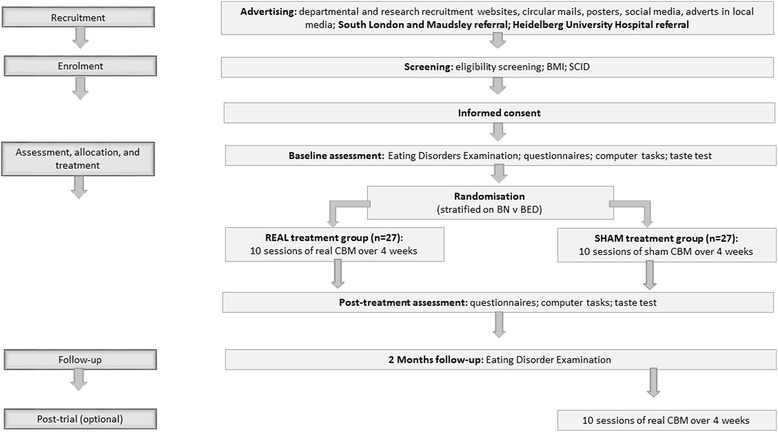
This is a double-blind, randomised, placebo-controlled, parallel-group superiority trial with two parallel arms. A total of 54 BN/BED patients will be recruited. Approach bias towards food will be retrained by a computer task adopting an implicit learning paradigm. Patients in the control condition (sham) will conduct a similar task but will not be trained to avoid food cues. Methods against bias include public registration, randomisation by a central study office, standardisation of the treatments and blinding of assessors. Furthermore, the session number and duration will be equivalent in the two conditions.
This is the first registered randomised controlled trial of approach bias modification in a clinical BN/BED sample. Results from this study will provide an indication of the efficacy of approach bias modification training for BN/BED and the potential mechanisms of action underlying this treatment.
DRKS00010231 (retrospectively registered on 24 March 2016; first version).
神经性贪食症(BN)和暴饮暴食症(BED)的核心症状是反复出现的暴饮暴食发作。尽管存在负面的心理和生理后果,但BN/BED患者对食物表现出无法控制的趋近倾向。这种认知偏差出现在信息处理的早期阶段。认知偏差矫正(CBM)直接针对此类偏差,已被证明在治疗多种精神障碍方面有效。在酒精成瘾中,一种特定形式的CBM(称为趋近偏差矫正)成功降低了对酒精线索的自动行为倾向和复发率。基于这些发现以及一项针对食物渴望程度高的人群的概念验证研究的数据,CBM被认为是一种有前景的针对BN/BED的新治疗方法。鉴于BN/BED与成瘾性障碍之间的相似性,使用趋近偏差矫正的理论依据似乎尤为充分。本研究的目的是检验与假训练相比,计算机化的趋近偏差矫正(10次疗程)是否能在从治疗前到随访期间减少BN/BED患者的暴饮暴食发作次数。此外,我们将调查这种CBM方案是否还能减少全球饮食失调心理病理学、特质性和线索诱发的食物渴望、食物摄入量以及对视觉食物线索的趋近和注意偏差。治疗接受度将通过失访率和反馈表上的回复来确定。
这是一项双盲、随机、安慰剂对照、平行组优效性试验,有两个平行组。总共将招募54名BN/BED患者。对食物的趋近偏差将通过采用内隐学习范式的计算机任务进行再训练。对照组(假训练组)的患者将进行类似任务,但不会接受避免食物线索的训练。针对偏差的方法包括公开注册、由中央研究办公室进行随机化、治疗标准化以及评估者设盲。此外,两种情况下的疗程次数和时长将相等。
这是第一项在临床BN/BED样本中注册的趋近偏差矫正随机对照试验。本研究的结果将为BN/BED的趋近偏差矫正训练的疗效以及该治疗潜在的作用机制提供一个指示。
DRKS00010231(于2016年3月24日追溯注册;第一版)