Murata Ayato, Genda Takuya, Ichida Takafumi, Amano Nozomi, Sato Sho, Tsuzura Hironori, Sato Shunsuke, Narita Yutaka, Kanemitsu Yoshio, Shimada Yuji, Hirano Katsuharu, Iijima Katsuyori, Wada Ryo, Nagahara Akihito, Watanabe Sumio
Ayato Murata, Takuya Genda, Nozomi Amano, Sho Sato, Hironori Tsuzura, Shunsuke Sato, Yutaka Narita, Yoshio Kanemitsu, Yuji Shimada, Katsuyori Iijima, Akihito Nagahara, Department of Gastroenterology and Hepatology, Juntendo University Shizuoka Hospital, Shizuoka 410-2295, Japan.
World J Gastroenterol. 2016 Sep 7;22(33):7569-78. doi: 10.3748/wjg.v22.i33.7569.
To clarify the association between aldo-keto reductase family 1 member B10 (AKR1B10) expression and hepatocarcinogenesis after hepatitis C virus eradication.
In this study, we enrolled 303 chronic hepatitis C patients who had achieved sustained virological response (SVR) through interferon-based antiviral therapy. Pretreatment AKR1B10 expression in the liver was immunohistochemically assessed and quantified as a percentage of positive staining area by using image-analysis software. A multivariate Cox analysis was used to estimate the hazard ratios (HRs) of AKR1B10 expression for hepatocellular carcinoma (HCC) development after achieving SVR. The cumulative incidences of HCC development were evaluated using Kaplan-Meier analysis and the log-rank test.
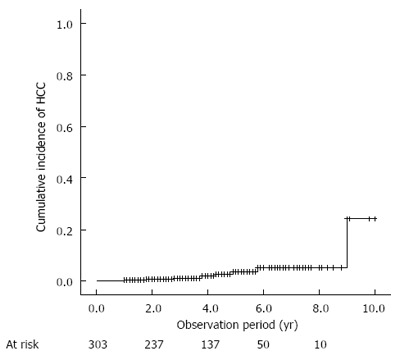
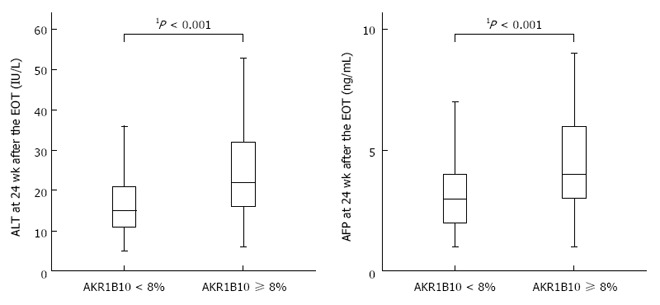
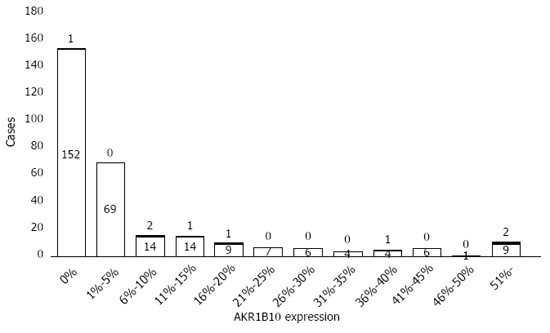
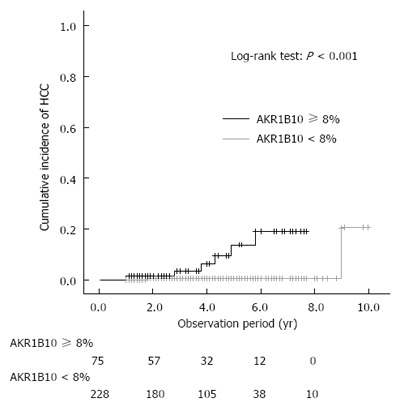
Of the 303 chronic hepatitis C patients, 153 (50.5%) showed scarce hepatic AKR1B10 expression, quantified as 0%, which was similar to the expression in control normal liver tissues. However, the remaining 150 patients (49.5%) exhibited various degrees of AKR1B10 expression in the liver, with a maximal AKR1B10 expression of 73%. During the median follow-up time of 3.6 years (range 1.0-10.0 years), 8/303 patients developed HCC. Multivariate analysis revealed that only high AKR1B10 expression (≥ 8%) was an independent risk factor for HCC development (HR = 15.4, 95%CI: 1.8-132.5, P = 0.012). The 5-year cumulative incidences of HCC development were 13.7% and 0.5% in patients with high and low AKR1B10 expression, respectively (P < 0.001). During the follow-up period after viral eradication, patients expressing high levels of AKR1B10 expressed markedly higher levels of alanine aminotransferase and α-fetoprotein than did patients exhibiting low AKR1B10 expression.
Chronic hepatitis C patients expressing high levels of hepatic AKR1B10 had an increased risk of HCC development even after SVR.
阐明丙型肝炎病毒根除后醛糖还原酶家族1成员B10(AKR1B10)表达与肝癌发生之间的关联。
在本研究中,我们纳入了303例通过基于干扰素的抗病毒治疗实现持续病毒学应答(SVR)的慢性丙型肝炎患者。采用免疫组织化学方法评估肝脏中治疗前AKR1B10的表达,并使用图像分析软件将其量化为阳性染色面积的百分比。采用多因素Cox分析来估计实现SVR后AKR1B10表达对于肝细胞癌(HCC)发生的风险比(HR)。使用Kaplan-Meier分析和对数秩检验评估HCC发生的累积发病率。
在303例慢性丙型肝炎患者中,153例(50.5%)肝脏AKR1B10表达稀少,量化为0%,这与对照正常肝组织中的表达相似。然而,其余150例患者(49.5%)肝脏呈现不同程度的AKR1B10表达,AKR1B10最大表达为73%。在3.6年(范围1.0 - 10.0年)的中位随访时间内,303例患者中有8例发生HCC。多因素分析显示,仅AKR1B10高表达(≥8%)是HCC发生的独立危险因素(HR = 15.4,95%CI:1.8 - 132.5,P = 0.012)。AKR1B10高表达和低表达患者的HCC发生5年累积发病率分别为13.7%和0.5%(P < 0.001)。在病毒根除后的随访期间,AKR1B10高表达的患者谷丙转氨酶和甲胎蛋白水平明显高于AKR1B10低表达的患者。
即使在实现SVR后,肝脏AKR1B10高表达的慢性丙型肝炎患者发生HCC的风险仍会增加。