Courtin Aurelie, Smyth Tomoko, Hearn Keisha, Saini Harpreet K, Thompson Neil T, Lyons John F, Wallis Nicola G
Astex Pharmaceuticals, 436 Cambridge Science Park, Milton Road, Cambridge, CB4 0QA, UK.
Br J Cancer. 2016 Oct 25;115(9):1069-1077. doi: 10.1038/bjc.2016.294. Epub 2016 Sep 27.
Tyrosine kinase inhibitors, such as crizotinib and erlotinib, are widely used to treat non-small-cell lung cancer, but after initial response, relapse is common because of the emergence of resistance through multiple mechanisms. Here, we investigated whether a frontline combination with an HSP90 inhibitor could delay the emergence of resistance to these inhibitors in preclinical lung cancer models.
The HSP90 inhibitor, onalespib, was combined with either crizotinib or erlotinib in ALK- or EGFR-activated xenograft models respectively (H2228, HCC827).
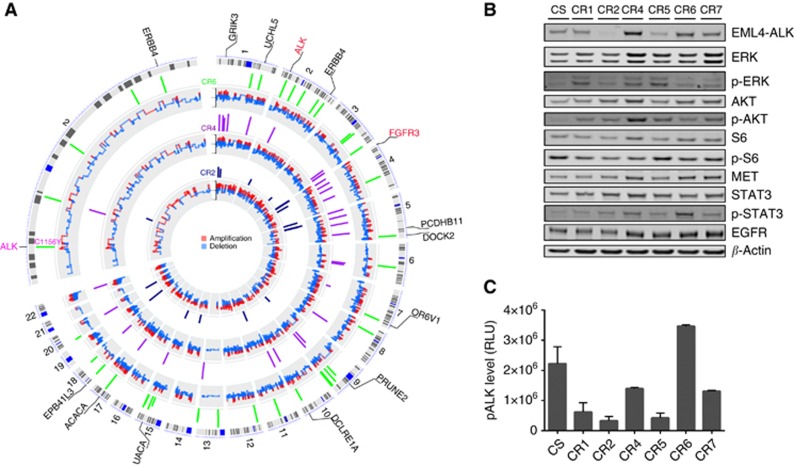
In both models, after initial response to the monotherapy kinase inhibitors, tumour relapse was observed. In contrast, tumour growth remained inhibited when treated with an onalespib/kinase inhibitor combination. Analysis of H2228 tumours, which had relapsed on crizotinib monotherapy, identified a number of clinically relevant crizotinib resistance mechanisms, suggesting that HSP90 inhibitor treatment was capable of suppressing multiple mechanisms of resistance. Resistant cell lines, derived from these tumours, retained sensitivity to onalespib (proliferation and signalling pathways were inhibited), indicating that, despite their resistance to crizotinib, they were still sensitive to HSP90 inhibition.
Together, these preclinical data suggest that frontline combination with an HSP90 inhibitor may be a method for delaying the emergence of resistance to targeted therapies.
酪氨酸激酶抑制剂,如克唑替尼和厄洛替尼,被广泛用于治疗非小细胞肺癌,但在初始反应后,由于多种耐药机制的出现,复发很常见。在此,我们研究了在临床前肺癌模型中,与HSP90抑制剂进行一线联合治疗是否可以延迟对这些抑制剂耐药性的出现。
分别在ALK或EGFR激活的异种移植模型(H2228、HCC827)中,将HSP90抑制剂奥纳雷司匹与克唑替尼或厄洛替尼联合使用。
在这两种模型中,对单一疗法激酶抑制剂产生初始反应后,均观察到肿瘤复发。相比之下,用奥纳雷司匹/激酶抑制剂联合治疗时,肿瘤生长仍受到抑制。对克唑替尼单一疗法复发的H2228肿瘤进行分析,确定了一些临床上相关的克唑替尼耐药机制,表明HSP90抑制剂治疗能够抑制多种耐药机制。从这些肿瘤中获得的耐药细胞系对奥纳雷司匹仍保持敏感性(增殖和信号通路受到抑制),这表明,尽管它们对克唑替尼耐药,但对HSP90抑制仍敏感。
总之,这些临床前数据表明,与HSP90抑制剂进行一线联合治疗可能是一种延迟对靶向治疗耐药性出现的方法。