Vallo Stefan, Michaelis Martin, Gust Kilian M, Black Peter C, Rothweiler Florian, Kvasnicka Hans-Michael, Blaheta Roman A, Brandt Maximilian P, Wezel Felix, Haferkamp Axel, Cinatl Jindrich
Institute of Medical Virology, Goethe University Frankfurt, Paul-Ehrlich-Str. 40, 60596, Frankfurt am Main, Germany.
Department of Urology, Goethe University Frankfurt, Frankfurt, Germany.
BMC Res Notes. 2016 Sep 27;9(1):454. doi: 10.1186/s13104-016-2256-3.
Systemic chemotherapy with gemcitabine and cisplatin is standard of care for patients with metastatic urothelial bladder cancer. However, resistance formation is common after initial response. The protein Src is known as a proto-oncogene, which is overexpressed in various human cancers. Since there are controversial reports about the role of Src in bladder cancer, we evaluated the efficacy of the Src kinase inhibitor dasatinib in the urothelial bladder cancer cell line RT112 and its gemcitabine-resistant sub-line RT112GEMCI in vitro and in vivo.
RT112 urothelial cancer cells were adapted to growth in the presence of 20 ng/ml gemcitabine (RT112GEMCI) by continuous cultivation at increasing drug concentrations. Cell viability was determined by MTT assay, cell growth kinetics were determined by cell count, protein levels were measured by western blot, and cell migration was evaluated by scratch assays. In vivo tumor growth was tested in a murine orthotopic xenograft model using bioluminescent imaging.
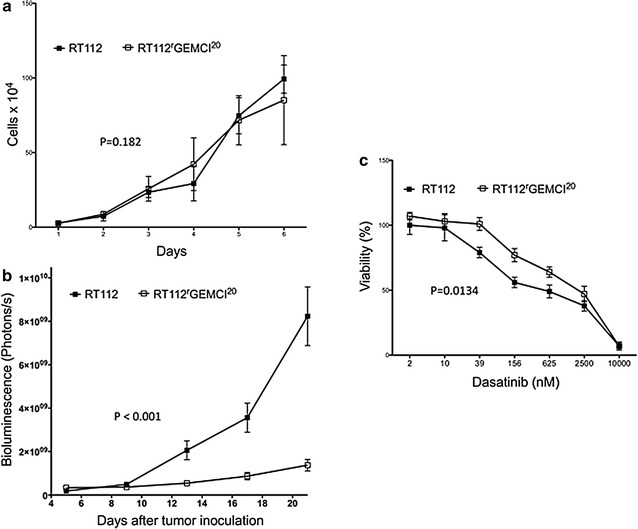
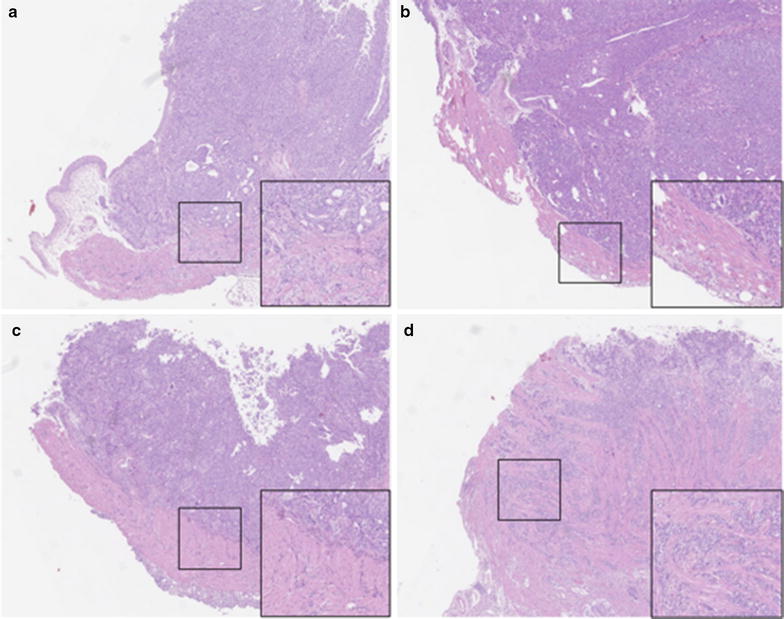
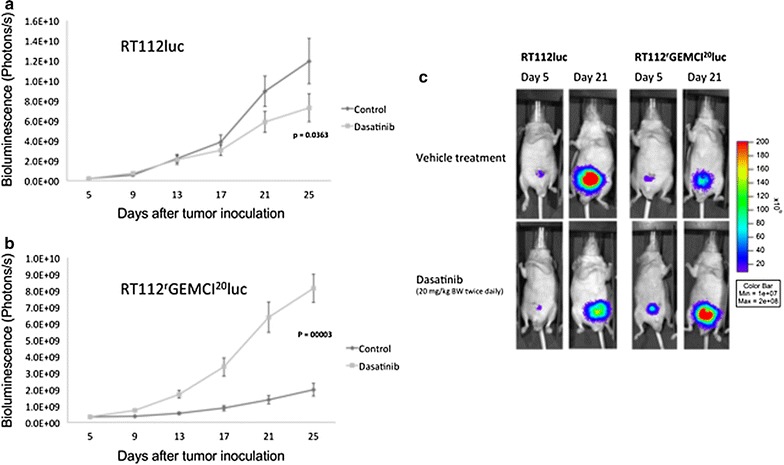
Dasatinib exerted similar effects on Src signaling in RT112 and RT112GEMCI cells but RT112GEMCI cells were less sensitive to dasatinib-induced anti-cancer effects (half maximal inhibitory concentration (IC) of dasatinib in RT112 cells: 349.2 ± 67.2 nM; IC of dasatinib in RT112GEMCI cells: 1081.1 ± 239.2 nM). Dasatinib inhibited migration of chemo-naive and gemcitabine-resistant cells. Most strikingly, dasatinib treatment reduced RT112 tumor growth and muscle invasion in orthotopic xenografts, while it was associated with increased size and muscle-invasive growth in RT112GEMCI tumors.
Dasatinib should be considered with care for the treatment of urothelial cancer, in particular for therapy-refractory cases.
吉西他滨和顺铂联合全身化疗是转移性尿路上皮膀胱癌患者的标准治疗方案。然而,初始缓解后耐药的形成很常见。蛋白Src是一种原癌基因,在多种人类癌症中过度表达。由于关于Src在膀胱癌中作用的报道存在争议,我们评估了Src激酶抑制剂达沙替尼在体外和体内对尿路上皮膀胱癌细胞系RT112及其吉西他滨耐药亚系RT112GEMCI的疗效。
通过在不断增加的药物浓度下连续培养,使RT112尿路上皮癌细胞适应在20 ng/ml吉西他滨存在的情况下生长(RT112GEMCI)。通过MTT法测定细胞活力,通过细胞计数测定细胞生长动力学,通过蛋白质印迹法测量蛋白质水平,并通过划痕试验评估细胞迁移。在小鼠原位异种移植模型中使用生物发光成像测试体内肿瘤生长情况。
达沙替尼对RT112和RT112GEMCI细胞中的Src信号传导产生相似的作用,但RT112GEMCI细胞对达沙替尼诱导的抗癌作用较不敏感(达沙替尼在RT112细胞中的半数最大抑制浓度(IC):349.2±67.2 nM;达沙替尼在RT112GEMCI细胞中的IC:1081.1±239.2 nM)。达沙替尼抑制未接受化疗和吉西他滨耐药细胞的迁移。最显著的是,达沙替尼治疗减少了原位异种移植中RT112肿瘤的生长和肌肉浸润,而它与RTl12GEMCI肿瘤的大小增加和肌肉浸润性生长有关。
在治疗尿路上皮癌时,尤其是治疗难治性病例时,应谨慎考虑使用达沙替尼。