Chaguza Chrispin, Andam Cheryl P, Harris Simon R, Cornick Jennifer E, Yang Marie, Bricio-Moreno Laura, Kamng'ona Arox W, Parkhill Julian, French Neil, Heyderman Robert S, Kadioglu Aras, Everett Dean B, Bentley Stephen D, Hanage William P
Department of Clinical Infection, Microbiology and Immunology, Institute of Infection and Global Health, University of Liverpool, Liverpool, United Kingdom Microbial Ecology, Malawi-Liverpool-Wellcome Trust Clinical Research Programme, University of Malawi, College of Medicine, Blantyre, Malawi
Department of Clinical Infection, Microbiology and Immunology, Institute of Infection and Global Health, University of Liverpool, Liverpool, United Kingdom Department of Epidemiology, Harvard T.H. Chan School of Public Health, Boston, Massachusetts, USA.
mBio. 2016 Sep 27;7(5):e01053-16. doi: 10.1128/mBio.01053-16.
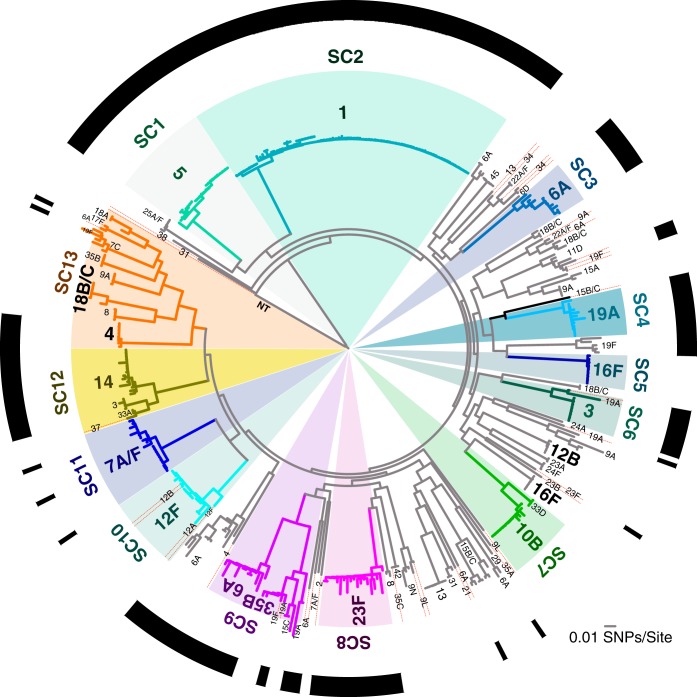
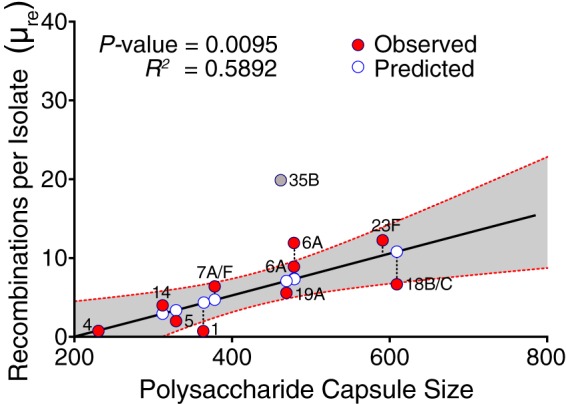
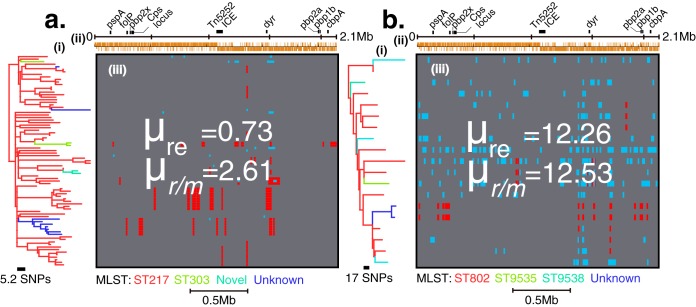
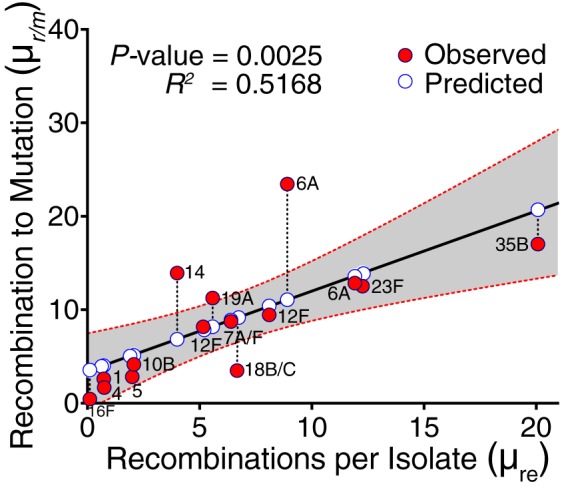
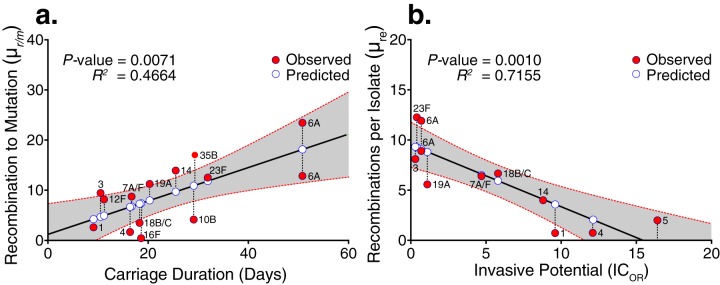
Streptococcus pneumoniae causes a high burden of invasive pneumococcal disease (IPD) globally, especially in children from resource-poor settings. Like many bacteria, the pneumococcus can import DNA from other strains or even species by transformation and homologous recombination, which has allowed the pneumococcus to evade clinical interventions such as antibiotics and pneumococcal conjugate vaccines (PCVs). Pneumococci are enclosed in a complex polysaccharide capsule that determines the serotype; the capsule varies in size and is associated with properties including carriage prevalence and virulence. We determined and quantified the association between capsule and recombination events using genomic data from a diverse collection of serotypes sampled in Malawi. We determined both the amount of variation introduced by recombination relative to mutation (the relative rate) and how many individual recombination events occur per isolate (the frequency). Using univariate analyses, we found an association between both recombination measures and multiple factors associated with the capsule, including duration and prevalence of carriage. Because many capsular factors are correlated, we used multivariate analysis to correct for collinearity. Capsule size and carriage duration remained positively associated with recombination, although with a reduced P value, and this effect may be mediated through some unassayed additional property associated with larger capsules. This work describes an important impact of serotype on recombination that has been previously overlooked. While the details of how this effect is achieved remain to be determined, it may have important consequences for the serotype-specific response to vaccines and other interventions.
The capsule determines >90 different pneumococcal serotypes, which vary in capsule size, virulence, duration, and prevalence of carriage. Current serotype-specific vaccines elicit anticapsule antibodies. Pneumococcus can take up exogenous DNA by transformation and insert it into its chromosome by homologous recombination. This mechanism has disseminated drug resistance and generated vaccine escape variants. It is hence crucial to pneumococcal evolutionary response to interventions, but there has been no systematic study quantifying whether serotypes vary in recombination and whether this is associated with serotype-specific properties such as capsule size or carriage duration. Larger capsules could physically inhibit DNA uptake, or given the longer carriage duration for larger capsules, this may promote recombination. We find that recombination varies among capsules and is associated with capsule size, carriage duration, and carriage prevalence and negatively associated with invasiveness. The consequence of this work is that serotypes with different capsules may respond differently to selective pressures like vaccines.
肺炎链球菌在全球范围内导致侵袭性肺炎球菌疾病(IPD)的负担很重,尤其是在资源匮乏地区的儿童中。与许多细菌一样,肺炎球菌可以通过转化和同源重组从其他菌株甚至其他物种中导入DNA,这使得肺炎球菌能够逃避抗生素和肺炎球菌结合疫苗(PCV)等临床干预措施。肺炎球菌被包裹在一个复杂的多糖荚膜中,该荚膜决定了血清型;荚膜大小各异,并与包括携带率和毒力在内的特性相关。我们利用在马拉维采集的多种血清型的基因组数据,确定并量化了荚膜与重组事件之间的关联。我们既确定了相对于突变由重组引入的变异量(相对率),也确定了每个分离株发生的个体重组事件的数量(频率)。通过单变量分析,我们发现这两种重组指标与多个与荚膜相关的因素之间存在关联,包括携带时间和携带率。由于许多荚膜因素相互关联,我们使用多变量分析来校正共线性。荚膜大小和携带时间与重组仍呈正相关,尽管P值有所降低,这种效应可能是通过与较大荚膜相关的一些未检测的其他特性介导的。这项工作描述了血清型对重组的重要影响,而这一点此前一直被忽视。虽然这种效应是如何实现的细节仍有待确定,但它可能对疫苗和其他干预措施的血清型特异性反应产生重要影响。
荚膜决定了90多种不同的肺炎球菌血清型,这些血清型在荚膜大小、毒力、携带时间和携带率方面各不相同。目前的血清型特异性疫苗可引发抗荚膜抗体。肺炎球菌可以通过转化摄取外源DNA,并通过同源重组将其插入染色体。这种机制传播了耐药性并产生了疫苗逃逸变体。因此,这对肺炎球菌对干预措施的进化反应至关重要,但此前没有系统研究量化血清型在重组方面是否存在差异,以及这是否与血清型特异性特性如荚膜大小或携带时间有关。较大的荚膜可能会物理性地抑制DNA摄取,或者鉴于较大荚膜的携带时间更长,这可能会促进重组。我们发现重组在不同荚膜之间存在差异,并且与荚膜大小、携带时间和携带率相关,与侵袭性呈负相关。这项工作的结果是,具有不同荚膜的血清型可能对疫苗等选择压力有不同的反应。