Department of Microbiology, School of Medicine, University of Alabama at Birminghamgrid.265892.2, Birmingham, Alabama, USA.
Division of Pulmonary, Allergy, and Critical Care Medicine, Department of Medicine, University of Alabama at Birminghamgrid.265892.2, Birmingham, Alabama, USA.
mBio. 2021 Oct 26;12(5):e0251621. doi: 10.1128/mBio.02516-21. Epub 2021 Oct 12.
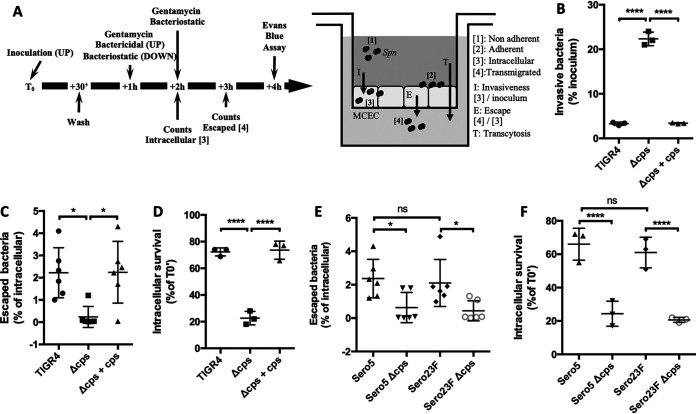
The polysaccharide capsule that surrounds Streptococcus pneumoniae () is one of its most important virulence determinants, serving to protect against phagocytosis. To date, 100 biochemical and antigenically distinct capsule types, i.e., serotypes, of have been identified. Yet how capsule influences pneumococcal translocation across vascular endothelial cells (VEC), a key step in the progression of invasive disease, was unknown. Here, we show that despite capsule being inhibitory of uptake by VEC, capsule enhances the escape rate of internalized pneumococci and thereby promotes translocation. Upon investigation, we determined that capsule protected against intracellular killing by VEC and HO-mediated killing . Using a nitroblue tetrazolium reduction assay and nuclear magnetic resonance (NMR) analyses, purified capsule was confirmed as having antioxidant properties which varied according to serotype. Using an 11-member panel of isogenic capsule-switch mutants, we determined that serotype affected levels of resistance to HO-mediated killing , with killing resistance correlated positively with survival duration within VEC, rate of transcytosis to the basolateral surface, and human attack rates. Experiments with mice supported our findings, with producing oxidative-stress-resistant type 4 capsule being more organ-invasive than that producing oxidative-stress-sensitive type 2 capsule during bacteremia. Capsule-mediated protection against intracellular killing was also observed for Streptococcus pyogenes and Staphylococcus aureus. We conclude that capsular polysaccharide plays an important role within VEC, serving as an intracellular antioxidant, and that serotype-dependent differences in antioxidant capabilities impact the efficiency of VEC translocation and a serotype's potential for invasive disease. Streptococcus pneumoniae () is the leading cause of invasive disease. Importantly, only a subset of the 100 capsule types carried by cause the majority of serious infections, suggesting that the biochemical properties of capsular polysaccharide are directly tied to virulence. Here, we describe a new function for 's capsule-conferring resistance to oxidative stress. Moreover, we demonstrate that capsule promotes intracellular survival of pneumococci within vascular endothelial cells and thereby enhances bacterial translocation across the vasculature and into organs. Using isogenic capsule-switch mutants, we show that different capsule types, i.e., serotypes, vary in their resistance to oxidative stress-mediated killing and that resistance is positively correlated with intracellular survival in an model, organ invasion during bacteremia , and epidemiologically established pneumococcal attack rates in humans. Our findings define a new role of capsule and provide an explanation for why certain serotypes of more frequently cause invasive pneumococcal disease.
肺炎链球菌 () 表面的多糖荚膜是其最重要的毒力决定因素之一,可保护细菌免受吞噬作用。迄今为止,已经鉴定出 100 种具有不同生化和抗原特性的荚膜类型,即血清型。然而,荚膜如何影响肺炎链球菌穿过血管内皮细胞(VEC)的易位,这是侵袭性疾病进展的关键步骤,目前尚不清楚。在这里,我们表明,尽管荚膜抑制了 VEC 对肺炎链球菌的摄取,但荚膜增强了内化肺炎链球菌的逃逸率,从而促进了易位。经过研究,我们确定荚膜保护肺炎链球菌免受 VEC 和 HO 介导的杀伤。使用硝基四唑蓝还原测定和核磁共振(NMR)分析,纯化的荚膜被确认为具有抗氧化特性,其特性因血清型而异。使用 11 种同基因荚膜转换突变体的小组,我们确定血清型影响肺炎链球菌对 HO 介导的杀伤的抗性水平,杀伤抗性与 VEC 内的存活时间、穿越细胞的转运率以及人类攻击率呈正相关。用小鼠进行的实验支持了我们的发现,在菌血症期间,产生氧化应激抗性 4 型荚膜的 比产生氧化应激敏感 2 型荚膜的更具器官侵袭性。荚膜介导的对细胞内杀伤的保护作用也见于化脓性链球菌和金黄色葡萄球菌。我们得出结论,荚膜多糖在 VEC 中发挥重要作用,作为细胞内抗氧化剂,并且血清型依赖性抗氧化能力差异影响 VEC 易位的效率和血清型引起侵袭性疾病的潜力。肺炎链球菌 () 是侵袭性疾病的主要原因。重要的是, 携带的 100 种荚膜类型中只有一部分导致大多数严重感染,这表明荚膜多糖的生化特性与毒力直接相关。在这里,我们描述了荚膜赋予的抵抗氧化应激的新功能。此外,我们证明荚膜促进肺炎链球菌在血管内皮细胞内的存活,从而增强细菌穿过血管并进入器官的易位。使用同基因荚膜转换突变体,我们表明不同的荚膜类型,即血清型,在其对氧化应激介导的杀伤的抗性方面存在差异,并且抗性与在 模型中的细胞内存活呈正相关,菌血症期间的器官侵袭,以及在人类中已建立的流行病学侵袭性肺炎球菌攻击率。我们的发现定义了荚膜的新作用,并解释了为什么某些血清型的 更常引起侵袭性肺炎球菌病。