Varney J E, Liew D, Weiland T J, Inder W J, Jelinek G A
Department of Gastroenterology, Faculty of Medicine, Nursing and Health Sciences, Monash University, Level 6, The Alfred Centre, 99 Commercial Road, Melbourne, 3004, Australia.
Department of Epidemiology and Preventive Medicine, Faculty of Medicine, Nursing and Health Sciences, Monash University, Level 6, The Alfred Centre, 99 Commercial Road, Melbourne, 3004, Australia.
BMC Health Serv Res. 2016 Sep 27;16(1):521. doi: 10.1186/s12913-016-1645-6.
Type 2 diabetes (T2DM) is a burdensome condition for individuals to live with and an increasingly costly condition for health services to treat. Cost-effective treatment strategies are required to delay the onset and slow the progression of diabetes related complications. The Diabetes Telephone Coaching Study (DTCS) demonstrated that telephone coaching is an intervention that may improve the risk factor status and diabetes management practices of people with T2DM. Measuring the cost effectiveness of this intervention is important to inform funding decisions that may facilitate the translation of this research into clinical practice. The purpose of this study is to assess the cost-effectiveness of telephone coaching, compared to usual diabetes care, in participants with poorly controlled T2DM.
A cost utility analysis was undertaken using the United Kingdom Prospective Diabetes Study (UKPDS) Outcomes Model to extrapolate outcomes collected at 6 months in the DTCS over a 10 year time horizon. The intervention's impact on life expectancy, quality-adjusted life expectancy (QALE) and costs was estimated. Costs were reported from a health system perspective. A 5 % discount rate was applied to all future costs and effects. One-way sensitivity analyses were conducted to reflect uncertainty surrounding key input parameters.
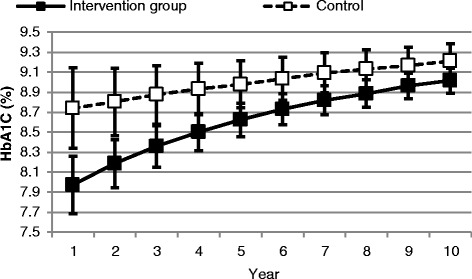
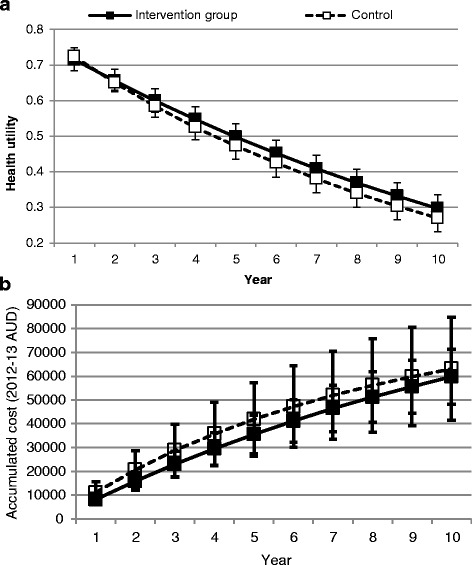
The intervention dominated the control condition in the base-case analysis, contributing to cost savings of $3327 per participant, along with non-significant improvements in QALE (0.2 QALE) and life expectancy (0.3 years).
The cost of delivering the telephone coaching intervention continuously, for 10 years, was fully recovered through cost savings and a trend towards net health benefits. Findings of cost savings and net health benefits are rare and should prove attractive to decision makers who will determine whether this intervention is implemented into clinical practice.
ACTRN12609000075280.
2型糖尿病(T2DM)对患者而言是一种负担沉重的疾病,对卫生服务系统来说也是治疗成本日益高昂的疾病。需要具有成本效益的治疗策略来延缓糖尿病相关并发症的发生并减缓其进展。糖尿病电话指导研究(DTCS)表明,电话指导是一种可能改善T2DM患者危险因素状况和糖尿病管理实践的干预措施。衡量这种干预措施的成本效益对于为可能促进该研究转化为临床实践的资金决策提供信息很重要。本研究的目的是评估与常规糖尿病护理相比,电话指导对T2DM控制不佳的参与者的成本效益。
使用英国前瞻性糖尿病研究(UKPDS)结局模型进行成本效用分析,以推断DTCS在6个月时收集的结局在10年时间范围内的情况。估计了该干预措施对预期寿命、质量调整预期寿命(QALE)和成本的影响。成本从卫生系统的角度进行报告。对所有未来成本和效果应用5%的贴现率。进行单向敏感性分析以反映关键输入参数周围的不确定性。
在基础病例分析中,干预措施优于对照条件,每位参与者节省成本3327美元,同时QALE(0.2 QALE)和预期寿命(0.3年)有不显著的改善。
持续10年提供电话指导干预措施的成本通过成本节约和净健康效益趋势得到了完全回收。成本节约和净健康效益的结果很少见,应该会对决定是否将这种干预措施应用于临床实践的决策者有吸引力。
ACTRN12609000075280。