Sang Won Jeon, Yong Ku Kim, Department of Psychiatry, College of Medicine, Korea University, Ansan Hospital, Seoul 02841, South Korea.
World J Psychiatry. 2016 Sep 22;6(3):283-93. doi: 10.5498/wjp.v6.i3.283.
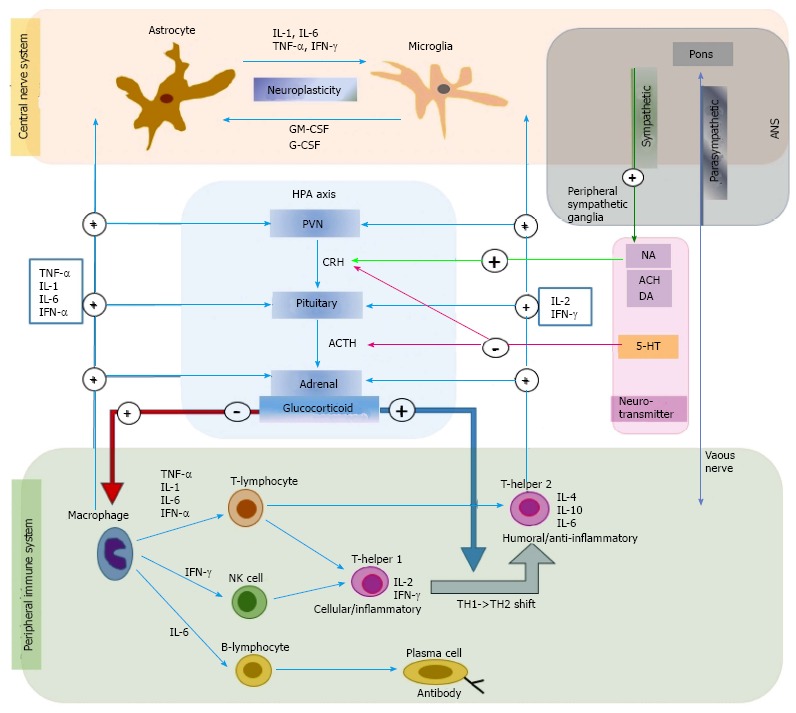
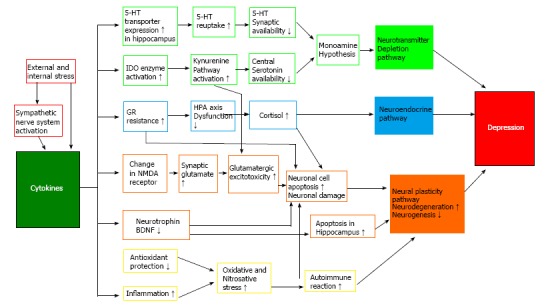
Depression results from changes in the central nervous system (CNS) that may result from immunological abnormalities. The immune system affects the CNS through cytokines, which regulate brain activities and emotions. Cytokines affect two biological systems that are most associated with the pathophysiology of depression: The hypothalamic-pituitary-adrenal axis and the catecholamine/sympathetic nervous system. Neuroinflammation and cytokines affect the brain signal patterns involved in the psychopathology of depression and the mechanisms of antidepressants, and they are associated with neurogenesis and neural plasticity. These observations suggest that neuroinflammation and cytokines might cause and/or maintain depression, and that they might be useful in the diagnosis and prognosis of depression. This psychoneuroimmunologic perspective might compensate for some of the limitations of the monoamine theory by suggesting that depression is a result of a failure to adapt to stress and that inflammatory responses and cytokines are involved in this process. In this review, the interactions of cytokines with the CNS, neuroendocrine system, neurotransmitters, neurodegeneration/neurogenesis, and antidepressants are discussed. The roles of cytokines in the etiology and psychopathology of depression are examined. The use of cytokine inhibitors or anti-inflammatory drugs in depression treatment is explored. Finally, the significance and limitations of the cytokine hypothesis are discussed.
抑郁症是由中枢神经系统(CNS)的变化引起的,这些变化可能是免疫异常的结果。免疫系统通过细胞因子影响中枢神经系统,细胞因子调节大脑活动和情绪。细胞因子影响与抑郁症病理生理学最相关的两个生物系统:下丘脑-垂体-肾上腺轴和儿茶酚胺/交感神经系统。神经炎症和细胞因子会影响与抑郁症的精神病理学和抗抑郁药的机制相关的大脑信号模式,它们与神经发生和神经可塑性有关。这些观察结果表明,神经炎症和细胞因子可能导致和/或维持抑郁症,并且它们可能对抑郁症的诊断和预后有用。这种心理神经免疫学观点可能通过表明抑郁症是对压力无法适应的结果,以及炎症反应和细胞因子参与这一过程,来弥补单胺理论的一些局限性。在这篇综述中,讨论了细胞因子与中枢神经系统、神经内分泌系统、神经递质、神经退行性变/神经发生和抗抑郁药的相互作用。研究了细胞因子在抑郁症病因和精神病理学中的作用。探讨了细胞因子抑制剂或抗炎药物在抑郁症治疗中的应用。最后,讨论了细胞因子假说的意义和局限性。