Pathania Anup S, Guru Santosh K, Kumar Suresh, Kumar Ashok, Ahmad Masroor, Bhushan Shashi, Sharma Parduman R, Mahajan Priya, Shah Bhahwal A, Sharma Simmi, Nargotra Amit, Vishwakarma Ram, Korkaya Hasan, Malik Fayaz
Departments of Cancer Pharmacology, Natural Products Microbes; Indian Institute of Integrative Medicine, Canal road Jammu, Jammu and Kashmir, 180001, India.
Academy of Scientific and Innovative Research (AcSIR), New Delhi, 110001, India.
Sci Rep. 2016 Sep 29;6:33146. doi: 10.1038/srep33146.
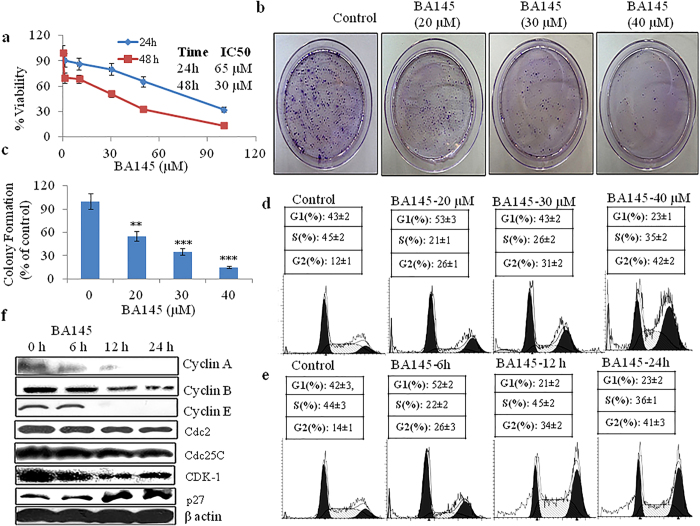
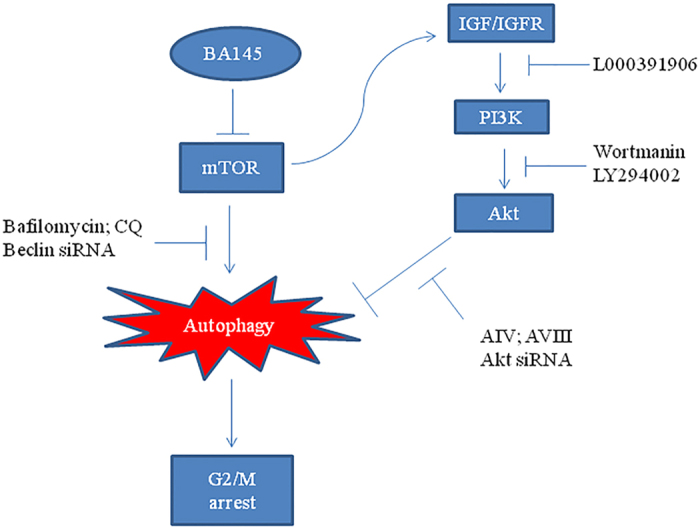
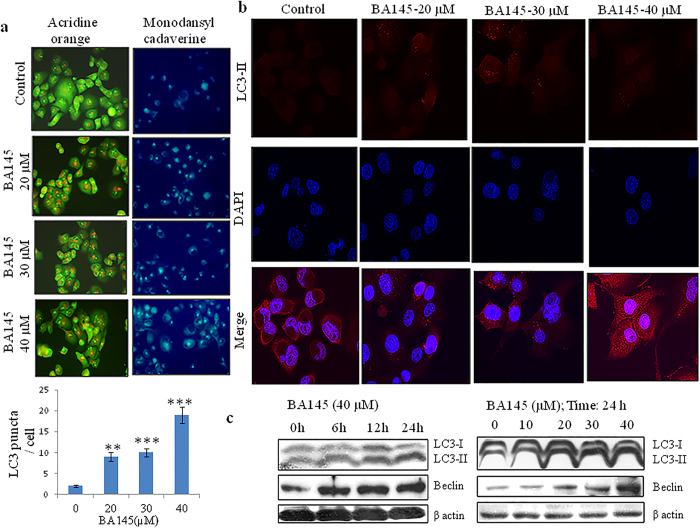
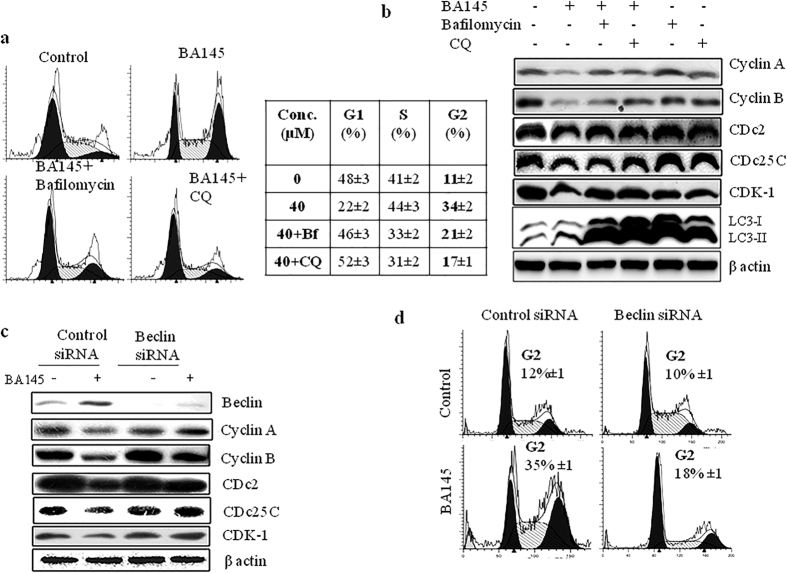
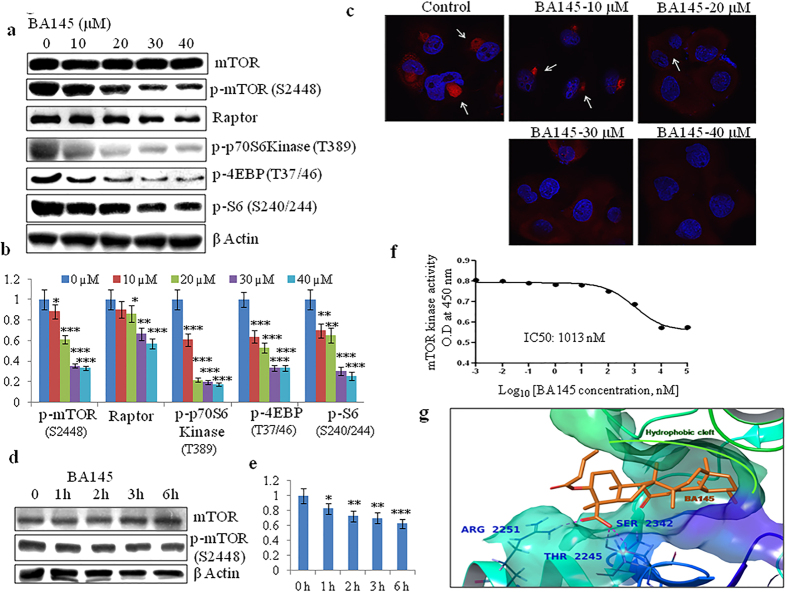
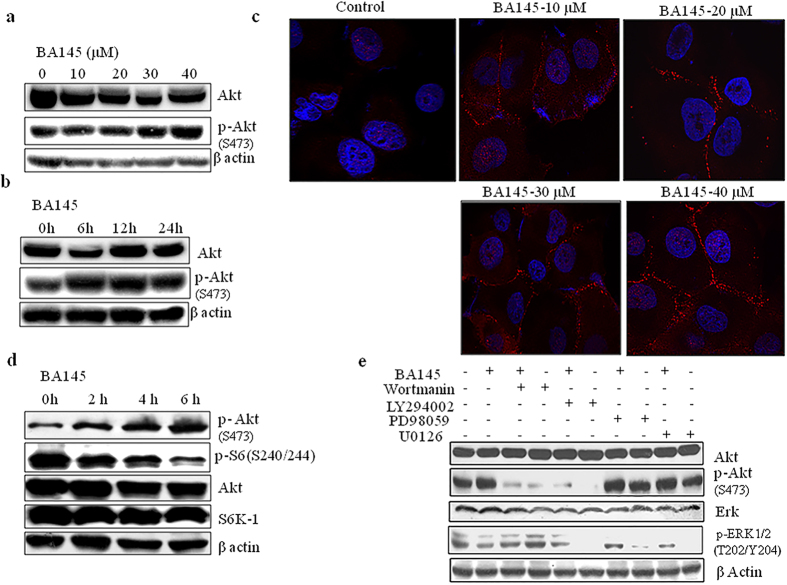
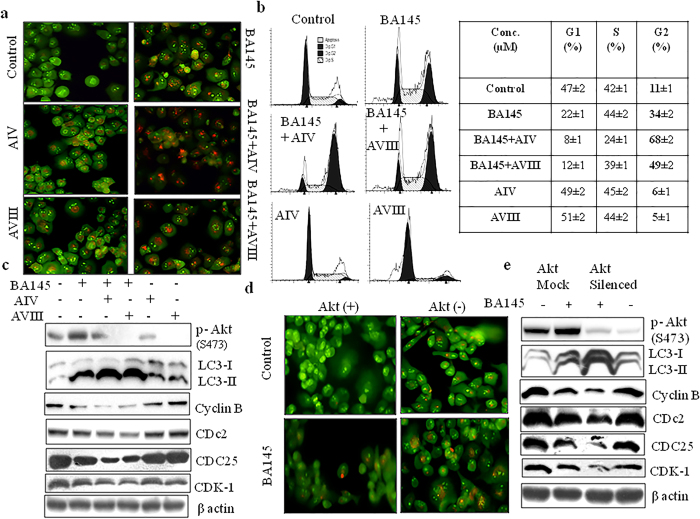
In this study, we investigated the role of autophagy induced by boswellic acid analog BA145 on cell cycle progression in pancreatic cancer cells. BA145 induced robust autophagy in pancreatic cancer cell line PANC-1 and exhibited cell proliferation inhibition by inducing cells to undergo G2/M arrest. Inhibition of G2/M progression was associated with decreased expression of cyclin A, cyclin B, cyclin E, cdc2, cdc25c and CDK-1. Pre-treatment of cells with autophagy inhibitors or silencing the expression of key autophagy genes abrogated BA145 induced G2/M arrest and downregulation of cell cycle regulatory proteins. It was further observed that BA145 induced autophagy by targeting mTOR kinase (IC 1 μM), leading to reduced expression of p-mTOR, p-p70S6K (T389), p-4EBP (T37/46) and p-S6 (S240/244). Notably, inhibition of mTOR signalling by BA145 was followed by attendant activation of AKT and its membrane translocation. Inhibition of Akt through pharmacological inhibitors or siRNAs enhanced BA145 mediated autophagy, G2/M arrest and reduced expression of G2/M regulators. Further studies revealed that BA145 arbitrated inhibition of mTOR led to the activation of Akt through IGFR/PI3k/Akt feedback loop. Intervention in IGFR/PI3k/Akt loop further depreciated Akt phosphorylation and its membrane translocation that culminates in augmented autophagy with concomitant G2/M arrest and cell death.
在本研究中,我们调查了乳香酸类似物BA145诱导的自噬在胰腺癌细胞细胞周期进程中的作用。BA145在胰腺癌细胞系PANC-1中诱导强烈的自噬,并通过诱导细胞发生G2/M期阻滞来抑制细胞增殖。G2/M期进程的抑制与细胞周期蛋白A、细胞周期蛋白B、细胞周期蛋白E、细胞周期蛋白依赖性激酶2(cdc2)、细胞周期蛋白依赖性激酶25C(cdc25c)和细胞周期蛋白依赖性激酶1(CDK-1)的表达降低有关。用自噬抑制剂预处理细胞或沉默关键自噬基因的表达可消除BA145诱导的G2/M期阻滞和细胞周期调节蛋白的下调。进一步观察到,BA145通过靶向雷帕霉素靶蛋白(mTOR)激酶(IC50为1μM)诱导自噬,导致磷酸化mTOR、磷酸化核糖体蛋白S6激酶(p-p70S6K,T389位点磷酸化)、4E结合蛋白1(p-4EBP,T37/46位点磷酸化)和核糖体蛋白S6(p-S6,S240/244位点磷酸化)的表达降低。值得注意的是,BA145对mTOR信号通路的抑制伴随着AKT的激活及其向膜的转位。通过药理学抑制剂或小干扰RNA(siRNA)抑制Akt可增强BA145介导的自噬、G2/M期阻滞以及G2/M期调节因子表达的降低。进一步研究表明,BA145介导的mTOR抑制通过胰岛素样生长因子受体(IGFR)/磷脂酰肌醇-3激酶(PI3k)/Akt反馈环导致Akt激活。干预IGFR/PI3k/Akt环可进一步降低Akt磷酸化及其向膜的转位,最终导致自噬增强,同时伴有G2/M期阻滞和细胞死亡。