van Rooij Sanne J H, Stevens Jennifer S, Ely Timothy D, Fani Negar, Smith Alicia K, Kerley Kimberly A, Lori Adriana, Ressler Kerry J, Jovanovic Tanja
Department of Psychiatry and Behavioral Sciences, Emory University School of Medicine , Atlanta, GA , USA.
Department of Psychiatry and Behavioral Sciences, Emory University School of Medicine, Atlanta, GA, USA; McLean Hospital, Department of Psychiatry, Harvard Medical School, Belmont, MA, USA.
Front Psychiatry. 2016 Sep 14;7:156. doi: 10.3389/fpsyt.2016.00156. eCollection 2016.
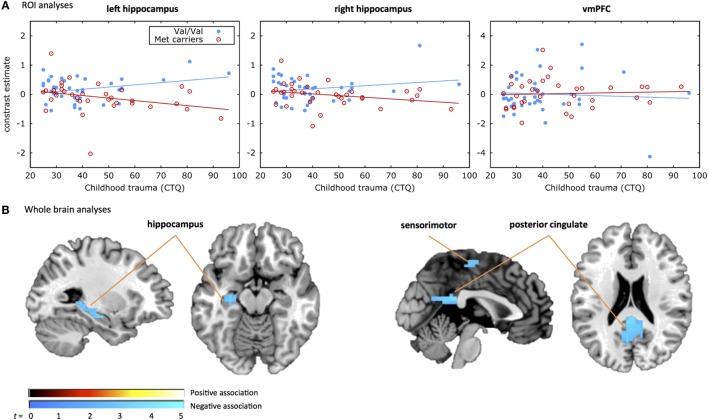
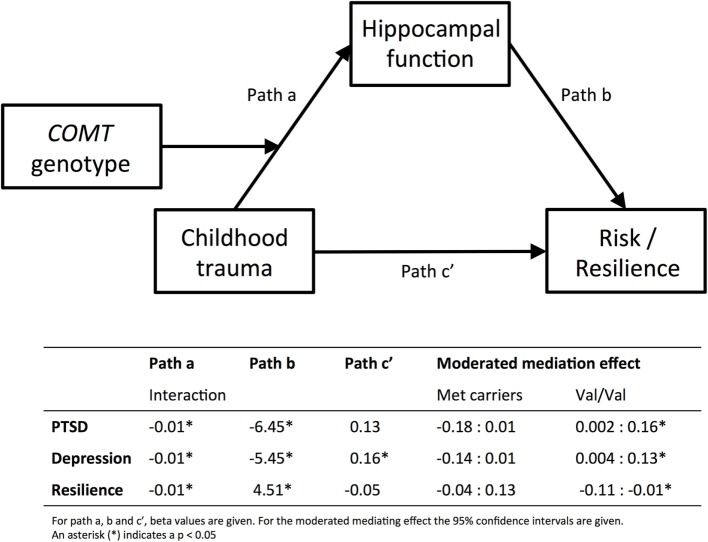
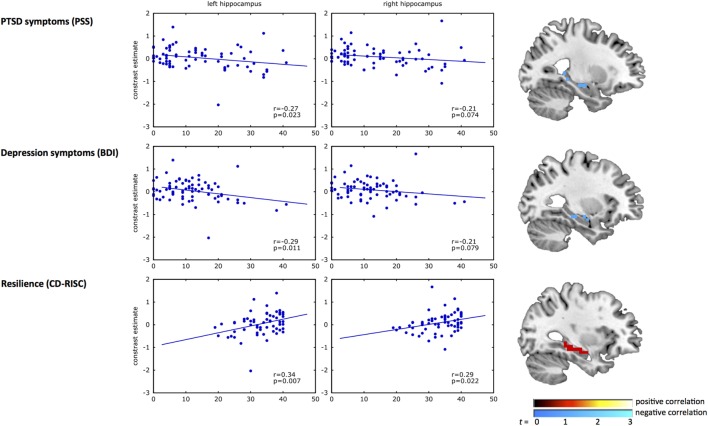
Both childhood trauma and a functional catechol-O-methyltransferase (COMT) genetic polymorphism have been associated with posttraumatic stress disorder (PTSD) and depression; however, it is still unclear whether the two interact and how this interaction relates to long-term risk or resilience. Imaging and genotype data were collected on 73 highly traumatized women. DNA extracted from saliva was used to determine COMT genotype (Val/Val, n = 38, Met carriers, n = 35). Functional MRI data were collected during a Go/NoGo task to investigate the neurocircuitry underlying response inhibition. Self-report measures of adult and childhood trauma exposure, PTSD and depression symptom severity, and resilience were collected. Childhood trauma was found to interact with COMT genotype to impact inhibition-related hippocampal activation. In Met carriers, more childhood trauma was associated with decreased hippocampal activation, whereas in the Val/Val group childhood trauma was related to increased hippocampal activation. Second, hippocampal activation correlated negatively with PTSD and depression symptoms and positively with trait resilience. Moreover, hippocampal activation mediated the relationship between childhood trauma and psychiatric risk or resilience in the Val/Val, but not in the Met carrier group. These data reveal a potential mechanism by which childhood trauma and COMT genotype interact to increase risk for trauma-related psychopathology or resilience. Hippocampal recruitment during inhibition may improve the ability to use contextual information to guide behavior, thereby enhancing resilience in trauma-exposed individuals. This finding may contribute to early identification of individuals at risk and suggests a mechanism that can be targeted in future studies aiming to prevent or limit negative outcomes.
童年创伤和功能性儿茶酚-O-甲基转移酶(COMT)基因多态性均与创伤后应激障碍(PTSD)和抑郁症有关;然而,两者是否相互作用以及这种相互作用如何与长期风险或恢复力相关仍不清楚。收集了73名受高度创伤女性的影像学和基因型数据。从唾液中提取的DNA用于确定COMT基因型(Val/Val,n = 38;Met携带者,n = 35)。在一项Go/NoGo任务期间收集功能磁共振成像数据,以研究反应抑制背后的神经回路。收集了关于成人和童年创伤暴露、PTSD和抑郁症状严重程度以及恢复力的自我报告测量数据。发现童年创伤与COMT基因型相互作用,影响与抑制相关的海马激活。在Met携带者中,更多的童年创伤与海马激活减少有关,而在Val/Val组中,童年创伤与海马激活增加有关。其次,海马激活与PTSD和抑郁症状呈负相关,与特质恢复力呈正相关。此外,海马激活在Val/Val组中介导了童年创伤与精神风险或恢复力之间的关系,但在Met携带者组中没有。这些数据揭示了童年创伤和COMT基因型相互作用以增加创伤相关精神病理学风险或恢复力的潜在机制。抑制过程中海马的募集可能会提高利用情境信息指导行为的能力,从而增强创伤暴露个体的恢复力。这一发现可能有助于早期识别有风险的个体,并提出一种在未来旨在预防或限制负面结果的研究中可作为靶点的机制。