
线粒体活性氧与衰老细胞中内源性凋亡途径的效应器:明辨的杀手!
Mitochondrial ROS and the Effectors of the Intrinsic Apoptotic Pathway in Aging Cells: The Discerning Killers!
作者信息
Hekimi Siegfried, Wang Ying, Noë Alycia
机构信息
Department of Biology, McGill University Montreal, QC, Canada.
出版信息
Front Genet. 2016 Sep 14;7:161. doi: 10.3389/fgene.2016.00161. eCollection 2016.
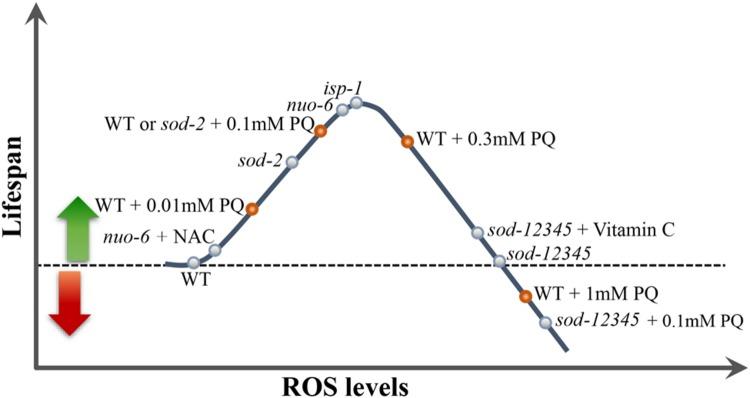
It has become clear that mitochondrial reactive oxygen species (mtROS) are not simply villains and mitochondria the hapless targets of their attacks. Rather, it appears that mitochondrial dysfunction itself and the signaling function of mtROS can have positive effects on lifespan, helping to extend longevity. If events in the mitochondria can lead to better cellular homeostasis and better survival of the organism in ways beyond providing ATP and biosynthetic products, we can conjecture that they act on other cellular components through appropriate signaling pathways. We describe recent advances in a variety of species which promoted our understanding of how changes of mtROS generation are part of a system of signaling pathways that emanate from the mitochondria to impact organism lifespan through global changes, including in transcriptional patterns. In unraveling this, many old players in cellular homeostasis were encountered. Among these, maybe most strikingly, is the intrinsic apoptotic signaling pathway, which is the conduit by which at least one class of mtROS exercise their actions in the nematode Caenorhabditis elegans. This is a pathway that normally contributes to organismal homeostasis by killing defective or otherwise unwanted cells, and whose various compounds have also been implicated in other cellular processes. However, it was a surprise that that appropriate activation of a cell killing pathway can in fact prolong the lifespan of the organism. In the soma of adult C. elegans, all cells are post-mitotic, like many of our neurons and possibly some of our immune cells. These cells cannot simply be killed and replaced when showing signs of dysfunction. Thus, we speculate that it is the ability of the apoptotic pathway to pull together information about the functional and structural integrity of different cellular compartments that is the key property for why this pathway is used to decide when to boost defensive and repair processes in irreplaceable cells. When this process is artificially stimulated in mutants with elevated mtROS generation or with drug treatments it leads to lifespan prolongations beyond the normal lifespan of the organism.
现已明确,线粒体活性氧(mtROS)并非单纯的“反派”,而线粒体也并非其攻击的无辜目标。相反,线粒体功能障碍本身以及mtROS的信号传导功能似乎对寿命具有积极影响,有助于延长寿命。如果线粒体中的事件能够以提供ATP和生物合成产物之外的方式,实现更好的细胞内稳态以及生物体更好的存活,那么我们可以推测,它们通过适当的信号通路作用于其他细胞成分。我们描述了多种物种的最新研究进展,这些进展促进了我们对mtROS生成变化如何成为信号通路系统一部分的理解,该信号通路系统源自线粒体,通过包括转录模式在内的全局变化影响生物体寿命。在揭示这一过程中,我们遇到了许多细胞内稳态中的“老角色”。其中,或许最引人注目的是内在凋亡信号通路,这是至少一类mtROS在秀丽隐杆线虫中发挥作用的途径。这条通路通常通过杀死有缺陷或其他不需要的细胞来维持生物体的内稳态,其各种成分也与其他细胞过程有关。然而,令人惊讶的是,适当激活细胞杀伤通路实际上可以延长生物体的寿命。在成年秀丽隐杆线虫的体细胞中,所有细胞都是有丝分裂后细胞,就像我们的许多神经元以及可能的一些免疫细胞一样。当这些细胞出现功能障碍迹象时,它们不能简单地被杀死并替换。因此,我们推测,凋亡通路整合不同细胞区室功能和结构完整性信息的能力,是该通路被用于决定何时增强不可替代细胞的防御和修复过程的关键特性。当在mtROS生成增加的突变体中或通过药物处理人为刺激这一过程时,会导致生物体寿命延长超过其正常寿命。


 Zotero 插件