Xu Chaoyi, Zhu Jinhong, Fu Wen, Liang Zongwen, Song Shujie, Zhao Yuan, Lyu Lihua, Zhang Anqi, He Jing, Duan Ping
Department of Obstetrics and Gynecology, The Second Affiliated Hospital and Yuying Children's Hospital, Wenzhou Medical University, Wenzhou 325027, Zhejiang, China.
Molecular Epidemiology Laboratory and Department of Laboratory Medicine, Harbin Medical University Cancer Hospital, Harbin 150040, Heilongjiang, China.
Oncotarget. 2016 Nov 1;7(44):71718-71726. doi: 10.18632/oncotarget.12326.
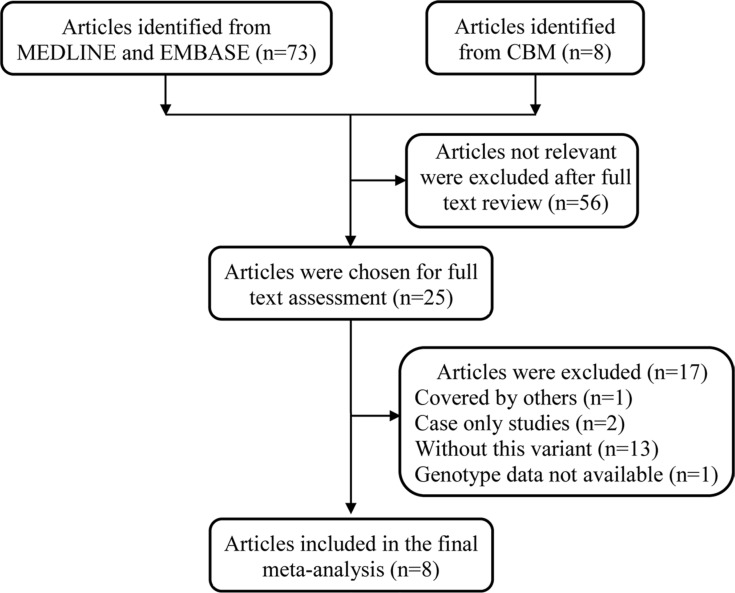
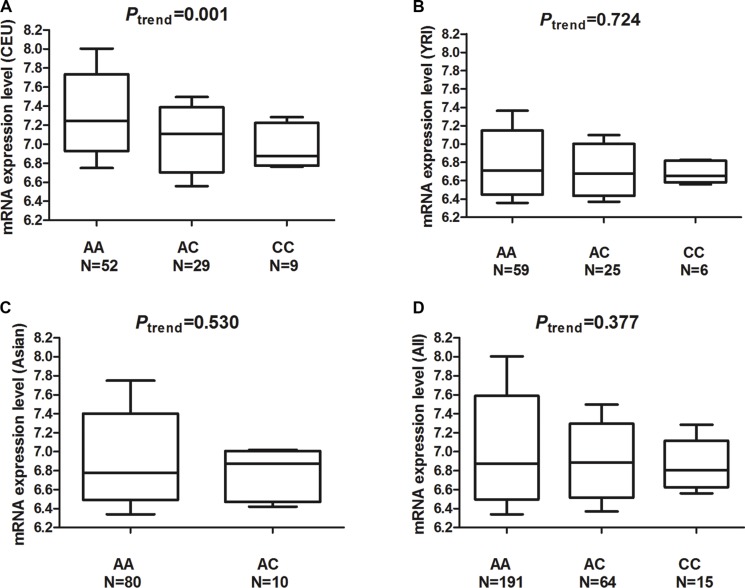
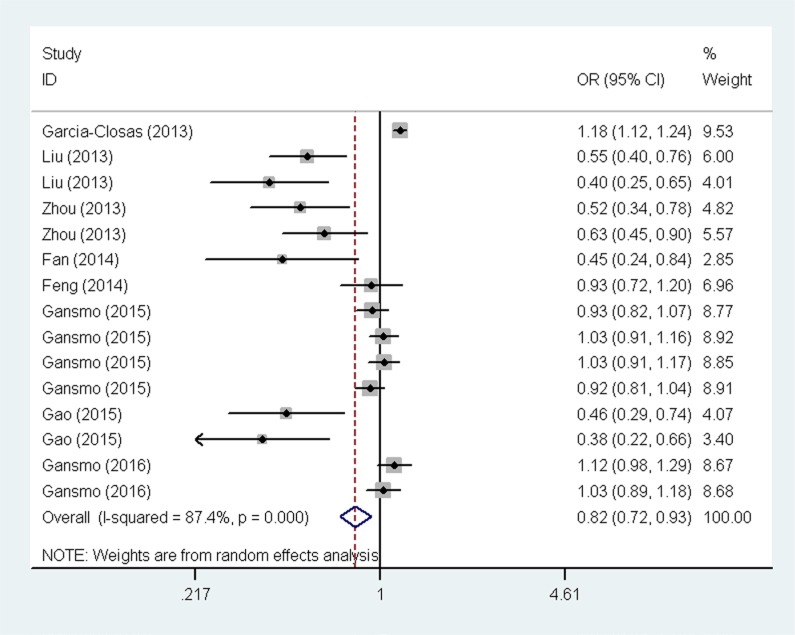
Mouse double minute 4 (MDM4) is a p53-interacting oncoprotein that plays an important role in the p53 tumor suppressor pathway. The common rs4245739 A > C polymorphism creates a miR-191 binding site in the MDM4 gene transcript. Numerous studies have investigated the association between this MDM4 polymorphism and cancer risk, but have failed to reach a definitive conclusion. To address this issue, we conducted a meta-analysis by selecting eligible studies from MEDLINE, EMBASE, and Chinese Biomedical databases. Odds ratios (ORs) and 95% confidence intervals (CIs) were used to assess the strength of the associations. We also performed genotype-based mRNA expression analysis using data from 270 individuals retrieved from public datasets. A total of 15 studies with 19796 cases and 49681 controls were included in the final meta-analysis. The pooled results revealed that the MDM4 rs4245739C allele is associated with a decreased cancer risk in the heterozygous (AC vs. AA: OR = 0.82, 95% CI = 0.73-0.93), dominant (AC/CC vs. AA: OR = 0.82, 95% CI = 0.72-0.93), and allele contrast models (C vs. A: OR = 0.84, 95% CI = 0.76-0.94). The association was more prominent in Asians and population-based studies. We also found that the rs4245739C allele was associated with decreased MDM4 mRNA expression, especially for Caucasians. Thus the MDM4 rs4245739 A > C polymorphism appears to be associated with decreased cancer risk. These findings would be strengthened by new studies with larger sample sizes and encompassing additional ethnicities.
小鼠双微体4(MDM4)是一种与p53相互作用的癌蛋白,在p53肿瘤抑制通路中发挥重要作用。常见的rs4245739 A>C多态性在MDM4基因转录本中创建了一个miR-191结合位点。许多研究调查了这种MDM4多态性与癌症风险之间的关联,但未能得出明确结论。为解决这一问题,我们通过从MEDLINE、EMBASE和中国生物医学数据库中选择符合条件的研究进行了一项荟萃分析。比值比(OR)和95%置信区间(CI)用于评估关联强度。我们还使用从公共数据集中检索的270名个体的数据进行了基于基因型的mRNA表达分析。最终的荟萃分析纳入了15项研究,共19796例病例和49681例对照。汇总结果显示,MDM4 rs4245739C等位基因与杂合子(AC与AA:OR = 0.82,95% CI = 0.73 - 0.93)、显性(AC/CC与AA:OR = 0.82,95% CI = 0.72 - 0.93)和等位基因对比模型(C与A:OR = 0.84,95% CI = 0.76 - 0.94)中的癌症风险降低相关。这种关联在亚洲人和基于人群的研究中更为显著。我们还发现,rs4245739C等位基因与MDM4 mRNA表达降低相关,尤其是对白种人而言。因此,MDM4 rs4245739 A>C多态性似乎与癌症风险降低相关。这些发现将通过更大样本量和涵盖更多种族的新研究得到加强。