Repa Andreas, Lochmann Ruth, Unterasinger Lukas, Weber Michael, Berger Angelika, Haiden Nadja
Department of Pediatrics and Adolescent Medicine, Division of Neonatology, Pediatric Intensive Care and Neuropediatrics, Medical University of Vienna , Vienna , Austria.
Department of Radiology, Medical University of Vienna , Vienna , Austria.
PeerJ. 2016 Sep 20;4:e2483. doi: 10.7717/peerj.2483. eCollection 2016.
Parenteral nutrition associated cholestasis (PNAC) is a frequently observed pathology in extremely low birth weight (ELBW) infants. Its pathogenesis is determined by the composition and duration of parenteral nutrition (PN) as well as the tolerance of enteral feeds (EF). "Aggressive" nutrition is increasingly used in ELBW infants to improve postnatal growth. Little is known about the effect of "aggressive" nutrition on the incidence of PNAC. We analyzed the influence of implementing an "aggressive" nutritional regimen on the incidence of PNAC and growth in a cohort of ELBW infants.
ELBW infants were nourished using a "conservative" (2005-6; n = 77) or "aggressive" (2007-9; n = 85) nutritional regimen that differed in the composition of PN after birth as well as the composition and timing of advancement of EFs. We analyzed the incidence of PNAC (conjugated bilirubin > 1.5 mg/dl (25 µmol/l)) corrected for confounders of cholestasis (i.e., NEC and/or gastrointestinal surgery, sepsis, birth weight, Z-score of birth weight, time on PN and male sex), growth until discharge (as the most important secondary outcome) and neonatal morbidities.
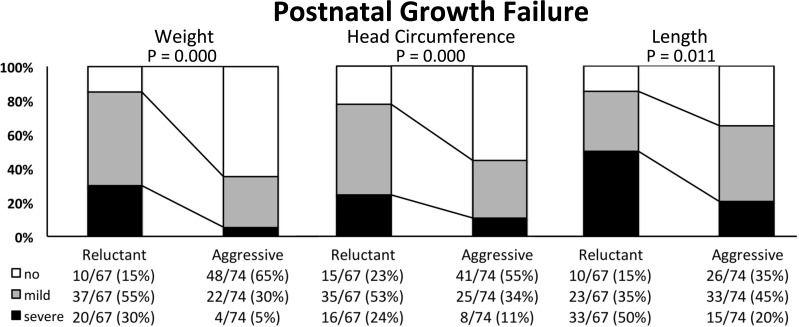
The incidence of PNAC was significantly lower during the period of "aggressive" vs. "conservative "nutrition (27% vs. 46%, P < 0.05; adjusted OR 0.275 [0.116-0.651], P < 0.01). Body weight (+411g), head circumference (+1 cm) and length (+1 cm) at discharge were significantly higher. Extra-uterine growth failure (defined as a Z-score difference from birth to discharge lower than -1) was significantly reduced for body weight (85% vs. 35%), head circumference (77% vs. 45%) and length (85% vs. 65%) (P < 0.05). The body mass index (BMI) at discharge was significantly higher (11.1 vs. 12.4) using "aggressive" nutrition and growth became more proportionate with significantly less infants being discharged below the 10th BMI percentile (44% vs. 9%), while the percentage of infants discharged over the 90th BMI percentile (3% vs. 5%) did not significantly increase.
"Aggressive" nutrition of ELBW infants was associated with a significant decrease of PNAC and marked improvement of postnatal growth.
肠外营养相关胆汁淤积症(PNAC)是极低出生体重(ELBW)婴儿中常见的一种病症。其发病机制由肠外营养(PN)的成分和持续时间以及肠内喂养(EF)的耐受性决定。“积极”营养越来越多地用于ELBW婴儿以促进出生后的生长。关于“积极”营养对PNAC发病率的影响知之甚少。我们分析了实施“积极”营养方案对一组ELBW婴儿PNAC发病率和生长的影响。
ELBW婴儿采用“保守”(2005 - 2006年;n = 77)或“积极”(2007 - 2009年;n = 85)营养方案进行喂养,这两种方案在出生后PN的成分以及EF的成分和推进时间上有所不同。我们分析了校正胆汁淤积症混杂因素(即坏死性小肠结肠炎和/或胃肠道手术、败血症、出生体重、出生体重Z评分、PN持续时间和男性性别)后的PNAC发病率(结合胆红素>1.5 mg/dl(25 µmol/l))、直至出院的生长情况(作为最重要的次要结局)以及新生儿疾病。
在“积极”营养与“保守”营养期间,PNAC的发病率显著降低(27%对46%,P < 0.05;校正后比值比0.275 [0.116 - 0.651],P < 0.01)。出院时的体重(增加411g)、头围(增加1 cm)和身长(增加1 cm)显著更高。宫外生长发育迟缓(定义为出生至出院的Z评分差异低于 -1)在体重(85%对35%)、头围(77%对45%)和身长(85%对65%)方面显著降低(P < 0.05)。采用“积极”营养时,出院时的体重指数(BMI)显著更高(11.1对12.4),生长变得更加匀称,出院时BMI低于第10百分位数的婴儿显著减少(44%对9%),而出院时BMI高于第90百分位数的婴儿百分比(3%对5%)没有显著增加。
ELBW婴儿的“积极”营养与PNAC的显著降低和出生后生长的显著改善相关。