Li Lushen, Liu Hongyu, Baxter Shaneen S, Gu Ning, Ji Min, Zhan Xi
School of Biological Science and Medical Engineering, Southeast University, Nanjing 210096, China; The Center for Vascular and Inflammatory Diseases and The Marlene and Stewart Greenebaum Cancer Center, University of Maryland School of Medicine, Baltimore, MD 21201, USA.
China-Japan Union Hospital of Jilin University, Changchun, 130031, China.
Biochem Biophys Res Commun. 2016 Oct 28;479(4):787-792. doi: 10.1016/j.bbrc.2016.09.131. Epub 2016 Sep 28.
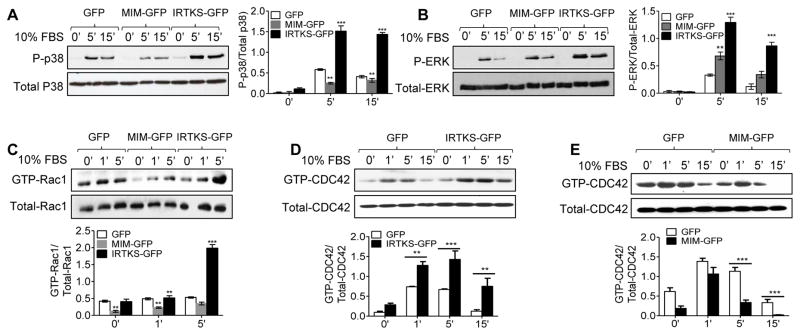
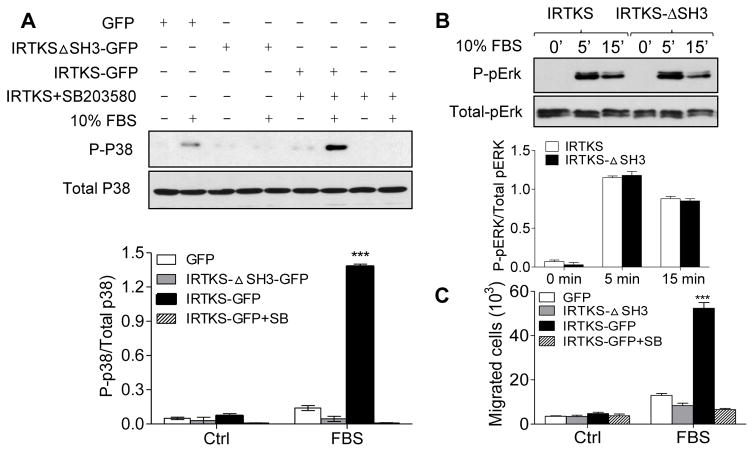
The family of inverse BAR (I-BAR) domain proteins participates in a range of cellular processes associated with membrane dynamics and consists of five distinct members. Three of the I-BAR proteins, including insulin receptor tyrosine kinase substrate (IRTKS), contain an SH3 domain near their C-termini. Yet, the function of the SH3 domain of IRTKS remains uncharacterized. Here we report that in contrast to MIM, which is a prototype of I-BAR proteins and does not contain an SH3 domain, IRTKS promoted serum-induced cell migration along with enhanced phosphorylation of mitogen activated kinases Erk1/2 and p38, and activation of small GTPases Rac1 and Cdc42. In addition, cells overexpressing IRTKS exhibited an increased polarity characterized by elongated cytoplasm and extensive lamellipodia at leading edges. However, a mutant with deletion of the SH3 domain attenuated both cellular motility and p38 phosphorylation but had little effect on Erk1/2 phosphorylation. Also, a chimeric mutant in which the N-terminal portion of MIM is fused with the C-terminal IRTKS, including the SH3 domain, was able to promote chemotactic response to serum and cellular polarity. In contrast, a chimeric mutant in which the N-terminal IRTKS is fused with the C-terminal MIM failed to do so. Furthermore, treatment of cells with SB203580, a selective inhibitor of p38, also neutralized the effect of IRTKS on cell migration. These data indicate that the SH3 domain distinguishes the function of IRTKS in promoting cell migration and inducing signal transduction from those of SH3-less I-BAR proteins.
反向BAR(I-BAR)结构域蛋白家族参与一系列与膜动力学相关的细胞过程,由五个不同的成员组成。其中三个I-BAR蛋白,包括胰岛素受体酪氨酸激酶底物(IRTKS),在其C末端附近含有一个SH3结构域。然而,IRTKS的SH3结构域的功能仍未明确。在这里,我们报告,与I-BAR蛋白的原型MIM不同,MIM不包含SH3结构域,IRTKS促进血清诱导的细胞迁移,同时增强丝裂原活化激酶Erk1/2和p38的磷酸化,以及小GTP酶Rac1和Cdc42的激活。此外,过表达IRTKS的细胞表现出极性增加,其特征是细胞质伸长和前缘有广泛的片状伪足。然而,缺失SH3结构域的突变体减弱了细胞运动性和p38磷酸化,但对Erk1/2磷酸化影响很小。同样,一种嵌合突变体,其中MIM的N末端部分与包括SH3结构域的IRTKS的C末端融合,能够促进对血清的趋化反应和细胞极性。相反,一种将IRTKS的N末端与MIM的C末端融合的嵌合突变体则不能。此外,用p38的选择性抑制剂SB203580处理细胞,也消除了IRTKS对细胞迁移的影响。这些数据表明,SH3结构域区分了IRTKS在促进细胞迁移和诱导信号转导方面的功能与不含SH3的I-BAR蛋白的功能。