Oikawa Tsukasa, Matsuo Koichi
Laboratory of Cell and Tissue Biology; School of Medicine; Keio University; Tokyo, Japan.
Commun Integr Biol. 2012 Sep 1;5(5):511-5. doi: 10.4161/cib.21252.
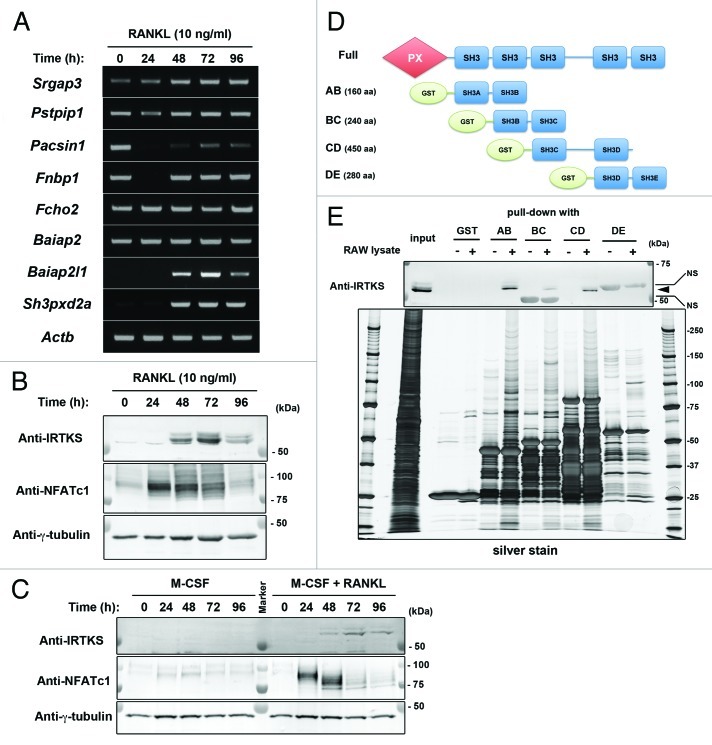
Podosomes and invadopodia seen in osteoclasts and cancer cells, respectively, are actin-rich membrane protrusions. We recently demonstrated that an adaptor protein, Tks5, which is an established regulator of invadopodia in cancer cells, drives osteoclast-osteoclast fusion as well as osteoclast-cancer cell fusion by generating circumferential podosomes/invadopodia. This finding revealed an unexpected potential of podosomes/invadopodia to act as fusion-competent protrusions. Fusion of biological membranes involves the intricate orchestration of various proteins and lipids. Recent literature suggests the importance of membrane curvature formation in lipid bilayer fusion. In this study, we investigated the expression of Bin-Amphiphysin-Rvs161/167 (BAR) domain superfamily proteins, which have membrane deforming activity, during osteoclastogenesis. We found that IRTKS was specifically induced during osteoclast fusion and interacted with Tks5, suggesting the role of IRTKS in the formation of fusion-competent protrusions via its BAR domain.
分别在破骨细胞和癌细胞中发现的足体和侵袭性伪足是富含肌动蛋白的膜突出结构。我们最近证明,衔接蛋白Tks5(一种已确定的癌细胞侵袭性伪足调节因子)通过生成周向足体/侵袭性伪足驱动破骨细胞-破骨细胞融合以及破骨细胞-癌细胞融合。这一发现揭示了足体/侵袭性伪足作为具有融合能力的突出结构的意外潜力。生物膜的融合涉及各种蛋白质和脂质的复杂协调。最近的文献表明膜曲率形成在脂质双层融合中的重要性。在本研究中,我们研究了具有膜变形活性的Bin-发动蛋白-Rvs161/167(BAR)结构域超家族蛋白在破骨细胞生成过程中的表达。我们发现IRTKS在破骨细胞融合过程中被特异性诱导,并与Tks5相互作用,提示IRTKS通过其BAR结构域在形成具有融合能力的突出结构中发挥作用。