Koenen K C, Sumner J A, Gilsanz P, Glymour M M, Ratanatharathorn A, Rimm E B, Roberts A L, Winning A, Kubzansky L D
Department of Epidemiology,Harvard T.H. Chan School of Public Health,Boston, MA,USA.
Department of Social and Behavioral Sciences,Harvard T.H. Chan School of Public Health,Boston, MA,USA.
Psychol Med. 2017 Jan;47(2):209-225. doi: 10.1017/S0033291716002294. Epub 2016 Oct 4.
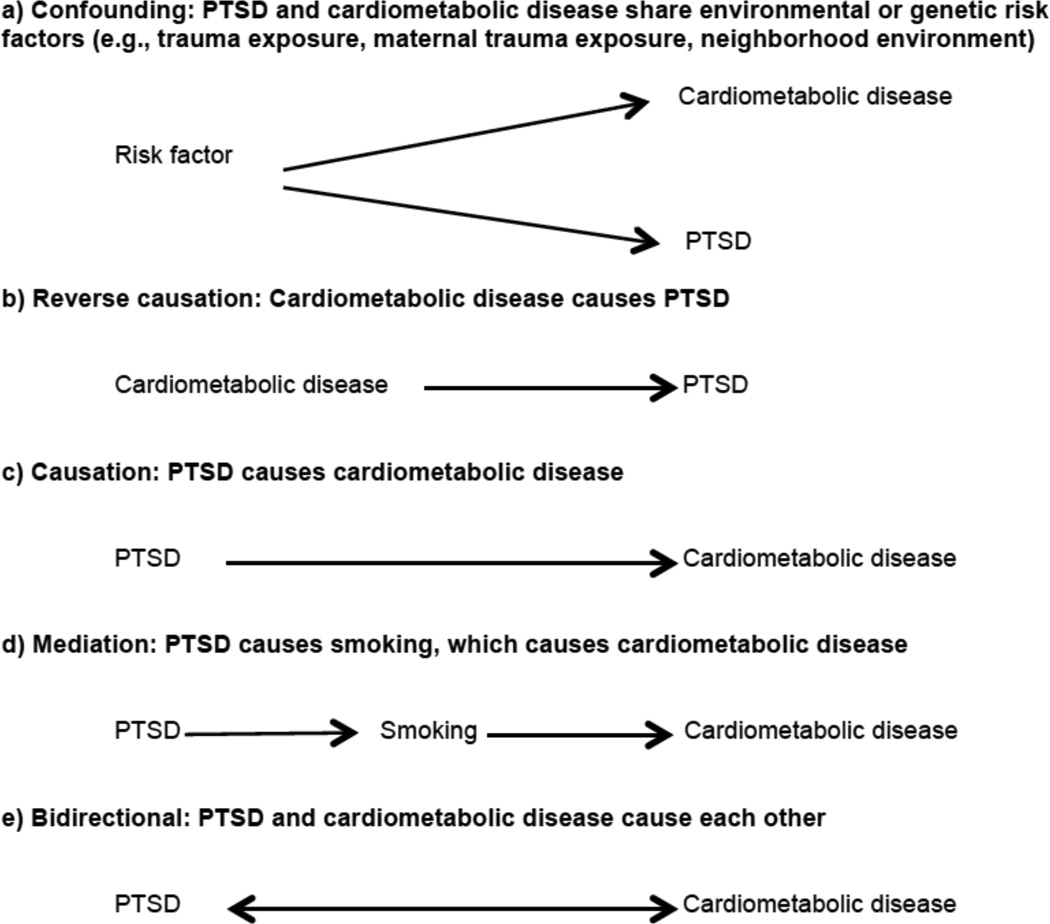
Post-traumatic stress disorder (PTSD) has been declared 'a life sentence' based on evidence that the disorder leads to a host of physical health problems. Some of the strongest empirical research - in terms of methodology and findings - has shown that PTSD predicts higher risk of cardiometabolic diseases, specifically cardiovascular disease (CVD) and type 2 diabetes (T2D). Despite mounting evidence, PTSD is not currently acknowledged as a risk factor by cardiovascular or endocrinological medicine. This view is unlikely to change absent compelling evidence that PTSD causally contributes to cardiometabolic disease. This review suggests that with developments in methods for epidemiological research and the rapidly expanding knowledge of the behavioral and biological effects of PTSD the field is poised to provide more definitive answers to questions of causality. First, we discuss methods to improve causal inference using the observational data most often used in studies of PTSD and health, with particular reference to issues of temporality and confounding. Second, we consider recent work linking PTSD with specific behaviors and biological processes, and evaluate whether these may plausibly serve as mechanisms by which PTSD leads to cardiometabolic disease. Third, we evaluate how looking more comprehensively into the PTSD phenotype provides insight into whether specific aspects of PTSD phenomenology are particularly relevant to cardiometabolic disease. Finally, we discuss new areas of research that are feasible and could enhance understanding of the PTSD-cardiometabolic relationship, such as testing whether treatment of PTSD can halt or even reverse the cardiometabolic risk factors causally related to CVD and T2D.
创伤后应激障碍(PTSD)已被宣称是“无期徒刑”,因为有证据表明该障碍会引发一系列身体健康问题。就方法和研究结果而言,一些最有力的实证研究表明,创伤后应激障碍预示着患心脏代谢疾病的风险更高,特别是心血管疾病(CVD)和2型糖尿病(T2D)。尽管证据越来越多,但心血管医学或内分泌医学目前并未将创伤后应激障碍视为一个风险因素。如果没有令人信服的证据表明创伤后应激障碍会导致心脏代谢疾病,这种观点不太可能改变。本综述表明,随着流行病学研究方法的发展以及对创伤后应激障碍行为和生物学影响的认识迅速扩大,该领域有望为因果关系问题提供更明确的答案。首先,我们讨论使用创伤后应激障碍与健康研究中最常用的观察数据来改善因果推断的方法,特别提及时间性和混杂问题。其次,我们考虑将创伤后应激障碍与特定行为和生物学过程联系起来的最新研究,并评估这些是否可能合理地作为创伤后应激障碍导致心脏代谢疾病的机制。第三,我们评估更全面地研究创伤后应激障碍表型如何有助于深入了解创伤后应激障碍现象学的特定方面是否与心脏代谢疾病特别相关。最后,我们讨论可行的新研究领域,这些领域可以增进对创伤后应激障碍与心脏代谢关系的理解,例如测试创伤后应激障碍的治疗是否可以阻止甚至逆转与心血管疾病和2型糖尿病因果相关的心脏代谢风险因素。