Vandenbroucke Jan P, Broadbent Alex, Pearce Neil
Department of Clinical Epidemiology, Leiden University Medical Center, Leiden, The Netherlands and Department of Clinical Epidemiology, Aarhus University Hospital, Aarhus, Denmark.
Department of Philosophy, University of Johannesburg, Auckland Park, South Africa.
Int J Epidemiol. 2016 Dec 1;45(6):1776-1786. doi: 10.1093/ije/dyv341.
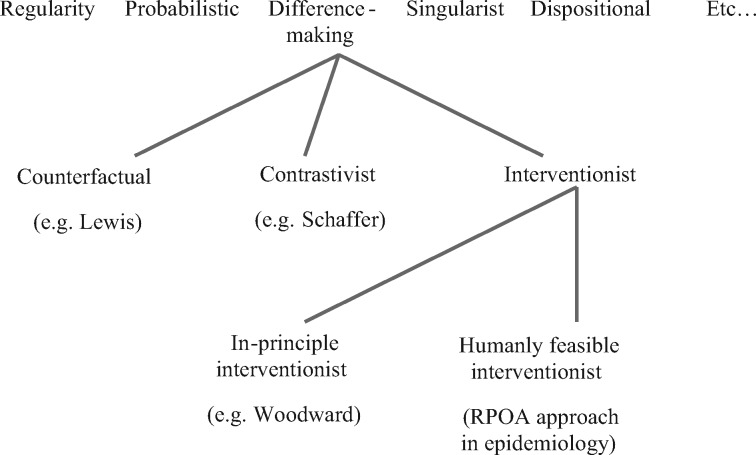
Causal inference based on a restricted version of the potential outcomes approach reasoning is assuming an increasingly prominent place in the teaching and practice of epidemiology. The proposed concepts and methods are useful for particular problems, but it would be of concern if the theory and practice of the complete field of epidemiology were to become restricted to this single approach to causal inference. Our concerns are that this theory restricts the questions that epidemiologists may ask and the study designs that they may consider. It also restricts the evidence that may be considered acceptable to assess causality, and thereby the evidence that may be considered acceptable for scientific and public health decision making. These restrictions are based on a particular conceptual framework for thinking about causality. In Section 1, we describe the characteristics of the restricted potential outcomes approach (RPOA) and show that there is a methodological movement which advocates these principles, not just for solving particular problems, but as ideals for which epidemiology as a whole should strive. In Section 2, we seek to show that the limitation of epidemiology to one particular view of the nature of causality is problematic. In Section 3, we argue that the RPOA is also problematic with regard to the assessment of causality. We argue that it threatens to restrict study design choice, to wrongly discredit the results of types of observational studies that have been very useful in the past and to damage the teaching of epidemiological reasoning. Finally, in Section 4 we set out what we regard as a more reasonable 'working hypothesis' as to the nature of causality and its assessment: pragmatic pluralism.
基于潜在结果方法推理的受限版本的因果推断,在流行病学的教学与实践中正占据着日益突出的地位。所提出的概念和方法对于特定问题是有用的,但如果流行病学整个领域的理论与实践都局限于这种单一的因果推断方法,那将令人担忧。我们担心的是,这种理论限制了流行病学家可能提出的问题以及他们可能考虑的研究设计。它还限制了在评估因果关系时可被视为可接受的证据,从而也限制了在科学和公共卫生决策中可被视为可接受的证据。这些限制基于一种关于因果关系的特定概念框架。在第1节中,我们描述了受限潜在结果方法(RPOA)的特征,并表明存在一种方法学趋势,它倡导这些原则,不仅是为了解决特定问题,而且是将其作为整个流行病学应追求的理想。在第2节中,我们试图表明,将流行病学局限于因果关系本质的一种特定观点是有问题的。在第3节中,我们认为RPOA在因果关系评估方面也存在问题。我们认为它有可能限制研究设计的选择,错误地诋毁过去非常有用的各类观察性研究的结果,并损害流行病学推理的教学。最后,在第4节中,我们阐述了我们认为关于因果关系本质及其评估更为合理的“工作假设”:实用多元主义。