Cai Tommaso, Verze Paolo, Massenio Paolo, Tiscione Daniele, Malossini Gianni, Cormio Luigi, Carrieri Giuseppe, Mirone Vincenzo
Department of Urology, Santa Chiara Regional Hospital, I-38123 Trento, Italy.
Department of Urology, University Federico II of Naples, I-80121 Naples, Italy.
Exp Ther Med. 2016 Oct;12(4):2083-2087. doi: 10.3892/etm.2016.3595. Epub 2016 Aug 12.
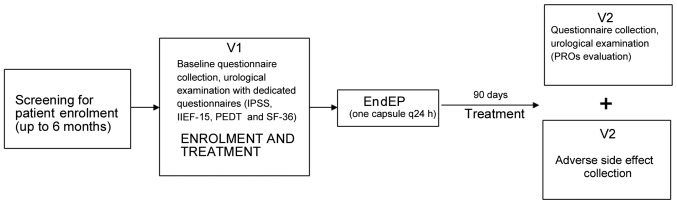
The therapeutic armamentarium currently available for the treatment of premature ejaculation (PE) is not highly satisfactory. However, phytotherapeutics appear to be an interesting option for PE management. The present study aimed to evaluate the tolerability and efficacy of a phytotherapeutic combination of , folic acid, biotin and zinc (EndEP) in the treatment of patients affected by lifelong PE. All patients affected by lifelong PE who were attending three Urological Institutions from July to December 2014 were enrolled in this prospective, multicentre, phase I-II study. All patients were assigned to receive oral tablets of EndEP (one tablet per day) for 90 days. Clinical and instrumental analyses were carried out at enrolment and at the end of the study. International Prostatic Symptom Score (IPSS), International Index of Erectile Function (IIEF)-15, Premature Ejaculation Diagnostic Tool (PEDT) and Short Form (SF)-36 questionnaires were used. The intravaginal ejaculation latency time (IELT) for each event was also evaluated using the stop-watch technique. The main outcome measure was the difference from baseline in PEDT questionnaire and mean IELT at the end of the follow-up period. In total, 91 patients (mean age, 32.3±5.6 years) were analysed. The baseline questionnaires mean scores were 1.1±1.6, 26.1±2.9, 15.3±3.4 and 98.2±0.5, for IPSS, IIEF-15, PEDT and SF-36, respectively. The mean IELT at baseline was 73.6±46.9s. At the follow-up examination (90 days after the start of treatment), no statistically significant differences were identified in terms of IPSS (1.4±1.5) or IIEF-15 (26.3±3.1) compared with the pre-treatment values (P=0.19 and P=0.64, respectively). A statistically significant difference was detected between the mean IELT at enrolment and after treatment (73.6±46.9 vs. 102.3±60.0; P<0.001) and SF-36 questionnaire (98.2±0.5 vs. 99.4±0.1; P<0.001). Fifty-five patients reported improvement in the control of ejaculation (60.4%). Very few adverse events were reported (4.4%). In conclusion, it was found that EndEP significantly improved ejaculatory control and the quality of sexual life in patients affected by lifelong PE, with a very low rate of adverse events.
目前可用于治疗早泄(PE)的治疗手段并不十分令人满意。然而,植物疗法似乎是早泄管理的一个有趣选择。本研究旨在评估一种由[具体成分未给出]、叶酸、生物素和锌组成的植物治疗组合(EndEP)在治疗终生性早泄患者中的耐受性和疗效。2014年7月至12月期间,在三家泌尿机构就诊的所有终生性早泄患者被纳入这项前瞻性、多中心、I-II期研究。所有患者被分配接受EndEP口服片剂(每天一片),持续90天。在入组时和研究结束时进行临床和仪器分析。使用国际前列腺症状评分(IPSS)、国际勃起功能指数(IIEF)-15、早泄诊断工具(PEDT)和简短形式(SF)-36问卷。还使用秒表技术评估每次性交时的阴道内射精潜伏期(IELT)。主要结局指标是随访期末PEDT问卷与基线的差异以及平均IELT。总共分析了91例患者(平均年龄32.3±5.6岁)。IPSS、IIEF-15、PEDT和SF-36问卷的基线平均得分分别为1.1±1.6、26.1±2.9、15.3±3.4和98.2±0.5。基线时的平均IELT为73.6±46.9秒。在随访检查(治疗开始90天后),与治疗前值相比,IPSS(1.4±1.5)或IIEF-15(26.3±3.1)方面未发现统计学上的显著差异(分别为P = 0.19和P = 0.64)。在入组时和治疗后的平均IELT(73.6±46.9对102.3±60.0;P<0.001)以及SF-36问卷(98.2±0.5对99.4±0.1;P<0.001)之间检测到统计学上的显著差异。55例患者报告射精控制有改善(60.4%)。报告的不良事件很少(4.4%)。总之,发现EndEP显著改善了终生性早泄患者的射精控制和性生活质量,不良事件发生率非常低。