Pons-Salort Margarita, Molodecky Natalie A, O'Reilly Kathleen M, Wadood Mufti Zubair, Safdar Rana M, Etsano Andrew, Vaz Rui Gama, Jafari Hamid, Grassly Nicholas C, Blake Isobel M
Department of Infectious Disease Epidemiology, St Mary's Campus, Imperial College London, London, United Kingdom.
World Health Organization, Islamabad, Pakistan.
PLoS Med. 2016 Oct 4;13(10):e1002140. doi: 10.1371/journal.pmed.1002140. eCollection 2016 Oct.
Global withdrawal of serotype-2 oral poliovirus vaccine (OPV2) took place in April 2016. This marked a milestone in global polio eradication and was a public health intervention of unprecedented scale, affecting 155 countries. Achieving high levels of serotype-2 population immunity before OPV2 withdrawal was critical to avoid subsequent outbreaks of serotype-2 vaccine-derived polioviruses (VDPV2s).
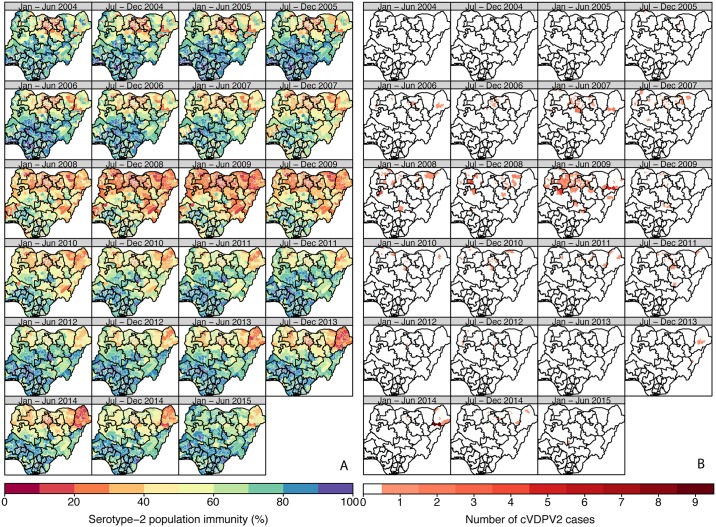
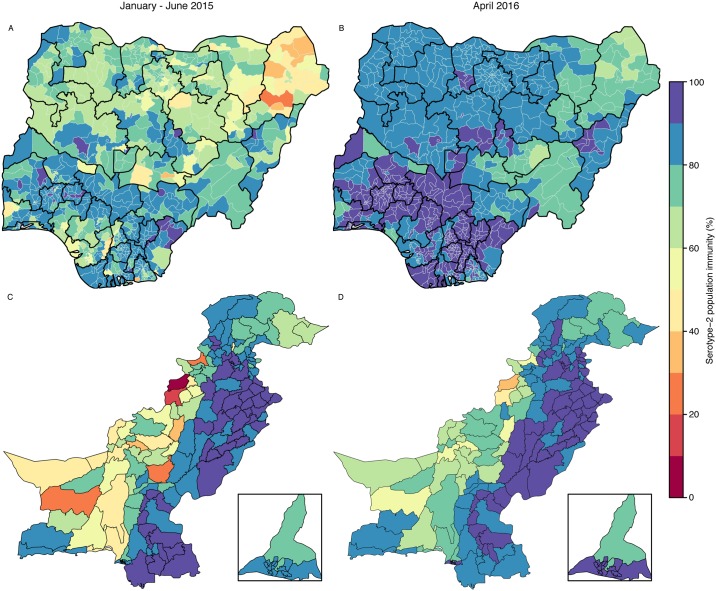
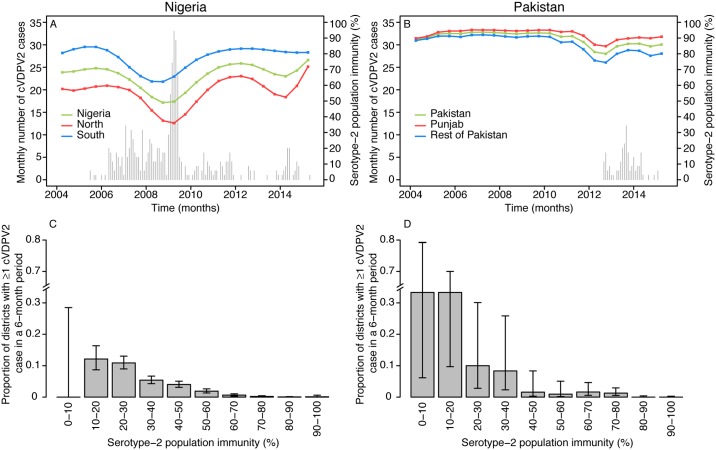
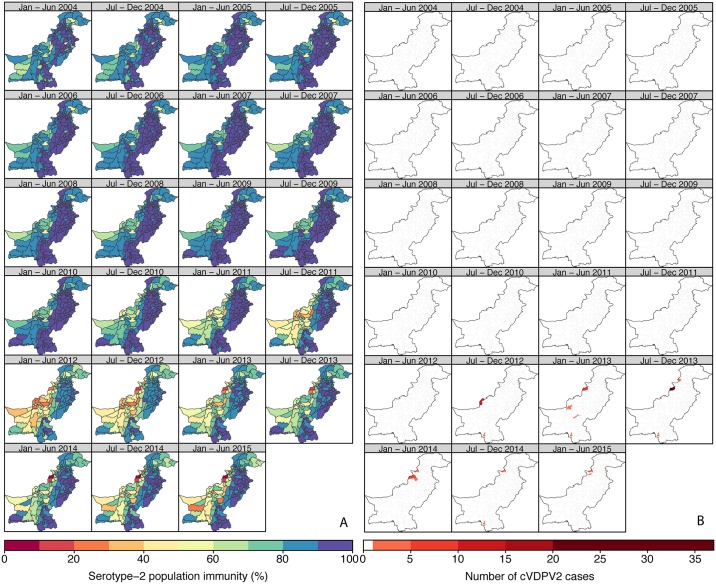
In August 2015, we estimated vaccine-induced population immunity against serotype-2 poliomyelitis for 1 January 2004-30 June 2015 and produced forecasts for April 2016 by district in Nigeria and Pakistan. Population immunity was estimated from the vaccination histories of children <36 mo old identified with non-polio acute flaccid paralysis (AFP) reported through polio surveillance, information on immunisation activities with different oral poliovirus vaccine (OPV) formulations, and serotype-specific estimates of the efficacy of these OPVs against poliomyelitis. District immunity estimates were spatio-temporally smoothed using a Bayesian hierarchical framework. Coverage estimates for immunisation activities were also obtained, allowing for heterogeneity within and among districts. Forward projections of immunity, based on these estimates and planned immunisation activities, were produced through to April 2016 using a cohort model. Estimated population immunity was negatively correlated with the probability of VDPV2 poliomyelitis being reported in a district. In Nigeria and Pakistan, declines in immunity during 2008-2009 and 2012-2013, respectively, were associated with outbreaks of VDPV2. Immunity has since improved in both countries as a result of increased use of trivalent OPV, and projections generally indicated sustained or improved immunity in April 2016, such that the majority of districts (99% [95% uncertainty interval 97%-100%] in Nigeria and 84% [95% uncertainty interval 77%-91%] in Pakistan) had >70% population immunity among children <36 mo old. Districts with lower immunity were clustered in northeastern Nigeria and northwestern Pakistan. The accuracy of immunity estimates was limited by the small numbers of non-polio AFP cases in some districts, which was reflected by large uncertainty intervals. Forecasted improvements in immunity for April 2016 were robust to the uncertainty in estimates of baseline immunity (January-June 2015), vaccine coverage, and vaccine efficacy.
Immunity against serotype-2 poliomyelitis was forecasted to improve in April 2016 compared to the first half of 2015 in Nigeria and Pakistan. These analyses informed the endorsement of OPV2 withdrawal in April 2016 by the WHO Strategic Advisory Group of Experts on Immunization.
2016年4月全球停用2型口服脊髓灰质炎疫苗(OPV2)。这标志着全球根除脊髓灰质炎工作的一个里程碑,是一次规模空前的公共卫生干预行动,影响了155个国家。在停用OPV2之前实现高水平的2型人群免疫对于避免随后出现2型疫苗衍生脊髓灰质炎病毒(VDPV2)疫情至关重要。
2015年8月,我们估算了2004年1月1日至2015年6月30日期间疫苗诱导的针对2型脊髓灰质炎的人群免疫,并对尼日利亚和巴基斯坦各地区2016年4月的情况进行了预测。根据通过脊髓灰质炎监测报告的非脊髓灰质炎急性弛缓性麻痹(AFP)患儿(年龄<36月龄)的疫苗接种史、不同口服脊髓灰质炎疫苗(OPV)制剂的免疫活动信息以及这些OPV针对脊髓灰质炎的血清型特异性效力估计值,估算人群免疫。使用贝叶斯分层框架对各地区免疫估计值进行时空平滑处理。还获得了免疫活动的覆盖率估计值,同时考虑到各地区内部和之间的异质性。基于这些估计值和计划免疫活动,使用队列模型对2016年4月之前的免疫情况进行了前瞻性预测。估计的人群免疫与某地区报告VDPV2脊髓灰质炎的概率呈负相关。在尼日利亚和巴基斯坦,分别在2008 - 2009年和2012 - 2013年出现的免疫下降与VDPV2疫情有关。此后,由于三价OPV使用增加,两国的免疫情况均有所改善,预测结果总体表明2016年4月免疫将持续或提高,因此大多数地区(尼日利亚99%[95%不确定区间97% - 100%],巴基斯坦84%[95%不确定区间77% - 91%])<36月龄儿童的人群免疫>70%。免疫较低的地区集中在尼日利亚东北部和巴基斯坦西北部。免疫估计的准确性受到一些地区非脊髓灰质炎AFP病例数量较少的限制,这体现在较大的不确定区间上。对2016年4月免疫改善情况的预测对于基线免疫(2015年1 - 6月)、疫苗覆盖率和疫苗效力估计中的不确定性具有稳健性。
预计2016年4月尼日利亚和巴基斯坦针对2型脊髓灰质炎的免疫情况相比2015年上半年将有所改善。这些分析为世界卫生组织免疫战略咨询专家组在2016年4月批准停用OPV2提供了依据。