Bossard Matthias, Kreuzmann Rahel, Hochgruber Thomas, Krisai Philipp, Zimmermann Andreas J, Aeschbacher Stefanie, Pumpol Katrin, Kessel-Schaefer Arnheid, Stephan Frank-Peter, Handschin Nadja, Sticherling Christian, Osswald Stefan, Kaufmann Beat A, Paré Guillaume, Kühne Michael, Conen David
Division of Cardiology, Hamilton General Hospital, Hamilton Health Sciences, McMaster University, 237 Barton Street East, Hamilton, ON, L8L 2X2, Canada.
Population Health Research Institute, David Braley Cardiac, Vascular and Stroke Research Institute, McMaster University, 237 Barton Street East, Hamilton, ON, L8L 2X2, Canada.
PLoS One. 2016 Oct 4;11(10):e0164145. doi: 10.1371/journal.pone.0164145. eCollection 2016.
Left atrial (LA) enlargement is an important risk factor for incident stroke and a key determinant for the success of rhythm control strategies in patients with atrial fibrillation (AF). However, factors associated with LA volume in AF patients remain poorly understood.
Patients with paroxysmal or persistent AF were enrolled in this study. Real time 3-D echocardiography was performed in all participants and analyzed offline in a standardized manner. We performed stepwise backward linear regression analyses using a broad set of clinical parameters to determine independent correlates for 3-D LA volume.
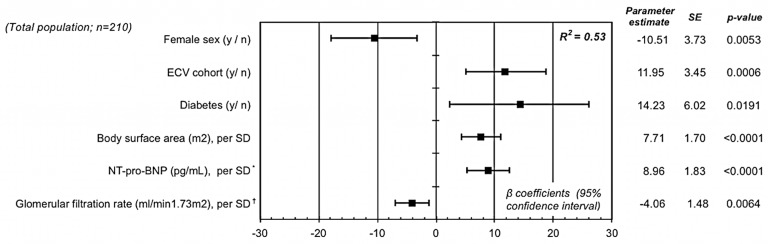
We included 210 patients (70.9% male, mean age 61±11years). Paroxysmal and persistent AF were present in 95 (45%) and 115 (55%) patients, respectively. Overall, 115 (55%) had hypertension, 11 (5%) had diabetes, and 18 (9%) had ischemic heart disease. Mean indexed LA volume was 36±12ml/m2. In multivariable models, significant associations were found for female sex (β coefficient -10.51 (95% confidence interval (CI) -17.85;-3.16), p = 0.0053), undergoing cardioversion (β 11.95 (CI 5.15; 18.74), p = 0.0006), diabetes (β 14.23 (CI 2.36; 26.10), p = 0.019), body surface area (BSA) (β 34.21 (CI 19.30; 49.12), p<0.0001), glomerular filtration rate (β -0.21 (CI -0.36; -0.06), p = 0.0064) and plasma levels of NT-pro brain natriuretic peptide (NT-proBNP) (β 6.79 (CI 4.05; 9.52), p<0.0001), but not age (p = 0.59) or hypertension (p = 0.42). Our final model explained 52% of the LA volume variability.
In patients with AF, the most important correlates with LA volume are sex, BSA, diabetes, renal function and NT-proBNP, but not age or hypertension. These results may help to refine rhythm control strategies in AF patients.
左心房(LA)扩大是发生中风的重要危险因素,也是房颤(AF)患者节律控制策略成功与否的关键决定因素。然而,房颤患者左心房容积相关因素仍知之甚少。
阵发性或持续性房颤患者纳入本研究。所有参与者均接受实时三维超声心动图检查,并以标准化方式进行离线分析。我们使用一系列广泛的临床参数进行逐步向后线性回归分析,以确定三维左心房容积的独立相关因素。
我们纳入了210例患者(男性占70.9%,平均年龄61±11岁)。阵发性房颤和持续性房颤患者分别有95例(45%)和115例(55%)。总体而言,115例(55%)患有高血压,11例(5%)患有糖尿病,18例(9%)患有缺血性心脏病。平均左心房容积指数为36±12ml/m²。在多变量模型中,发现女性(β系数-10.51(95%置信区间(CI)-17.85;-3.16),p = 0.0053)、接受心脏复律(β 11.95(CI 5.15;18.74),p = 0.0006)、糖尿病(β 14.23(CI 2.36;26.10),p = 0.019)、体表面积(BSA)(β 34.21(CI 19.30;49.12),p<0.0001)、肾小球滤过率(β -0.21(CI -0.36;-0.06),p = 0.0064)和血浆N末端脑钠肽前体(NT-proBNP)水平(β 6.79(CI 4.05;9.52),p<0.0001)与左心房容积存在显著关联,但年龄(p = 0.59)或高血压(p = 0.42)无关联。我们的最终模型解释了左心房容积变异性的52%。
在房颤患者中,与左心房容积最重要的相关因素是性别、体表面积、糖尿病、肾功能和NT-proBNP,而非年龄或高血压。这些结果可能有助于优化房颤患者的节律控制策略。