Bhatt Shantanu, Egan Marisa, Jenkins Valerie, Muche Sarah, El-Fenej Jihad
Department of Biology, Saint Joseph's University Philadelphia, PA, USA.
Front Cell Infect Microbiol. 2016 Sep 21;6:105. doi: 10.3389/fcimb.2016.00105. eCollection 2016.
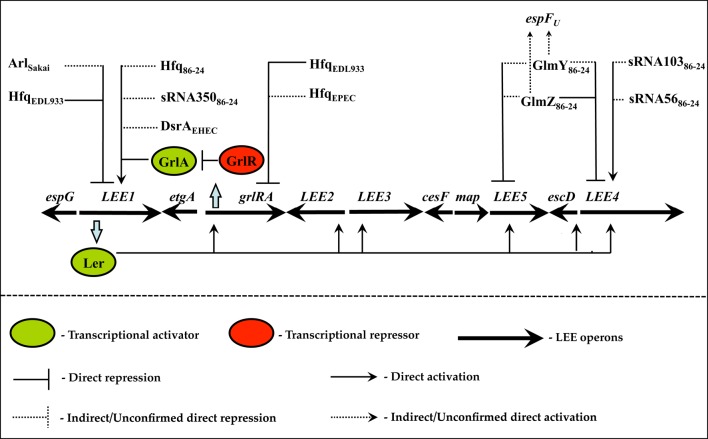
Enterohemorrhagic and enteropathogenic are gastrointestinal pathogens that disrupt the intestinal microvilli to form attaching and effacing (A/E) lesions on infected cells and cause diarrhea. This pathomorphological trait is encoded within the pathogenicity island locus of enterocyte effacement (LEE). The LEE houses a type 3 secretion system (T3SS), which upon assembly bridges the bacterial cytosol to that of the host and enables the bacterium to traffic dozens of effectors into the host where they hijack regulatory and signal transduction pathways and contribute to bacterial colonization and disease. Owing to the importance of the LEE to EHEC and EPEC pathogenesis, much of the research on these pathogens has centered on its regulation. To date, over 40 proteinaceous factors have been identified that control the LEE at various hierarchical levels of gene expression. In contrast, RNA-based regulatory mechanisms that converge on the LEE have only just begun to be unraveled. In this minireview, we highlight major breakthroughs in small RNAs (sRNAs)-dependent regulation of the LEE, with an emphasis on their mechanisms of action and/or LEE-encoded targets.
肠出血性和肠致病性细菌是胃肠道病原体,它们会破坏肠道微绒毛,在受感染细胞上形成紧密黏附并抹平(A/E)损伤,从而导致腹泻。这种病理形态学特征由肠上皮细胞抹平致病岛位点(LEE)编码。LEE包含一个III型分泌系统(T3SS),该系统组装后会在细菌胞质溶胶和宿主胞质溶胶之间形成桥梁,使细菌能够将数十种效应蛋白转运到宿主细胞中,在那里它们劫持调节和信号转导途径,促进细菌定植和致病。由于LEE对肠出血性大肠杆菌(EHEC)和肠致病性大肠杆菌(EPEC)致病机制的重要性,对这些病原体的许多研究都集中在其调控方面。迄今为止,已鉴定出40多种蛋白质因子,它们在基因表达的不同层次上控制LEE。相比之下,作用于LEE的基于RNA的调控机制才刚刚开始被揭示。在这篇小型综述中,我们重点介绍了小RNA(sRNA)依赖性调控LEE的主要突破,重点是它们的作用机制和/或LEE编码的靶标。