Schaadt Lone, Christensen Robin, Kristensen Lars Erik, Henriksen Marius
Department of Physio- and Occupational Therapy; The Parker Institute, Copenhagen University Hospital Bispebjerg-Frederiksberg, Copenhagen, Denmark.
The Parker Institute, Copenhagen University Hospital Bispebjerg-Frederiksberg, Copenhagen, Denmark.
Int J Chron Obstruct Pulmon Dis. 2016 Sep 26;11:2329-2334. doi: 10.2147/COPD.S114911. eCollection 2016.
Intensity of exercise is believed to be a key determinant of response to chronic obstructive pulmonary disease (COPD) rehabilitation. We hypothesized that a higher intensity of exercise, in combination with physiotherapist-led instructions and education in management of breathlessness, would lead to better self-management, possibly delaying calls to the emergency service and preventing hospitalization.
We aimed to test this hypothesis in a subsequent randomized trial, and in order to test study processes and estimate hospitalization rates, we did a small preliminary prospective cohort study on severe COPD patients referred to outpatient rehabilitation.
In 2013, four rehabilitation courses were scheduled (spring, summer, autumn, and winter) each lasting 8 weeks and including eight to ten patients. This preliminary study was designed as a controlled cohort study. The bi-weekly exercise sessions in the spring and autumn courses included a high-intensity walking exercise at 95% of estimated VO max for as long as possible. The other two rehabilitation courses included the usual walking exercise intensity (85% of estimated VO max). Hospitalization rates were assessed from the participants' medical records in an 18-month period.
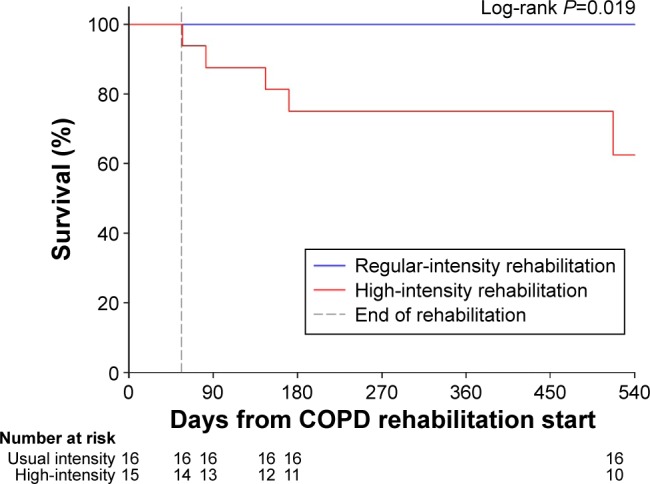
We were able to enroll 31 patients in total (15 in the high-intensity exercise group and 16 in regular intensity). There were no group differences in the hospitalization rates. However, during review of the medical records, we observed a striking mortality rate among participants who had attended the high-intensity rehabilitation courses (five deaths) compared to the standard rehabilitation (zero deaths). Four of the five deaths were COPD exacerbations. Fisher's exact test was statistically significant (=0.046), as was a log-rank test (=0.019) of the Kaplan-Meier estimated survival rates.
These results from this small preliminary cohort study are alarming and raise concerns about the possible serious risks associated with high-intensity exercise rehabilitation of severe COPD patients.
运动强度被认为是慢性阻塞性肺疾病(COPD)康复效果的关键决定因素。我们假设,更高强度的运动,结合物理治疗师指导的呼吸急促管理的指导和教育,将导致更好的自我管理,可能减少紧急服务呼叫并预防住院。
我们旨在随后的一项随机试验中检验这一假设,并且为了测试研究过程和估计住院率,我们对转介到门诊康复的重度COPD患者进行了一项小型前瞻性队列初步研究。
2013年安排了四个康复课程(春季、夏季、秋季和冬季),每个课程持续8周,每个课程有八到十名患者。这项初步研究设计为对照队列研究。春季和秋季课程的双周运动课程包括以估计最大摄氧量(VO max)的95%进行高强度步行运动,持续尽可能长的时间。另外两个康复课程包括常规步行运动强度(估计VO max的85%)。在18个月期间从参与者的病历中评估住院率。
我们总共招募了31名患者(高强度运动组15名,常规强度组16名)。两组的住院率没有差异。然而,在审查病历时,我们观察到参加高强度康复课程的参与者中的死亡率显著高于标准康复组(五例死亡)(零例死亡)。五例死亡中有四例是COPD急性加重。Fisher精确检验具有统计学意义(=0.046),Kaplan-Meier估计生存率的对数秩检验(=0.019)也是如此。
这项小型前瞻性队列研究的这些结果令人担忧,并引发了对重度COPD患者高强度运动康复可能存在的严重风险的关注。