Corallo Claudio, Cutolo Maurizio, Kahaleh Bashar, Pecetti Gianluca, Montella Antonio, Chirico Chiara, Soldano Stefano, Nuti Ranuccio, Giordano Nicola
Scleroderma Unit, Department of Medicine, Surgery and Neurosciences, University of Siena, 53100, Siena, Italy.
Research Laboratory and Academic Division of Clinical Rheumatology, Department of Internal Medicine, Institute for Research and Health Care (IRCCS), University of Genoa, San Martino, Genoa, Italy.
Arthritis Res Ther. 2016 Oct 6;18(1):228. doi: 10.1186/s13075-016-1122-y.
Systemic sclerosis (SSc) is characterized by early vascular abnormalities and subsequent fibroblast activation to myofibroblasts, leading to fibrosis. Recently, endothelial-to-mesenchymal transition (EndoMT), a complex biological process in which endothelial cells lose their specific markers and acquire a mesenchymal or myofibroblastic phenotype, has been reported in SSc. In the present study, we evaluated the ability of endothelin-1 (ET-1) dual receptor antagonists bosentan (BOS) and macitentan (MAC) to antagonize EndoMT in vitro.
Ten women with limited SSc were enrolled. They underwent double skin biopsy (affected and nonaffected skin). Fibroblasts and microvascular endothelial cells (MVECs) were isolated from biopsies. We performed mono- or coculture of MVECs (isolated from nonaffected skin) with fibroblasts (isolated from affected skin and stimulated with ET-1 and transforming growth factor beta [TGF-β]). In cocultures, the MVEC layer was left undisturbed or was preincubated with BOS or MAC. After 48 h of coculture, MVECs were analyzed for their tube formation ability and for messenger RNA and protein expression of different vascular (CD31, vascular endothelial growth factor-A [VEGF-A], VEGF-A165b) and profibrotic (alpha-smooth muscle actin [α-SMA], collagen type I [Col I], TGF-β) molecules.
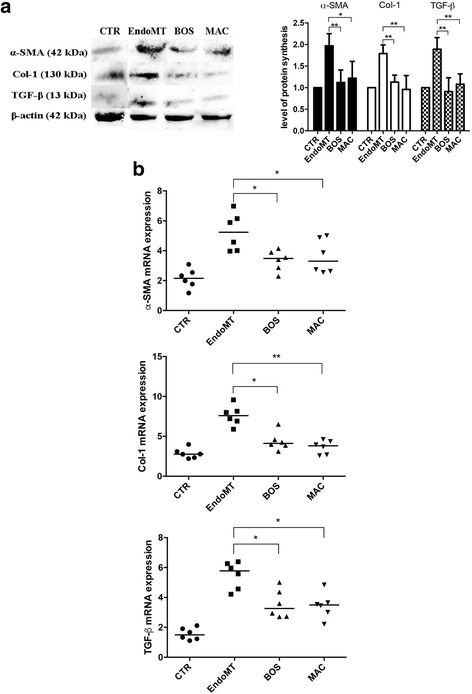
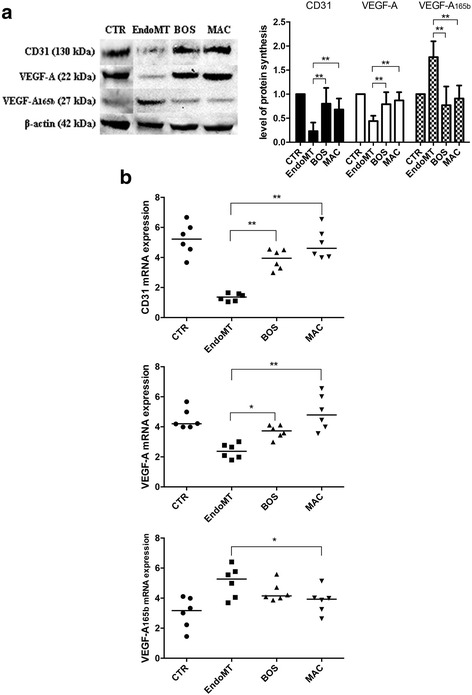
After 48 h, MVECs showed a reduced tube formation ability when cocultured with SSc fibroblasts. CD31 and VEGF-A resulted in downregulation, while VEGF-A165b, the antiangiogenic isoform, resulted in upregulation. At the same time, mesenchymal markers α-SMA, Col I, and TGF-β resulted in overexpression in MVECs. Tube formation ability was restored when MVECs were preincubated with BOS or MAC, also reducing the expression of mesenchymal markers and restoring CD31 expression and the imbalance between VEGF-A and VEGF-A165b.
With this innovative EndoMT in vitro model realized by coculturing nonaffected MVECs with affected SSc fibroblasts, we show that the presence of a myofibroblast phenotype in the fibroblast layer, coupled with an ET-1-TGF-β synergic effect, is responsible for EndoMT. BOS and MAC seem able to antagonize this phenomenon in vitro, confirming previous evidence of endothelium-derived fibrosis in SSc and possible pharmacological interference.
系统性硬化症(SSc)的特征是早期血管异常,随后成纤维细胞激活转变为肌成纤维细胞,导致纤维化。最近,内皮-间充质转化(EndoMT),即内皮细胞失去其特异性标志物并获得间充质或肌成纤维细胞表型的复杂生物学过程,已在SSc中被报道。在本研究中,我们评估了内皮素-1(ET-1)双重受体拮抗剂波生坦(BOS)和马昔腾坦(MAC)在体外拮抗EndoMT的能力。
招募了10名局限性SSc女性患者。她们接受了双皮肤活检(受累皮肤和未受累皮肤)。从活检组织中分离出成纤维细胞和微血管内皮细胞(MVECs)。我们将MVECs(从未受累皮肤分离)与成纤维细胞(从受累皮肤分离并用ET-1和转化生长因子β [TGF-β]刺激)进行单培养或共培养。在共培养中,MVEC层保持原状或预先用BOS或MAC孵育。共培养48小时后,分析MVECs的管形成能力以及不同血管(CD31、血管内皮生长因子-A [VEGF-A]、VEGF-A165b)和促纤维化(α-平滑肌肌动蛋白 [α-SMA]、I型胶原 [Col I]、TGF-β)分子的信使RNA和蛋白质表达。
48小时后,与SSc成纤维细胞共培养时,MVECs的管形成能力降低。CD31和VEGF-A下调,而抗血管生成异构体VEGF-A165b上调。同时,间充质标志物α-SMA、Col I和TGF-β在MVECs中过表达。当MVECs预先用BOS或MAC孵育时,管形成能力恢复,同时也降低了间充质标志物的表达,并恢复了CD31表达以及VEGF-A和VEGF-A165b之间的失衡。
通过将未受累的MVECs与受累的SSc成纤维细胞共培养建立的这种创新的体外EndoMT模型,我们表明成纤维细胞层中肌成纤维细胞表型的存在,加上ET-1-TGF-β协同效应,是EndoMT的原因。BOS和MAC似乎能够在体外拮抗这种现象,证实了先前关于SSc中内皮源性纤维化的证据以及可能的药物干预。