Dr. A. De Pieri, Prof. K. Wuertz-Kozak, Department of Biomedical Engineering, Rochester Institute of Technology (RIT), 106 Lomb Memorial Rd., Rochester, NY, 14623, USA.
Prof. B. D. Korman, Department of Medicine, Division of Allergy, Immunology and Rheumatology, University of Rochester Medical Center, Rochester, NY, 14623, USA.
Adv Biol (Weinh). 2021 Apr;5(4):e2000168. doi: 10.1002/adbi.202000168. Epub 2021 Feb 15.
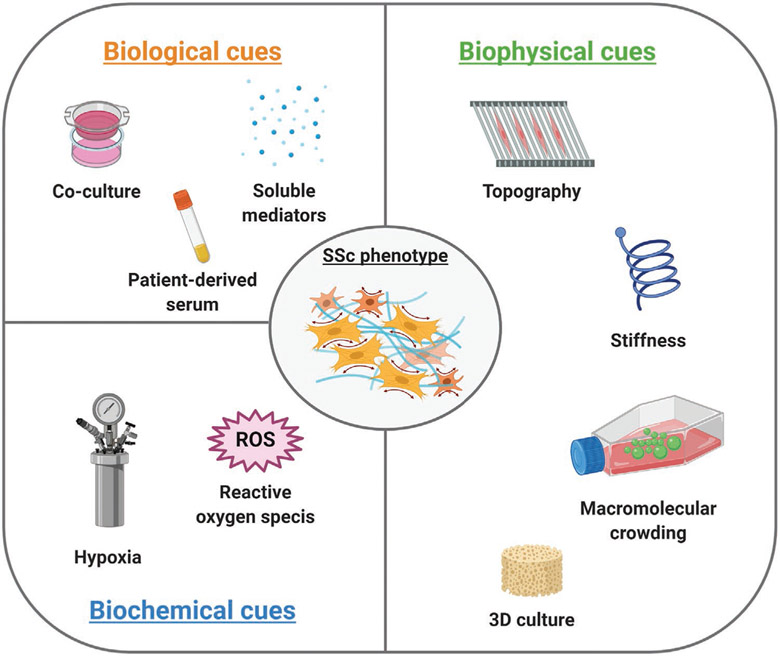
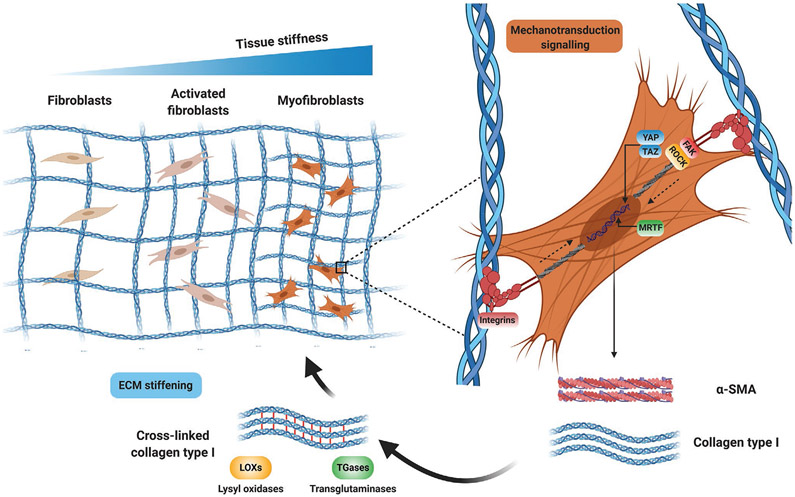
Systemic sclerosis (SSc) is a complex multisystem disease with the highest case-specific mortality among all autoimmune rheumatic diseases, yet without any available curative therapy. Therefore, the development of novel therapeutic antifibrotic strategies that effectively decrease skin and organ fibrosis is needed. Existing animal models are cost-intensive, laborious and do not recapitulate the full spectrum of the disease and thus commonly fail to predict human efficacy. Advanced in vitro models, which closely mimic critical aspects of the pathology, have emerged as valuable platforms to investigate novel pharmaceutical therapies for the treatment of SSc. This review focuses on recent advancements in the development of SSc in vitro models, sheds light onto biological (e.g., growth factors, cytokines, coculture systems), biochemical (e.g., hypoxia, reactive oxygen species) and biophysical (e.g., stiffness, topography, dimensionality) cues that have been utilized for the in vitro recapitulation of the SSc microenvironment, and highlights future perspectives for effective drug discovery and validation.
系统性硬化症(SSc)是一种复杂的多系统疾病,在所有自身免疫性风湿病中病死率最高,但目前尚无有效的治愈性治疗方法。因此,需要开发新型的抗纤维化治疗策略,以有效减少皮肤和器官纤维化。现有的动物模型成本高、费力,不能重现疾病的全貌,因此通常无法预测人类的疗效。高度模拟病理学关键方面的先进体外模型已成为研究治疗 SSc 的新型药物治疗方法的有价值的平台。本文综述了 SSc 体外模型的最新进展,重点介绍了用于 SSc 微环境体外再现的生物(例如生长因子、细胞因子、共培养系统)、生化(例如缺氧、活性氧)和生物物理(例如硬度、形貌、维度)线索,并强调了有效药物发现和验证的未来展望。