Xiong Lei, Tang Yi, Liu Zhaoyang, Dai Jing, Wang Xiaozhou
Department of Oral Medicine, The Second Clinical Medical College, Yangtze University, Jingzhou Central Hospital, Jingzhou, People's Republic of China.
Department of Clinical Medicine, Hubei College of Chinese Medicine, Academy Road 87, Jingzhou, 434020 People's Republic of China.
Springerplus. 2016 Sep 21;5(1):1626. doi: 10.1186/s40064-016-3310-2. eCollection 2016.
To understand the role of Bcl-2 overexpression in oral tongue squamous cell carcinoma (OTSCC) patients and investigate the efficacy of targeting Bcl-2 in OTSCC.
The expression level of Bcl-2 on normal tongue cells and OTSCC cells were measured by real-time PCR and western blotting. The functional roles of Bcl-2 were examined by MTS, flow cytometry and xenograft cancer mouse model. Mechanism studies were performed by analyzing mitochondrial functions in a panel of OTSCC cell lines.
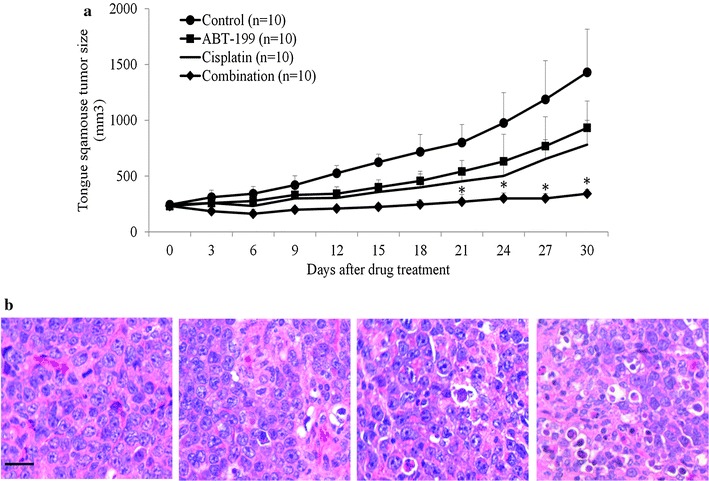
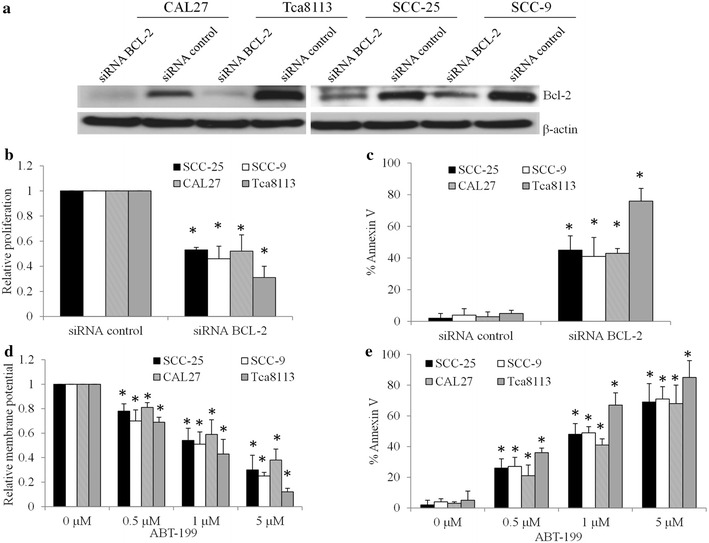
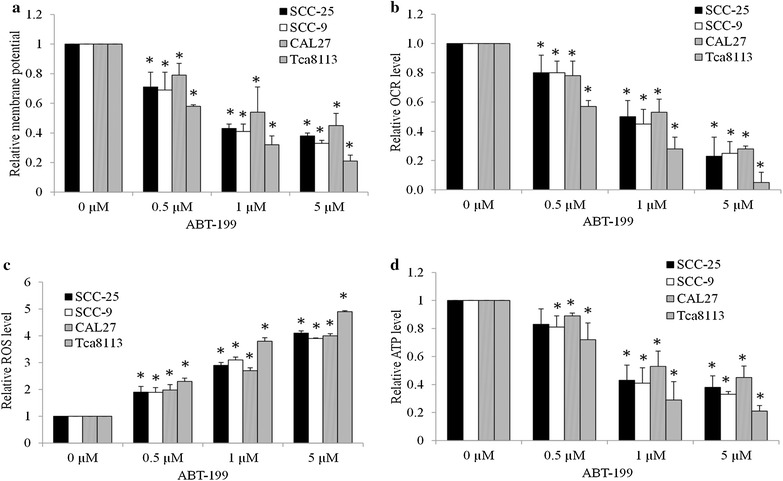
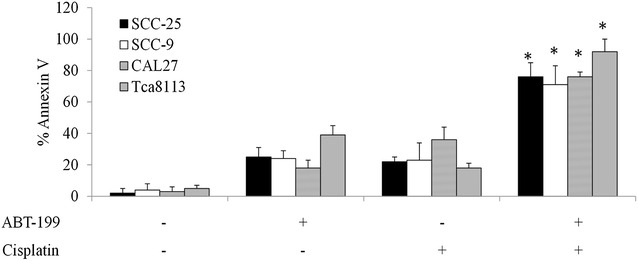
Bcl-2 is up-regulated at mRNA and protein levels in a panel of OTSCC cell lines compared to normal tongue epithelial cells (NTEC). Importantly, overexpression of Bcl-2 confers resistance of OTSCC cells to chemotherapeutic drug cisplatin treatment. Overexpression of Bcl-2 in NTEC significantly increased cell growth. In contrast, inhibition of Bcl-2 by genetic and pharmacological approaches inhibits proliferation and induces apoptosis in OTSCC cells. Mechanistically, Bcl-2 inhibitor ABT-199 impairs mitochondrial functions as shown by the decreased levels of mitochondrial membrane potential, mitochondrial respiration and ATP, and the increased levels of ROS in OTSCC cells. In addition, ABT-199 inhibits proliferation and induces apoptosis and mitochondrial dysfunctions in NTEC cells, but to a less extent than in OTSCC cells. We further show that ABT-199 augments the effects of cisplatin in eliminating OTSCC cells in in vitro tongue cancer cellular system and in vivo tongue cancer xenograft mouse model.
Inhibition of Bcl-2 effectively targets OTSCC cells through inhibiting proliferation and inducing apoptosis. Inhibition of Bcl-2 also augments the inhibitory effects of cisplatin in vitro and in vivo.
了解Bcl-2过表达在口腔舌鳞状细胞癌(OTSCC)患者中的作用,并研究靶向Bcl-2在OTSCC中的疗效。
通过实时PCR和蛋白质印迹法检测正常舌细胞和OTSCC细胞中Bcl-2的表达水平。通过MTS、流式细胞术和异种移植癌小鼠模型研究Bcl-2的功能作用。通过分析一组OTSCC细胞系中的线粒体功能进行机制研究。
与正常舌上皮细胞(NTEC)相比,一组OTSCC细胞系中Bcl-2在mRNA和蛋白质水平上上调。重要的是,Bcl-2的过表达赋予OTSCC细胞对化疗药物顺铂治疗的抗性。NTEC中Bcl-2的过表达显著增加细胞生长。相反,通过基因和药理学方法抑制Bcl-2可抑制OTSCC细胞的增殖并诱导其凋亡。机制上,Bcl-2抑制剂ABT-199损害线粒体功能,OTSCC细胞中线粒体膜电位、线粒体呼吸和ATP水平降低,ROS水平升高。此外,ABT-199抑制NTEC细胞的增殖并诱导其凋亡和线粒体功能障碍,但程度低于OTSCC细胞。我们进一步表明,在体外舌癌细胞系统和体内舌癌异种移植小鼠模型中,ABT-199增强了顺铂消除OTSCC细胞的作用。
抑制Bcl-2通过抑制增殖和诱导凋亡有效地靶向OTSCC细胞。抑制Bcl-2还增强了顺铂在体外和体内的抑制作用。