Yakushiji Hiromasa, Kaji Arito, Suzuki Keitarou, Yamada Motohiro, Horiuchi Takahiko, Sinozaki Masahiro
Emergency and Critical Care Center, Kishiwada Tokushukai Hospital, Japan.
Intern Med. 2016;55(19):2885-2887. doi: 10.2169/internalmedicine.55.6951. Epub 2016 Oct 1.
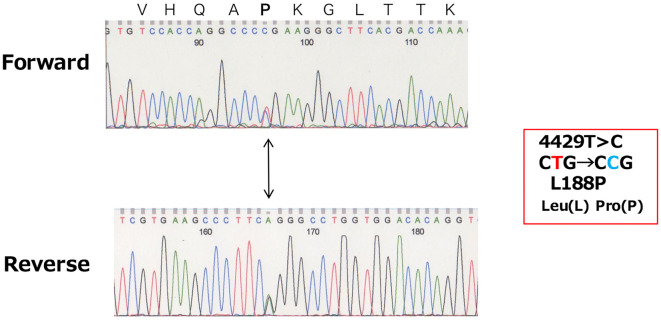
We describe a patient with hereditary angioedema type I. The patient had experienced recurrent abdominal pain around the time of her menstrual period for 13 years. A laboratory examination showed reduced functional and antigenic levels of C4 and C1 inhibitor (C1-INH). To establish a diagnosis, we carried out a DNA analysis of the patient's C1-INH gene. We determined that the patient was heterozygous for a single base pair transposition of T to C at nucleotide 4429 in exon 4, which had not been reported in the literature. As the patient had no family history of hereditary diseases, it was considered to be a de novo mutation.
我们描述了一名患有I型遗传性血管性水肿的患者。该患者在月经期间反复出现腹痛达13年。实验室检查显示C4和C1抑制物(C1-INH)的功能水平和抗原水平降低。为了确诊,我们对患者的C1-INH基因进行了DNA分析。我们确定该患者在第4外显子核苷酸4429处发生了单个碱基对由T到C的转位,呈杂合状态,这在文献中尚未见报道。由于该患者没有遗传性疾病家族史,因此被认为是一种新发突变。