Forgaard Christopher J, Franks Ian M, Maslovat Dana, Chua Romeo
School of Kinesiology, University of British Columbia, Vancouver, Canada.
PLoS One. 2016 Oct 11;11(10):e0163854. doi: 10.1371/journal.pone.0163854. eCollection 2016.
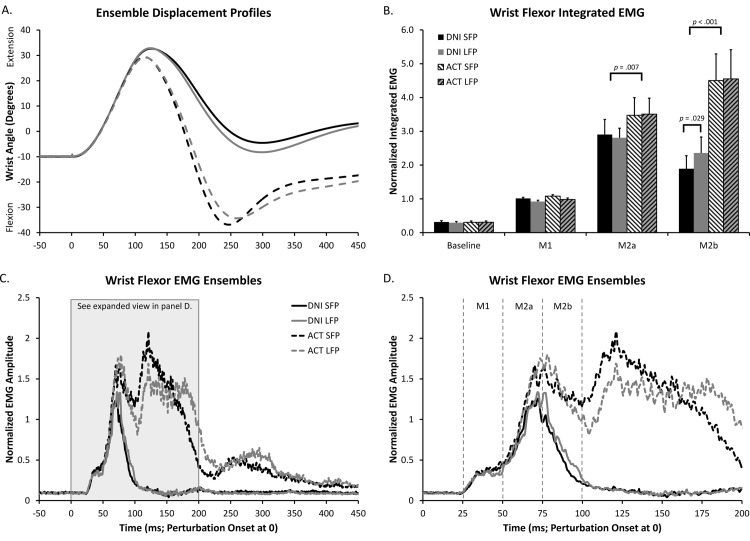
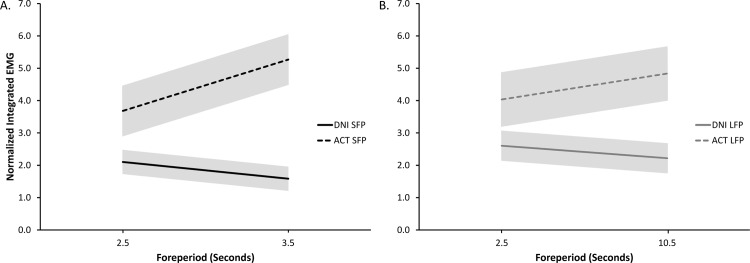
Perturbations applied to the upper limbs elicit short (M1: 25-50 ms) and long-latency (M2: 50-100 ms) responses in the stretched muscle. M1 is produced by a spinal reflex loop, and M2 receives contribution from multiple spinal and supra-spinal pathways. While M1 is relatively immutable to voluntary intention, the remarkable feature of M2 is that its size can change based on intention or goal of the participant (e.g., increasing when resisting the perturbation and decreasing when asked to let-go or relax following the perturbation). While many studies have examined modulation of M2 between passive and various active conditions, through the use of constant foreperiods (interval between warning signal and a perturbation), it has also been shown that the magnitude of the M2 response in a passive condition can change based on factors such as habituation and anticipation of perturbation delivery. To prevent anticipation of a perturbation, most studies have used variable foreperiods; however, the range of possible foreperiod duration differs between experiments. The present study examined the influence of different variable foreperiods on modulation of the M2 response. Fifteen participants performed active and passive responses to a perturbation that stretched wrist flexors. Each block of trials had either a short (2.5-3.5 seconds; high predictability) or long (2.5-10.5 seconds; low predictability) variable foreperiod. As expected, no differences were found between any conditions for M1, while M2 was larger in the active rather than passive conditions. Interestingly, within the two passive conditions, the long variable foreperiods resulted in greater activity at the end of the M2 response than the trials with short foreperiods. These results suggest that perturbation predictability, even when using a variable foreperiod, can influence circuitry contributing to the long-latency stretch response.
施加于上肢的扰动会在被拉伸的肌肉中引发短潜伏期(M1:25 - 50毫秒)和长潜伏期(M2:50 - 100毫秒)反应。M1由脊髓反射回路产生,而M2则接收来自多个脊髓和脊髓上通路的信号。虽然M1相对不受自主意图的影响,但M2的显著特征是其大小会根据参与者的意图或目标而变化(例如,在抵抗扰动时增大,在被要求在扰动后放手或放松时减小)。虽然许多研究通过使用恒定的前刺激间期(警告信号与扰动之间的间隔)来研究M2在被动和各种主动条件下的调制,但也有研究表明,被动条件下M2反应的幅度会因习惯化和对扰动传递的预期等因素而改变。为了防止对扰动的预期,大多数研究使用了可变的前刺激间期;然而,不同实验中前刺激间期的可能持续时间范围有所不同。本研究考察了不同可变前刺激间期对M2反应调制的影响。15名参与者对手腕屈肌拉伸扰动进行主动和被动反应。每个试验块都有一个短(2.5 - 3.5秒;高可预测性)或长(2.5 - 10.5秒;低可预测性)的可变前刺激间期。正如预期的那样,M1在任何条件下均未发现差异,而M2在主动条件下比被动条件下更大。有趣的是,在两种被动条件下,长可变前刺激间期的试验在M2反应末期比短前刺激间期的试验产生了更大的活动。这些结果表明,即使使用可变前刺激间期,扰动的可预测性也会影响对长潜伏期拉伸反应有贡献的神经回路。