Cui Yongxia, Song Beng Kah, Li Lin-Feng, Li Ya-Ling, Huang Zhongyun, Caicedo Ana L, Jia Yulin, Olsen Kenneth M
College of Science, Sichuan Agricultural University, Ya'an 625014, China.
Department of Biology, Washington University in St Louis, Missouri 63130.
G3 (Bethesda). 2016 Dec 7;6(12):4105-4114. doi: 10.1534/g3.116.035881.
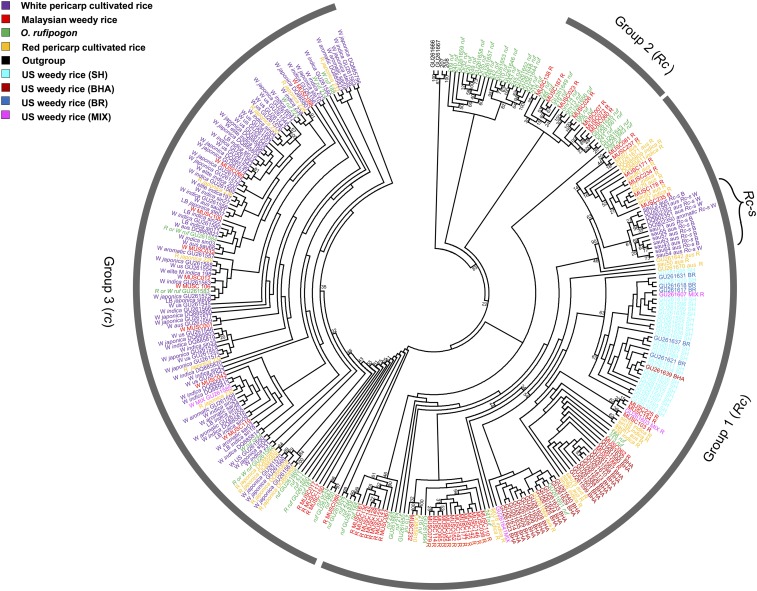
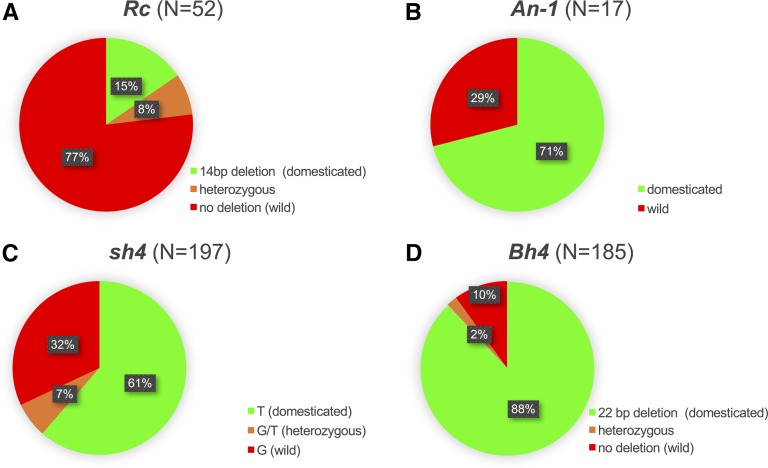
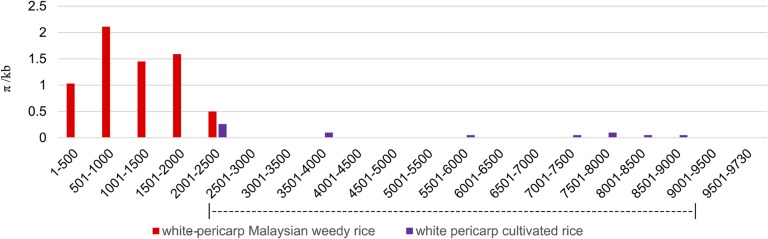
Weedy rice is a conspecific form of cultivated rice (Oryza sativa L.) that infests rice fields and results in severe crop losses. Weed strains in different world regions appear to have originated multiple times from different domesticated and/or wild rice progenitors. In the case of Malaysian weedy rice, a multiple-origin model has been proposed based on neutral markers and analyses of domestication genes for hull color and seed shattering. Here, we examined variation in pericarp (bran) color and its molecular basis to address how this trait evolved in Malaysian weeds and its possible role in weed adaptation. Functional alleles of the Rc gene confer proanthocyanidin pigmentation of the pericarp, a trait found in most wild and weedy Oryzas and associated with seed dormancy; nonfunctional rc alleles were strongly favored during rice domestication, and most cultivated varieties have nonpigmented pericarps. Phenotypic characterizations of 52 Malaysian weeds revealed that most strains are characterized by the pigmented pericarp; however, some weeds have white pericarps, suggesting close relationships to cultivated rice. Phylogenetic analyses indicate that the Rc haplotypes present in Malaysian weeds likely have at least three distinct origins: wild O. rufipogon, white-pericarp cultivated rice, and red-pericarp cultivated rice. These diverse origins contribute to high Rc nucleotide diversity in the Malaysian weeds. Comparison of Rc allelic distributions with other rice domestication genes suggests that functional Rc alleles may confer particular fitness benefits in weedy rice populations, for example, by conferring seed dormancy. This may promote functional Rc introgression from local wild Oryza populations.
杂草稻是栽培稻(Oryza sativa L.)的同种类型,它侵扰稻田并导致严重的作物损失。世界不同地区的杂草品系似乎多次起源于不同的驯化和/或野生稻祖先。就马来西亚杂草稻而言,基于中性标记以及对颖壳颜色和种子散落性等驯化基因的分析,提出了多起源模型。在此,我们研究了果皮(谷壳)颜色的变异及其分子基础,以探讨该性状在马来西亚杂草稻中是如何进化的以及它在杂草适应性中可能发挥的作用。Rc基因的功能等位基因赋予果皮原花青素色素沉着,这一性状在大多数野生和杂草型稻属植物中都有发现,并且与种子休眠相关;在水稻驯化过程中,无功能的rc等位基因受到强烈青睐,大多数栽培品种的果皮无色素沉着。对52个马来西亚杂草稻的表型特征分析表明,大多数品系的特征是果皮有色素沉着;然而,一些杂草稻的果皮是白色的,这表明它们与栽培稻关系密切。系统发育分析表明,马来西亚杂草稻中存在的Rc单倍型可能至少有三个不同的起源:野生的普通野生稻、白果皮栽培稻和红果皮栽培稻。这些不同的起源导致了马来西亚杂草稻中Rc核苷酸的高度多样性。将Rc等位基因分布与其他水稻驯化基因进行比较表明,功能性Rc等位基因可能赋予杂草稻群体特定的适应性优势,例如通过赋予种子休眠特性。这可能促进功能性Rc从当地野生稻群体渗入。