Wang Wenjia, Zhao Minghui, Zhang Guangchen, Liu Zimeng, Hua Yuchen, Jia Xingtian, Song Jiayu, Ma Dianrong, Sun Jian
Rice Research Institute, Shenyang Agricultural University, Shenyang, China.
Front Plant Sci. 2020 Jun 11;11:878. doi: 10.3389/fpls.2020.00878. eCollection 2020.
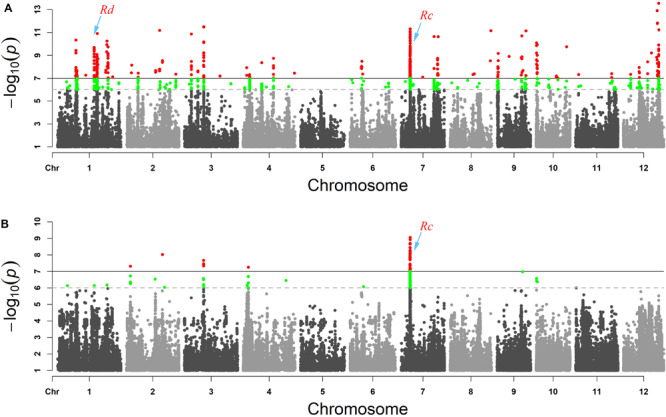
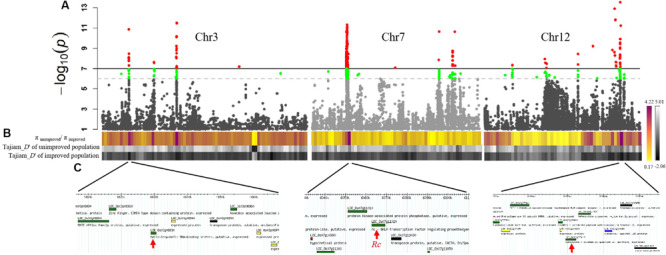
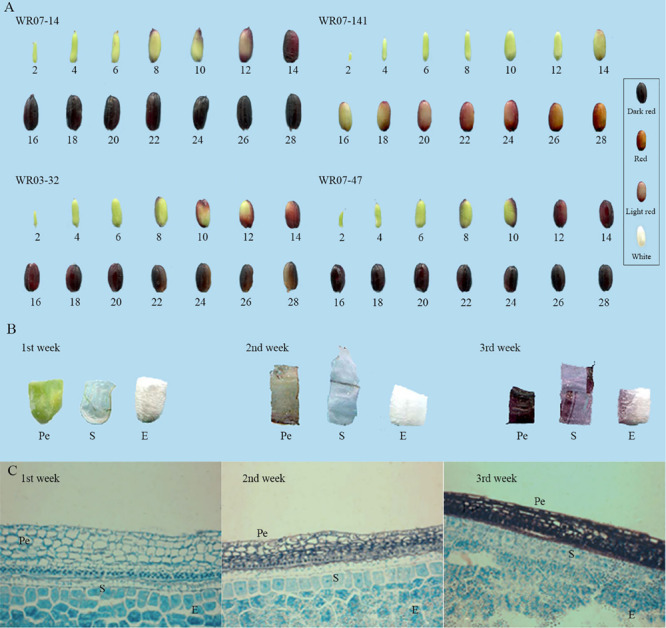
The pericarp color of rice grains is an important agronomic trait affected by domestication, and the color pigment, anthocyanin, is one of the key determinants of rice nutritional quality. Weedy rice, also called red rice because its pericarp is often red, may be a novel gene resource for the development of new rice. However, the genetic basis and nutritional quality of anthocyanin are poorly known. In this study, we used a genome-wide association study (GWAS) to find novel and specific QTLs of red pericarp in weedy rice. The known key gene site of red pericarp was detected as the common genetic basis of both weedy and cultivated rice, and another 13 associated signals of pericarp color that were identified may contribute specifically to weedy rice pericarp color. We then nominated three pericarp color genes that may contribute to weedy rice divergence from cultivated rice based on selection sweep analysis. After clarifying the distribution and growth dynamics of pigment in weedy rice caryopsis, we compared its nutritional quality with cultivated rice. We found that sampled weedy rice pericarps had much greater quantities of anthocyanin, beneficial trace elements, free amino acids, and unsaturated fatty acids than the cultivated rice. In conclusion, the gene resources and novel genetic systems of rice anthocyanin biosynthesis explored in this study are of great value for the development of nutritious, high anthocyanin content rice.
水稻籽粒的果皮颜色是受驯化影响的重要农艺性状,而色素花青素是水稻营养品质的关键决定因素之一。杂草稻,因其果皮常呈红色也被称为红米,可能是培育新型水稻的新基因资源。然而,花青素的遗传基础和营养品质却鲜为人知。在本研究中,我们利用全基因组关联研究(GWAS)来寻找杂草稻中红色果皮的新的特异性数量性状位点(QTL)。已检测到的已知红色果皮关键基因位点是杂草稻和栽培稻的共同遗传基础,另外鉴定出的13个果皮颜色相关信号可能特异性地影响杂草稻的果皮颜色。然后,基于选择清除分析,我们确定了三个可能导致杂草稻与栽培稻分化的果皮颜色基因。在明确了色素在杂草稻颖果中的分布和生长动态后,我们将其营养品质与栽培稻进行了比较。我们发现,所采样的杂草稻果皮中的花青素、有益微量元素、游离氨基酸和不饱和脂肪酸含量均远高于栽培稻。总之,本研究探索的水稻花青素生物合成的基因资源和新遗传系统对于培育营养丰富、花青素含量高的水稻具有重要价值。