Hulbert Alicia, Jusue-Torres Ignacio, Stark Alejandro, Chen Chen, Rodgers Kristen, Lee Beverly, Griffin Candace, Yang Andrew, Huang Peng, Wrangle John, Belinsky Steven A, Wang Tza-Huei, Yang Stephen C, Baylin Stephen B, Brock Malcolm V, Herman James G
Sidney Kimmel Cancer Center, Department of Oncology, The Johns Hopkins University School of Medicine, Baltimore, Maryland.
Department of Surgery, The Johns Hopkins University School of Medicine, Baltimore, Maryland.
Clin Cancer Res. 2017 Apr 15;23(8):1998-2005. doi: 10.1158/1078-0432.CCR-16-1371. Epub 2016 Oct 11.
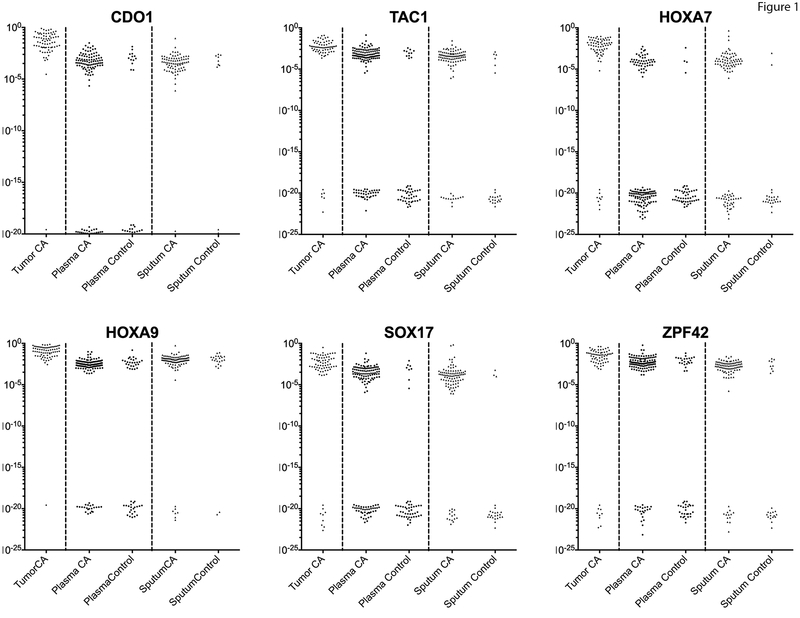
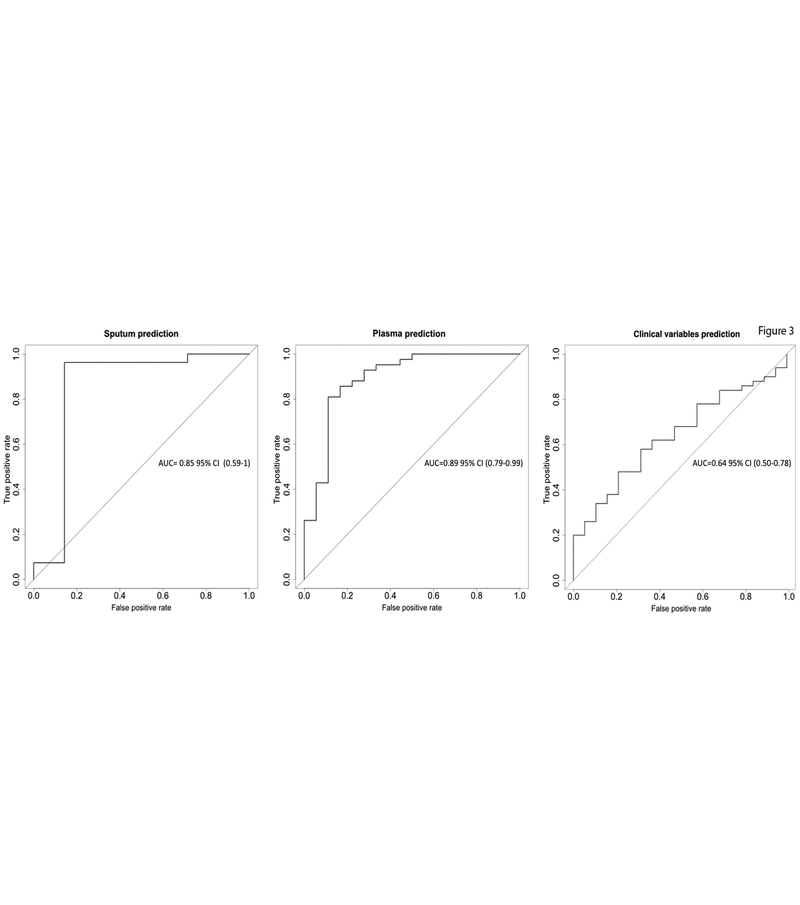
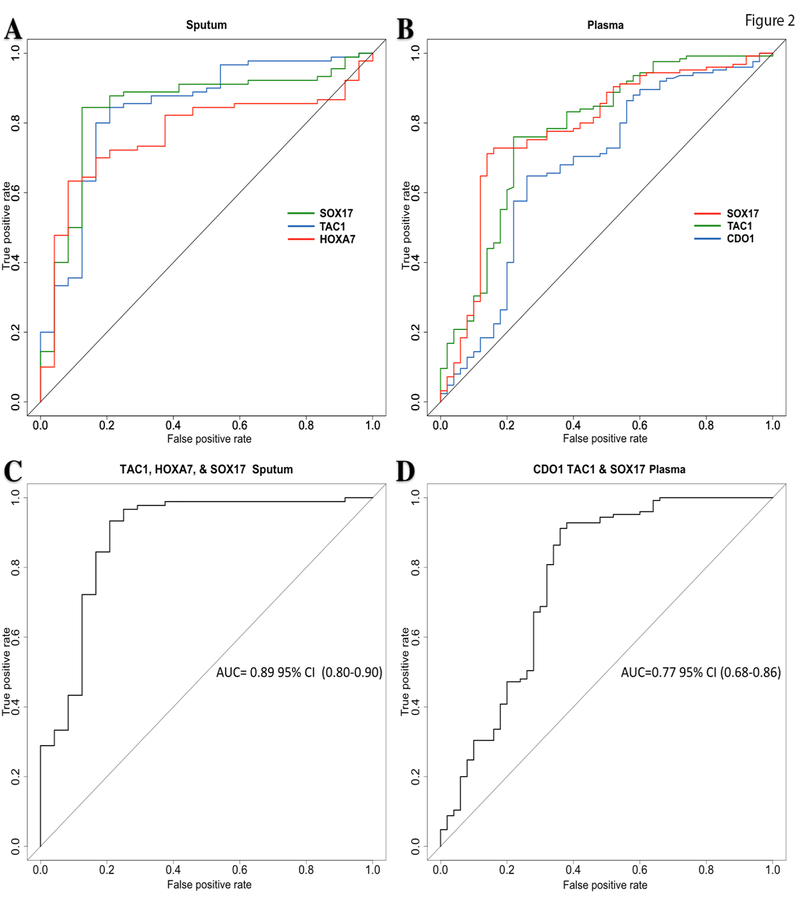
CT screening can reduce death from lung cancer. We sought to improve the diagnostic accuracy of lung cancer screening using ultrasensitive methods and a lung cancer-specific gene panel to detect DNA methylation in sputum and plasma. This is a case-control study of subjects with suspicious nodules on CT imaging. Plasma and sputum were obtained preoperatively. Cases ( = 150) had pathologic confirmation of node-negative (stages I and IIA) non-small cell lung cancer. Controls ( = 60) had non-cancer diagnoses. We detected promoter methylation using quantitative methylation-specific real-time PCR and methylation-on-beads for cancer-specific genes (, and ). DNA methylation was detected in plasma and sputum more frequently in people with cancer compared with controls ( < 0.001) for five of six genes. The sensitivity and specificity for lung cancer diagnosis using the best individual genes was 63% to 86% and 75% to 92% in sputum, respectively, and 65% to 76% and 74% to 84% in plasma, respectively. A three-gene combination of the best individual genes has sensitivity and specificity of 98% and 71% using sputum and 93% and 62% using plasma. Area under the receiver operating curve for this panel was 0.89 [95% confidence interval (CI), 0.80-0.98] in sputum and 0.77 (95% CI, 0.68-0.86) in plasma. Independent blinded random forest prediction models combining gene methylation with clinical information correctly predicted lung cancer in 91% of subjects using sputum detection and 85% of subjects using plasma detection. High diagnostic accuracy for early-stage lung cancer can be obtained using methylated promoter detection in sputum or plasma. .
CT筛查可降低肺癌死亡率。我们试图通过超灵敏方法和肺癌特异性基因检测组合来检测痰液和血浆中的DNA甲基化,以提高肺癌筛查的诊断准确性。这是一项针对CT影像上有可疑结节的受试者的病例对照研究。术前采集血浆和痰液。病例组(n = 150)经病理证实为淋巴结阴性(I期和IIA期)非小细胞肺癌。对照组(n = 60)为非癌症诊断。我们使用定量甲基化特异性实时PCR和针对癌症特异性基因(、和)的磁珠甲基化检测法来检测启动子甲基化。与对照组相比,癌症患者的血浆和痰液中DNA甲基化的检测频率更高(P < 0.001),六个基因中的五个均如此。使用最佳单个基因进行肺癌诊断时,痰液中的敏感性和特异性分别为63%至86%和75%至92%,血浆中的敏感性和特异性分别为65%至76%和74%至84%。最佳单个基因的三基因组合在痰液中的敏感性和特异性分别为98%和71%,在血浆中的敏感性和特异性分别为93%和62%。该检测组合在痰液中的受试者操作特征曲线下面积为0.89 [95%置信区间(CI),0.80 - 0.98],在血浆中的受试者操作特征曲线下面积为0.77(95% CI,0.68 - 0.86)。将基因甲基化与临床信息相结合的独立双盲随机森林预测模型,使用痰液检测可正确预测91%的受试者患有肺癌,使用血浆检测可正确预测85%的受试者患有肺癌。通过检测痰液或血浆中的甲基化启动子可获得较高的早期肺癌诊断准确性。