
消除细胞培养代谢组学的瓶颈:快速标准化程序、代谢物与细胞数量的相关性以及细胞收获方法的影响。
Removing the bottlenecks of cell culture metabolomics: fast normalization procedure, correlation of metabolites to cell number, and impact of the cell harvesting method.
作者信息
Muschet Caroline, Möller Gabriele, Prehn Cornelia, de Angelis Martin Hrabě, Adamski Jerzy, Tokarz Janina
机构信息
Helmholtz Zentrum München, German Research Center for Environmental Health, Institute of Experimental Genetics, Genome Analysis Center, Ingolstaedter Landstrasse 1, 85764 Neuherberg, Germany.
Helmholtz Zentrum München, German Research Center for Environmental Health, Institute of Experimental Genetics, Genome Analysis Center, Ingolstaedter Landstrasse 1, 85764 Neuherberg, Germany ; Lehrstuhl für Experimentelle Genetik, Technische Universität München, 85350 Freising-Weihenstephan, Germany ; German Center for Diabetes Research (DZD), 85764 Neuherberg, Germany.
出版信息
Metabolomics. 2016;12(10):151. doi: 10.1007/s11306-016-1104-8. Epub 2016 Sep 15.
INTRODUCTION
Although cultured cells are nowadays regularly analyzed by metabolomics technologies, some issues in study setup and data processing are still not resolved to complete satisfaction: a suitable harvesting method for adherent cells, a fast and robust method for data normalization, and the proof that metabolite levels can be normalized to cell number.
OBJECTIVES
We intended to develop a fast method for normalization of cell culture metabolomics samples, to analyze how metabolite levels correlate with cell numbers, and to elucidate the impact of the kind of harvesting on measured metabolite profiles.
METHODS
We cultured four different human cell lines and used them to develop a fluorescence-based method for DNA quantification. Further, we assessed the correlation between metabolite levels and cell numbers and focused on the impact of the harvesting method (scraping or trypsinization) on the metabolite profile.
RESULTS
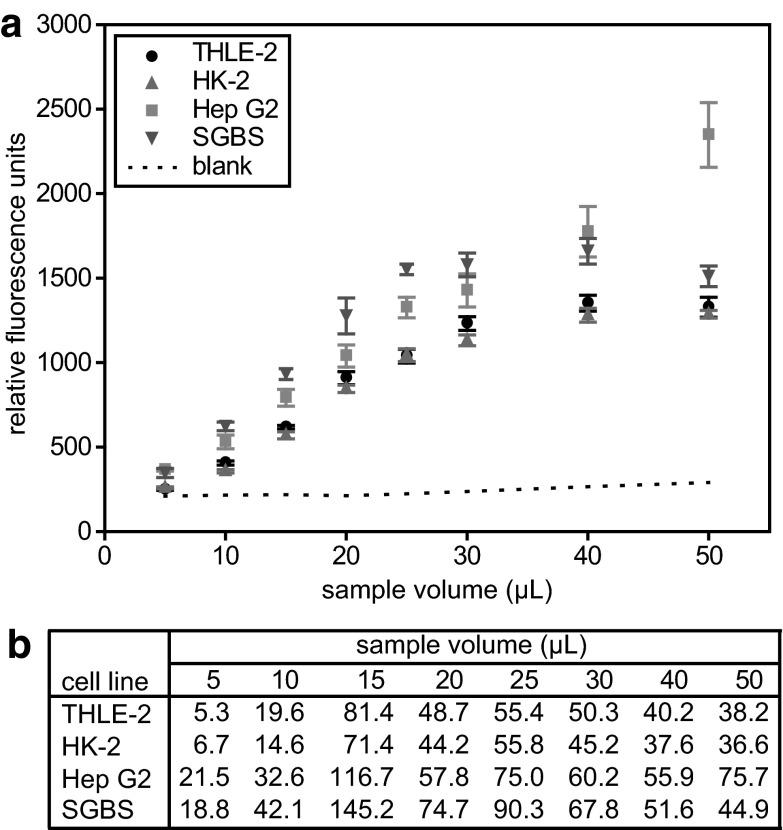
We developed a fast, sensitive and robust fluorescence-based method for DNA quantification showing excellent linear correlation between fluorescence intensities and cell numbers for all cell lines. Furthermore, 82-97 % of the measured intracellular metabolites displayed linear correlation between metabolite concentrations and cell numbers. We observed differences in amino acids, biogenic amines, and lipid levels between trypsinized and scraped cells.
CONCLUSION
We offer a fast, robust, and validated normalization method for cell culture metabolomics samples and demonstrate the eligibility of the normalization of metabolomics data to the cell number. We show a cell line and metabolite-specific impact of the harvesting method on metabolite concentrations.
引言
尽管如今代谢组学技术经常用于分析培养细胞,但研究设置和数据处理中的一些问题仍未得到完全解决,令人满意:适合贴壁细胞的收获方法、快速且可靠的数据归一化方法,以及代谢物水平可按细胞数量进行归一化的证据。
目的
我们旨在开发一种快速的细胞培养代谢组学样本归一化方法,分析代谢物水平与细胞数量之间的相关性,并阐明收获方式对测量的代谢物谱的影响。
方法
我们培养了四种不同的人类细胞系,并使用它们开发了一种基于荧光的DNA定量方法。此外,我们评估了代谢物水平与细胞数量之间的相关性,并重点关注收获方法(刮取或胰蛋白酶消化)对代谢物谱的影响。
结果
我们开发了一种快速、灵敏且可靠的基于荧光的DNA定量方法,所有细胞系的荧光强度与细胞数量之间均呈现出良好的线性相关性。此外,82% - 97% 的细胞内代谢物浓度与细胞数量之间呈现线性相关。我们观察到经胰蛋白酶消化的细胞和刮取的细胞在氨基酸、生物胺和脂质水平上存在差异。
结论
我们为细胞培养代谢组学样本提供了一种快速、可靠且经过验证的归一化方法,并证明了代谢组学数据按细胞数量进行归一化的可行性。我们展示了收获方法对代谢物浓度的细胞系和代谢物特异性影响。


 Zotero 插件