Kim Songmi, Cho Chun-Sung, Han Kyudong, Lee Jungnam
Department of Nanobiomedical Science, Dankook University, Cheonan 31116, Korea.; BK21 PLUS NBM Global Research Center for Regenerative Medicine, Dankook University, Cheonan 31116, Korea.
Department of Neurosurgery, Dankook University College of Medicine, Cheonan 31116, Korea.
Genomics Inform. 2016 Sep;14(3):70-77. doi: 10.5808/GI.2016.14.3.70. Epub 2016 Sep 30.
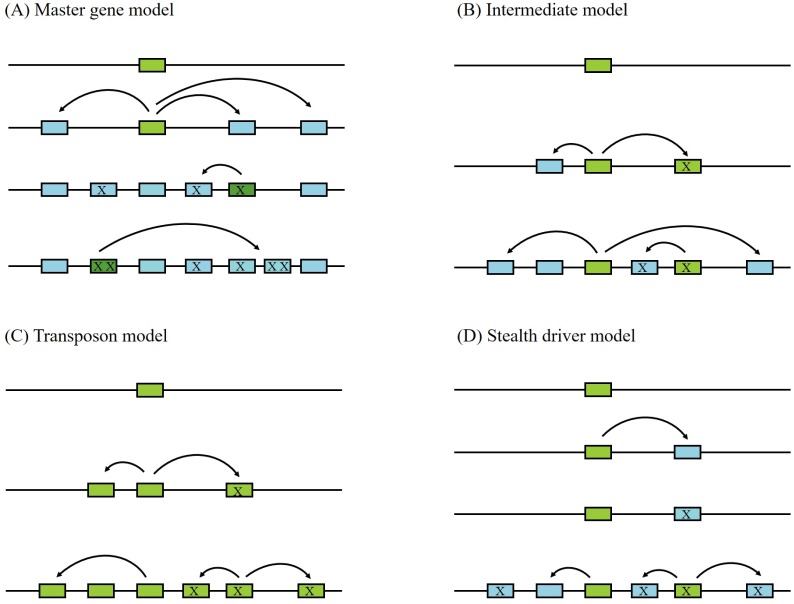
Transposable elements are one of major sources to cause genomic instability through various mechanisms including insertion, insertion-mediated genomic deletion, and recombination-associated genomic deletion. Among them is element which is the most abundant element, composing ~10% of the human genome. The element emerged in the primate genome 65 million years ago and has since propagated successfully in the human and non-human primate genomes. element is a non-autonomous retrotransposon and therefore retrotransposed using L1-enzyme machinery. The 'master gene' model has been generally accepted to explain element amplification in primate genomes. According to the model, different subfamilies of elements are created by mutations on the master gene and most elements are amplified from the hyperactive master genes. element is frequently involved in genomic rearrangements in the human genome due to its abundance and sequence identity between them. The genomic rearrangements caused by elements could lead to genetic disorders such as hereditary disease, blood disorder, and neurological disorder. In fact, elements are associated with approximately 0.1% of human genetic disorders. The first part of this review discusses mechanisms of amplification and diversity among different subfamilies. The second part discusses the particular role of elements in generating genomic rearrangements as well as human genetic disorders.
转座元件是通过包括插入、插入介导的基因组缺失和重组相关的基因组缺失等多种机制导致基因组不稳定的主要来源之一。其中,元件是最丰富的元件,占人类基因组的约10%。该元件于6500万年前出现在灵长类基因组中,此后在人类和非人类灵长类基因组中成功传播。元件是一种非自主逆转录转座子,因此利用L1酶机制进行逆转录转座。“主基因”模型已被普遍接受用于解释灵长类基因组中元件的扩增。根据该模型,元件的不同亚家族是由主基因上的突变产生的,并且大多数元件是从高活性主基因扩增而来的。元件由于其在人类基因组中的丰度和序列同一性,经常参与基因组重排。元件引起的基因组重排可能导致遗传疾病,如遗传性疾病、血液疾病和神经疾病。事实上,元件与约0.1%的人类遗传疾病有关。本综述的第一部分讨论了元件扩增的机制以及不同元件亚家族之间的多样性。第二部分讨论了元件在产生基因组重排以及人类遗传疾病中的特殊作用。