School of Chemistry, University of Leeds, Leeds, LS2 9JT, U.K.
Institute for Materials Research, School of Process, Environmental and Materials Engineering, University of Leeds, Leeds LS2 9JT, U.K.
Sci Adv. 2016 Oct 7;2(10):e1600567. doi: 10.1126/sciadv.1600567. eCollection 2016 Oct.
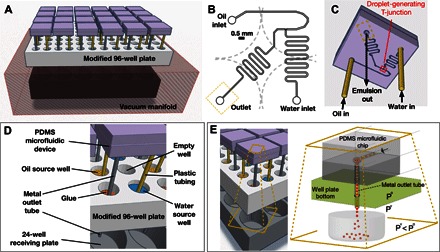
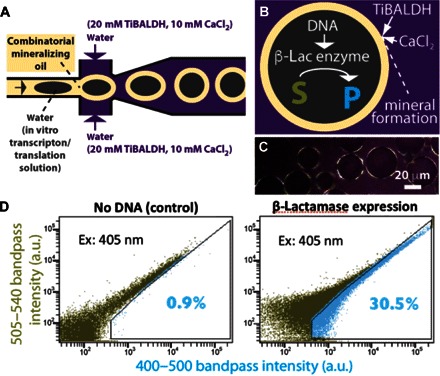
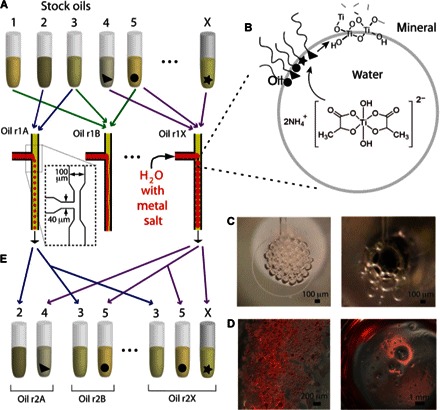
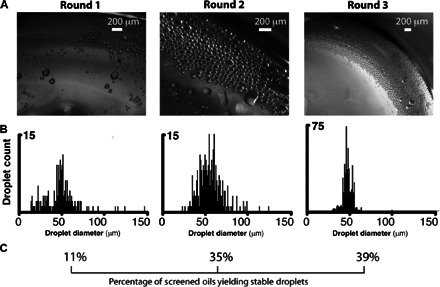
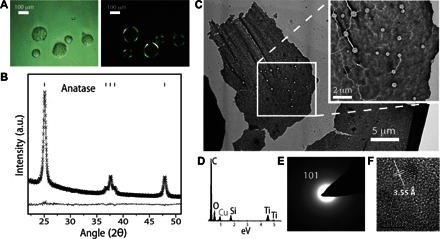
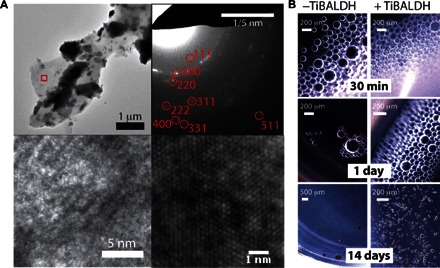
Although droplet-based systems are used in a wide range of technologies, opportunities for systematically customizing their interface chemistries remain relatively unexplored. This article describes a new microfluidic strategy for rapidly tailoring emulsion droplet compositions and properties. The approach uses a simple platform for screening arrays of droplet-based microfluidic devices and couples this with combinatorial selection of the droplet compositions. Through the application of genetic algorithms over multiple screening rounds, droplets with target properties can be rapidly generated. The potential of this method is demonstrated by creating droplets with enhanced stability, where this is achieved by selecting carrier fluid chemistries that promote titanium dioxide formation at the droplet interfaces. The interface is a mixture of amorphous and crystalline phases, and the resulting composite droplets are biocompatible, supporting in vitro protein expression in their interiors. This general strategy will find widespread application in advancing emulsion properties for use in chemistry, biology, materials, and medicine.
尽管基于液滴的系统被广泛应用于各种技术中,但系统地定制其界面化学性质的机会仍然相对较少。本文介绍了一种用于快速定制乳液液滴组成和性质的新微流控策略。该方法使用一种简单的平台来筛选基于液滴的微流控器件的阵列,并将其与液滴组成的组合选择相结合。通过在多个筛选轮次中应用遗传算法,可以快速生成具有目标性质的液滴。通过选择促进液滴界面处二氧化钛形成的载液化学物质,来提高稳定性,从而证明了这种方法的潜力。该界面是无定形和结晶相的混合物,所得复合液滴具有生物相容性,可在内部支持蛋白质的体外表达。这种通用策略将广泛应用于推进乳液在化学、生物学、材料和医学中的应用的性质。