Thangavadivel Shanmugapriya, Zelle-Rieser Claudia, Olivier Angelika, Postert Benno, Untergasser Gerold, Kern Johann, Brunner Andrea, Gunsilius Eberhard, Biedermann Rainer, Hajek Roman, Pour Ludek, Willenbacher Wolfgang, Greil Richard, Jöhrer Karin
Tyrolean Cancer Research Institute, Innsbruck, Austria.
Laboratory of Tumor Angiogenesis and Tumorbiology, Department of Internal Medicine V, Medical University of Innsbruck, Innsbruck, Austria.
Oncotarget. 2016 Nov 29;7(48):78605-78618. doi: 10.18632/oncotarget.12522.
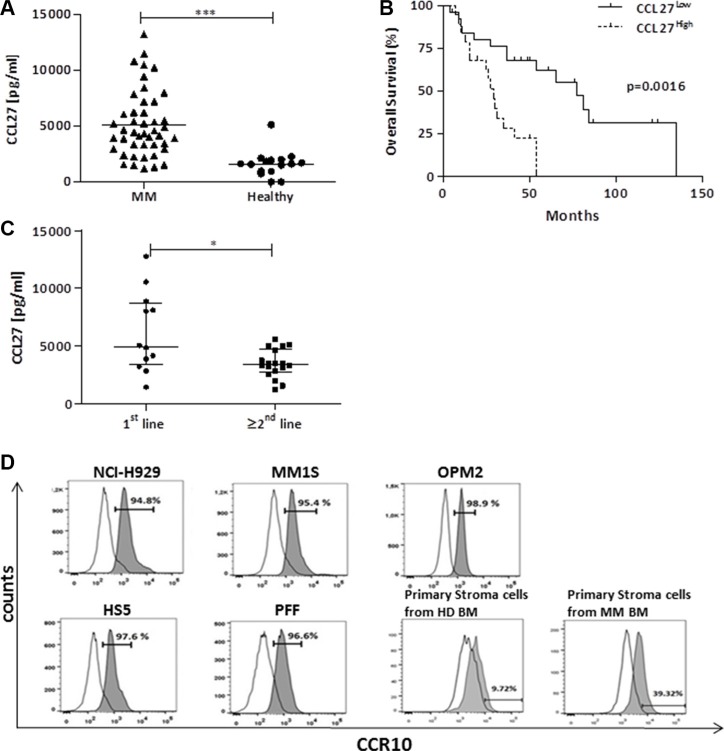
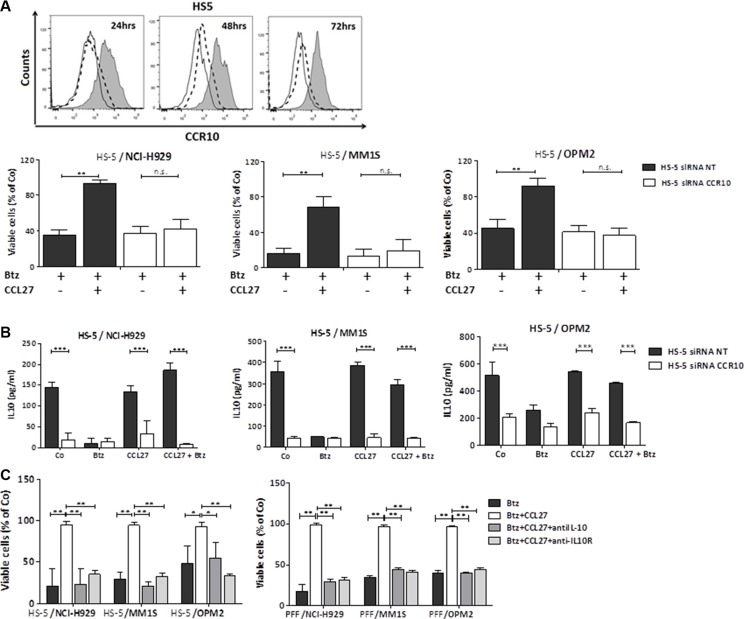
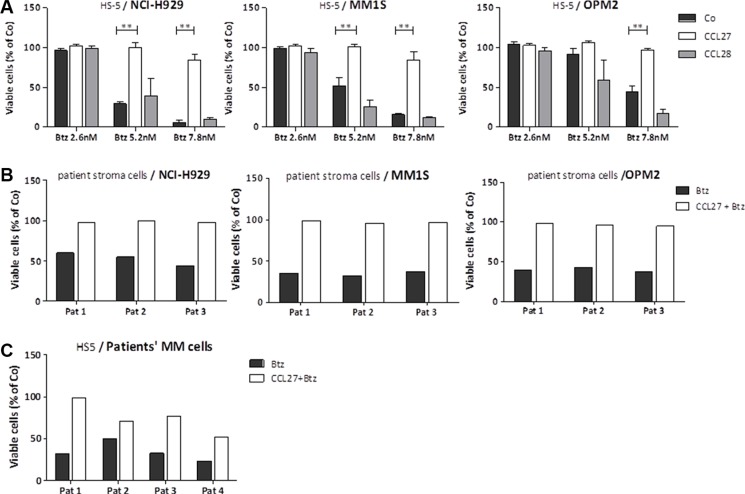
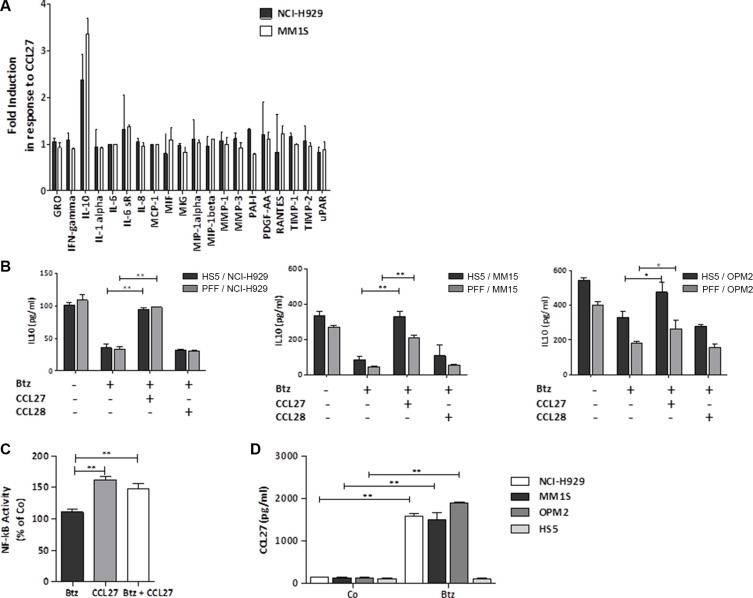
The bone marrow microenvironment plays a decisive role in multiple myeloma progression and drug resistance. Chemokines are soluble mediators of cell migration, proliferation and survival and essentially modulate tumor progression and drug resistance. Here we investigated bone marrow-derived chemokines of naive and therapy-refractory myeloma patients and discovered that high levels of the chemokine CCL27, known so far for its role in skin inflammatory processes, correlated with worse overall survival of the patients. In addition, chemokine levels were significantly higher in samples from patients who became refractory to bortezomib at first line treatment compared to resistance at later treatment lines.In vitro as well as in an in vivo model we could show that CCL27 triggers bortezomib-resistance of myeloma cells. This effect was strictly dependent on the expression of the respective receptor, CCR10, on stroma cells and involved the modulation of IL-10 expression, activation of myeloma survival pathways, and modulation of proteasomal activity. Drug resistance could be totally reversed by blocking CCR10 by siRNA as well as blocking IL-10 and its receptor.From our data we suggest that blocking the CCR10/CCL27/IL-10 myeloma-stroma crosstalk is a novel therapeutic target that could be especially relevant in early refractory myeloma patients.
骨髓微环境在多发性骨髓瘤的进展和耐药性中起决定性作用。趋化因子是细胞迁移、增殖和存活的可溶性介质,本质上调节肿瘤进展和耐药性。在这里,我们研究了初治和难治性骨髓瘤患者骨髓来源的趋化因子,发现趋化因子CCL27水平升高(其在皮肤炎症过程中的作用迄今已知)与患者较差的总生存期相关。此外,与后期治疗线耐药相比,一线治疗对硼替佐米耐药患者样本中的趋化因子水平显著更高。在体外以及体内模型中,我们可以证明CCL27触发骨髓瘤细胞的硼替佐米耐药性。这种效应严格依赖于基质细胞上相应受体CCR10的表达,并涉及IL-10表达的调节、骨髓瘤存活途径的激活以及蛋白酶体活性的调节。通过小干扰RNA阻断CCR10以及阻断IL-10及其受体,耐药性可完全逆转。根据我们的数据,我们认为阻断CCR10/CCL27/IL-10骨髓瘤-基质串扰是一个新的治疗靶点,这可能对早期难治性骨髓瘤患者尤为重要。