Santhi B, Dheeptha B
Department of Information and Communication Technology, School of Computing, SASTRA University, Thirumalaisamudram, Thanjavur, 613401 India.
Springerplus. 2016 Sep 29;5(1):1670. doi: 10.1186/s40064-016-3356-1. eCollection 2016.
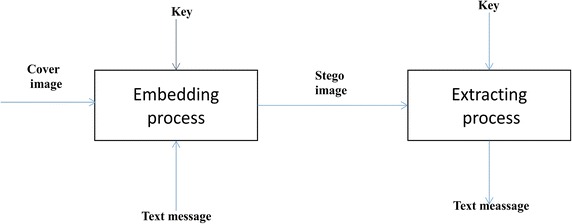
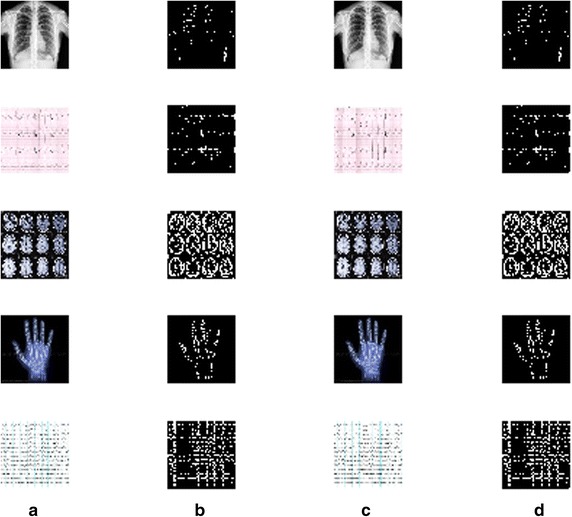
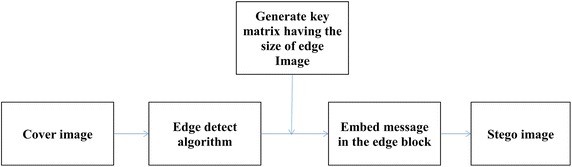
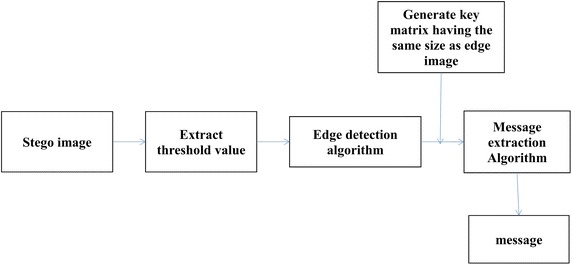
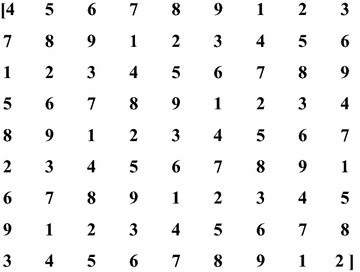
The field of telemedicine has gained immense momentum, owing to the need for transmitting patients' information securely. This paper puts forth a unique method for embedding data in medical images. It is based on edge based embedding and XOR coding. The algorithm proposes a novel key generation technique by utilizing the design of a sudoku puzzle to enhance the security of the transmitted message. The edge blocks of the cover image alone, are utilized to embed the payloads. The least significant bit of the pixel values are changed by XOR coding depending on the data to be embedded and the key generated. Hence the distortion in the stego image is minimized and the information is retrieved accurately. Data is embedded in the RGB planes of the cover image, thus increasing its embedding capacity. Several measures including peak signal noise ratio (PSNR), mean square error (MSE), universal image quality index (UIQI) and correlation coefficient (R) are the image quality measures that have been used to analyze the quality of the stego image. It is evident from the results that the proposed technique outperforms the former methodologies.
由于安全传输患者信息的需求,远程医疗领域获得了巨大的发展势头。本文提出了一种在医学图像中嵌入数据的独特方法。它基于基于边缘的嵌入和异或编码。该算法通过利用数独谜题的设计提出了一种新颖的密钥生成技术,以增强传输消息的安全性。仅利用封面图像的边缘块来嵌入有效载荷。根据要嵌入的数据和生成的密钥,通过异或编码改变像素值的最低有效位。因此,隐秘图像中的失真最小化,并且信息被准确检索。数据被嵌入到封面图像的RGB平面中,从而提高了其嵌入容量。包括峰值信噪比(PSNR)、均方误差(MSE)、通用图像质量指数(UIQI)和相关系数(R)在内的几种度量是用于分析隐秘图像质量的图像质量度量。从结果可以明显看出,所提出的技术优于以前的方法。