Najafzadeh Mojgan, Normington Charmaine, Jacob Badie K, Isreb Mohammad, Gopalan Rajendran C, Anderson Diana
Division of Medical Sciences, School of Life Sciences, University of Bradford Bradford, UK.
Bradford Royal InfirmaryBradford, UK; St Luke's HospitalBradford, UK.
Front Mol Biosci. 2016 Sep 28;3:50. doi: 10.3389/fmolb.2016.00050. eCollection 2016.
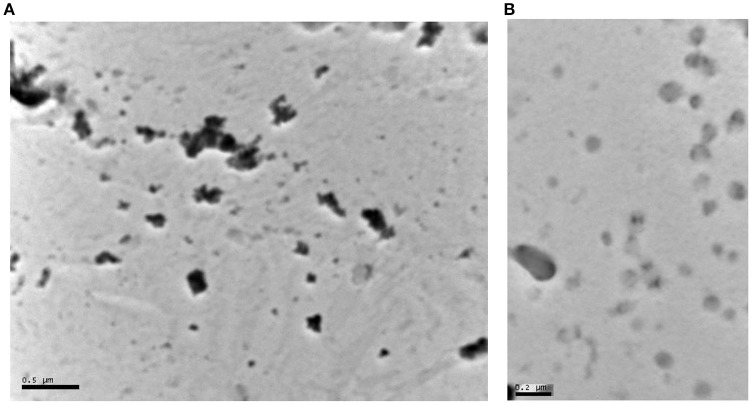
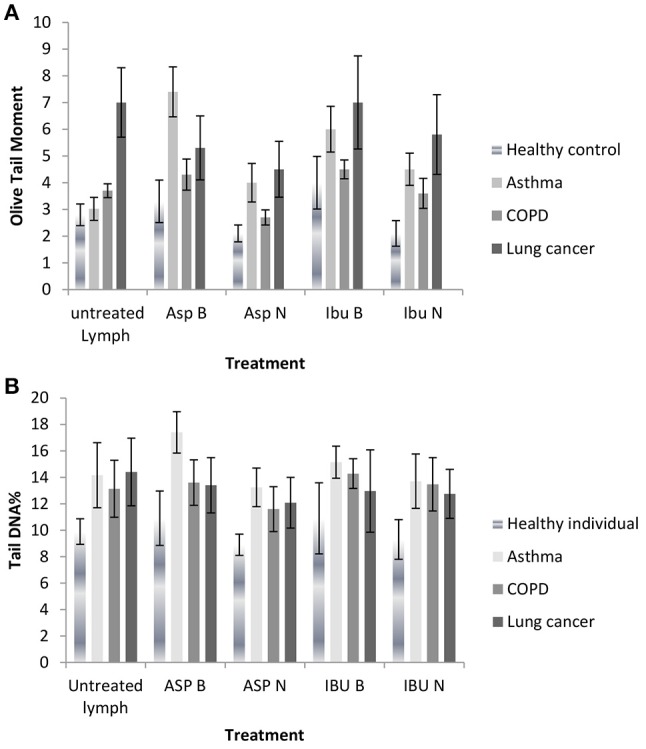
Non-steroidal anti-inflammatory drugs (NSAIDs) inhibit COX enzyme activity which affects the inflammatory response. Inflammation is associated with increasing cancer incidence. Pre-clinical and clinical studies have shown that NSAID treatment could cause an anti-tumor effect in cancers. In the present study, blood was taken from healthy individuals ( = 17) and patients with respiratory diseases or lung cancer ( = 36). White blood cells (WBC) were treated with either a micro-suspension, i.e., bulk (B) or nano-suspension (N) of aspirin (ASP) or ibuprofen (IBU) up to 500 μg/ml in the comet assay and up to 125 μg/ml in the micronucleus assay. In this study results were compared against untreated lymphocytes and their corresponding treated groups. The results showed, that NSAIDs in their nano form significantly reduced the DNA damage in WBCs from lung cancer patients in bulk and nano compared to untreated lymphocytes. Also, there was a decrease in the level of DNA damage in the comet assay after treating WBCs from healthy individuals, asthma and COPD groups with aspirin N (ASP N) but not with IBU N. In addition, the number of micronuclei decreased after treatment with NSAIDs in their nano form (ASP N and IBU N) in the healthy as well as in the lung cancer group. However, this was not the case for micronucleus frequency in asthma and COPD patients. These data show that lymphocytes from different groups respond differently to treatment with ASP and IBU as measured by comet assay and micronucleus assay, and that the size of the suspended particles of the drugs affects responses.
非甾体抗炎药(NSAIDs)抑制COX酶活性,而这会影响炎症反应。炎症与癌症发病率的增加有关。临床前和临床研究表明,NSAID治疗可在癌症中产生抗肿瘤作用。在本研究中,采集了健康个体(n = 17)以及患有呼吸系统疾病或肺癌的患者(n = 36)的血液。在彗星试验中,用阿司匹林(ASP)或布洛芬(IBU)的微悬浮液(即大量悬浮液(B)或纳米悬浮液(N))处理白细胞(WBC),浓度最高可达500μg/ml,在微核试验中最高可达125μg/ml。在本研究中,将结果与未处理的淋巴细胞及其相应的处理组进行了比较。结果显示,与未处理的淋巴细胞相比,纳米形式的NSAIDs显著降低了肺癌患者白细胞中大量悬浮液和纳米悬浮液中的DNA损伤。此外,用阿司匹林纳米悬浮液(ASP N)而非布洛芬纳米悬浮液(IBU N)处理健康个体、哮喘和慢性阻塞性肺疾病(COPD)组的白细胞后,彗星试验中的DNA损伤水平有所降低。此外,在健康组和肺癌组中,用纳米形式的NSAIDs(ASP N和IBU N)处理后微核数量减少。然而,哮喘和COPD患者的微核频率并非如此。这些数据表明,通过彗星试验和微核试验测量,不同组的淋巴细胞对ASP和IBU治疗的反应不同,并且药物悬浮颗粒的大小会影响反应。