Meng Xin, Clews Jack, Kargas Vasileios, Wang Xiaomeng, Ford Robert C
Faculty of Life Sciences, The University of Manchester, Oxford Rd, Manchester, M13 9PL, UK.
Cell Mol Life Sci. 2017 Jan;74(1):23-38. doi: 10.1007/s00018-016-2386-8. Epub 2016 Oct 12.
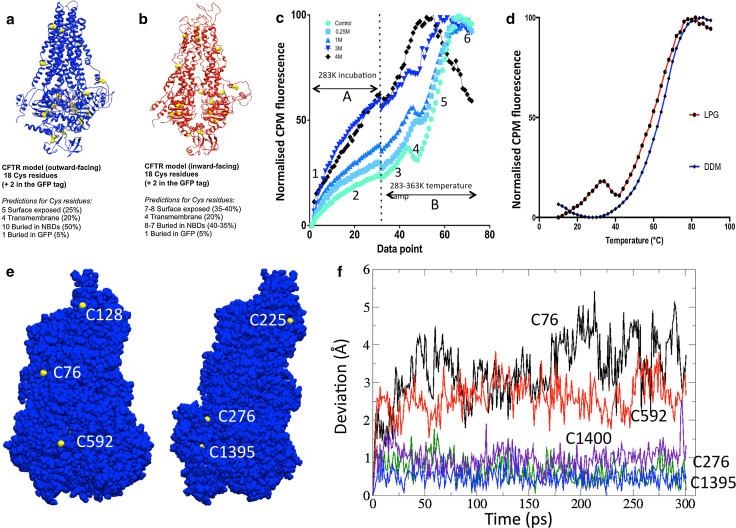
The cystic fibrosis transmembrane conductance regulator (CFTR) is responsible for the disease cystic fibrosis (CF). It is a membrane protein belonging to the ABC transporter family functioning as a chloride/anion channel in epithelial cells around the body. There are over 1500 mutations that have been characterised as CF-causing; the most common of these, accounting for ~70 % of CF cases, is the deletion of a phenylalanine at position 508. This leads to instability of the nascent protein and the modified structure is recognised and then degraded by the ER quality control mechanism. However, even pharmacologically 'rescued' F508del CFTR displays instability at the cell's surface, losing its channel function rapidly and it is rapidly removed from the plasma membrane for lysosomal degradation. This review will, therefore, explore the link between stability and structure/function relationships of membrane proteins and CFTR in particular and how approaches to study CFTR structure depend on its stability. We will also review the application of a fluorescence labelling method for the assessment of the thermostability and the tertiary structure of CFTR.
囊性纤维化跨膜传导调节因子(CFTR)是导致囊性纤维化(CF)疾病的原因。它是一种膜蛋白,属于ABC转运蛋白家族,在全身上皮细胞中作为氯离子/阴离子通道发挥作用。已鉴定出超过1500种导致CF的突变;其中最常见的是第508位苯丙氨酸的缺失,约占CF病例的70%。这导致新生蛋白不稳定,修饰后的结构被内质网质量控制机制识别并降解。然而,即使经过药理学“挽救”,F508del CFTR在细胞表面仍表现出不稳定性,迅速丧失其通道功能,并迅速从质膜上移除进行溶酶体降解。因此,本综述将探讨膜蛋白,特别是CFTR的稳定性与结构/功能关系之间的联系,以及研究CFTR结构的方法如何依赖于其稳定性。我们还将综述一种荧光标记方法在评估CFTR热稳定性和三级结构方面的应用。