Chen Chien-Chang, Rau Cheng-Shyuan, Wu Shao-Chun, Kuo Pao-Jen, Chen Yi-Chun, Hsieh Hsiao-Yun, Hsieh Ching-Hua
Department of Plastic Surgery, Kaohsiung Chang Gung Memorial Hospital, Kaohsiung 83301, Taiwan.
Chang Gung University College of Medicine, Taoyuan City 33302, Taiwan.
Int J Environ Res Public Health. 2016 Oct 10;13(10):995. doi: 10.3390/ijerph13100995.
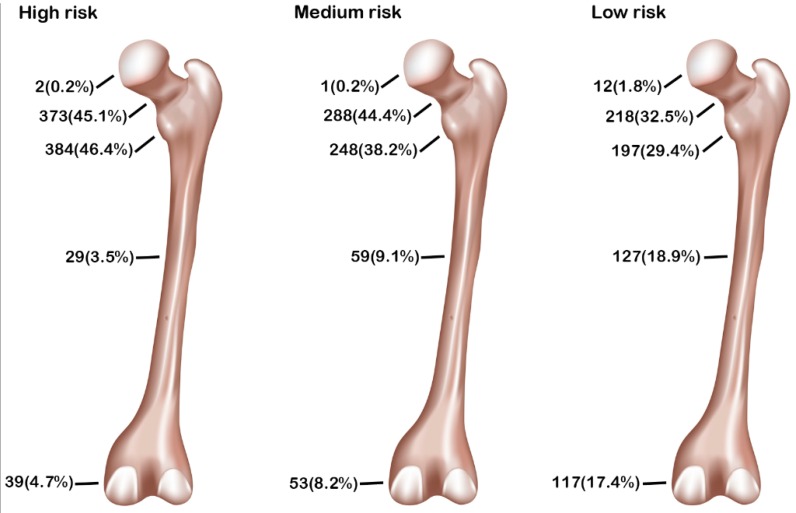
: A cross-sectional study to investigate the association of Osteoporosis Self-Assessment Tool for Asians (OSTA) score with clinical presentation and expenditure of hospitalized adult trauma patients with femoral fractures. : According to the data retrieved from the Trauma Registry System between 1 January 2009 and 31 December 2015, a total of 2086 patients aged ≥40 years and hospitalized for treatment of traumatic femoral bone fracture were categorized as high-risk patients (OSTA < -4, = 814), medium-risk patients (-1 ≥ OSTA ≥ -4, = 634), and low-risk patients (OSTA > -1, = 638). Two-sided Pearson's, chi-squared, or Fisher's exact tests were used to compare categorical data. Unpaired Student's -test and Mann-Whitney -test were used to analyze normally and non-normally distributed continuous data, respectively. Propensity-score matching in a 1:1 ratio was performed using Number Crunching Statistical Software (NCSS) software (NCSS 10; NCSS Statistical Software, Kaysville, UT, USA), with adjusted covariates including mechanism and Glasgow Coma Scale (GCS); injuries were assessed based on the Abbreviated Injury Scale (AIS), and Injury Severity Score (ISS) was used to evaluate the effect of OSTA-related grouping on a patient's outcome. : High-risk and medium-risk patients were predominantly female, presented with significantly older age and higher incidences of co-morbidity, and were injured in a fall accident more frequently than low-risk patients. High-risk patients and medium-risk patients had a different pattern of femoral fracture and a significantly lower ISS. Although high-risk and medium-risk patients had significantly shorter lengths hospital of stay (LOS) and less total expenditure than low-risk patients did, similar results were not found in the selected propensity score-matched patients, implying that the difference may be attributed to the associated injury severity of the patients with femoral fracture. However, the charge of surgery is significantly lower in high-risk and medium-risk patients than in low-risk patients, regardless of the total population or the selected propensity score-matched patients. This lower charge of surgery may be attributed to a less aggressive surgery applied for older patients with high or medium risk of osteoporosis. : This study of hospitalized trauma patients with femoral fracture according to OSTA risk classification revealed that high-risk and medium-risk patients had significantly higher odds of sustaining injury in a fall accident than low-risk patients; they also present a different pattern of femoral bone fracture as well as a significantly lower ISS, shorter hospital LOS, and less total expenditure. In addition, the significantly lower charge of surgery in high-risk and medium-risk patients than in low-risk patients may be because of the preference of orthopedists for less aggressive surgery in dealing with older patients with osteoporotic femoral bone fracture.
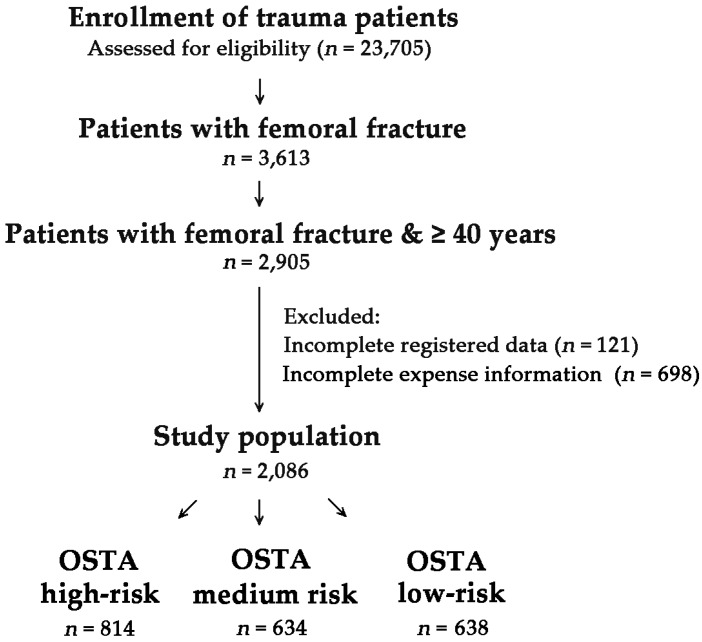
一项横断面研究,旨在调查亚洲人骨质疏松自我评估工具(OSTA)评分与成年股骨骨折创伤住院患者临床表现及费用之间的关联。根据2009年1月1日至2015年12月31日从创伤登记系统检索到的数据,共有2086名年龄≥40岁且因创伤性股骨骨折住院治疗的患者被分为高危患者(OSTA<-4,n = 814)、中危患者(-1≥OSTA≥-4,n = 634)和低危患者(OSTA>-1,n = 638)。采用双侧Pearson检验、卡方检验或Fisher精确检验比较分类数据。分别采用不成对学生t检验和Mann-Whitney U检验分析正态分布和非正态分布的连续数据。使用统计分析软件(NCSS)软件(NCSS 10;NCSS统计软件,美国犹他州凯斯维尔)进行1:1比例的倾向得分匹配,调整后的协变量包括受伤机制和格拉斯哥昏迷量表(GCS);根据简明损伤定级标准(AIS)评估损伤情况,并使用损伤严重度评分(ISS)评估OSTA相关分组对患者结局的影响。高危和中危患者以女性为主,年龄显著较大,合并症发生率较高,且比低危患者更频繁地因跌倒事故受伤。高危患者和中危患者的股骨骨折模式不同,ISS显著较低。尽管高危和中危患者的住院时间(LOS)显著短于低危患者,总费用也低于低危患者,但在选定的倾向得分匹配患者中未发现类似结果,这意味着差异可能归因于股骨骨折患者的相关损伤严重程度。然而,无论总体人群还是选定的倾向得分匹配患者,高危和中危患者的手术费用均显著低于低危患者。这种较低的手术费用可能归因于对骨质疏松风险高或中等的老年患者采用了不太激进的手术方式。这项根据OSTA风险分类对股骨骨折创伤住院患者进行的研究表明,高危和中危患者在跌倒事故中受伤的几率显著高于低危患者;他们还呈现出不同的股骨骨折模式,ISS显著较低,住院LOS较短,总费用较少。此外,高危和中危患者的手术费用显著低于低危患者,可能是因为骨科医生在处理骨质疏松性股骨骨折老年患者时倾向于采用不太激进的手术方式。