Kumagai Erina, Mano Yohei, Yoshio Sachiyo, Shoji Hirotaka, Sugiyama Masaya, Korenaga Masaaki, Ishida Tsuyoshi, Arai Taeang, Itokawa Norio, Atsukawa Masanori, Hyogo Hideyuki, Chayama Kazuaki, Ohashi Tomohiko, Ito Kiyoaki, Yoneda Masashi, Kawaguchi Takumi, Torimura Takuji, Nozaki Yuichi, Watanabe Sumio, Mizokami Masashi, Kanto Tatsuya
The Research Center for Hepatitis and Immunology, National Center for Global Health and Medicine, Ichikawa, Japan.
Department of Gastroenterology, Juntendo University School of Medicine, Hongo, Bunkyo, Tokyo, Japan.
Sci Rep. 2016 Oct 14;6:35282. doi: 10.1038/srep35282.
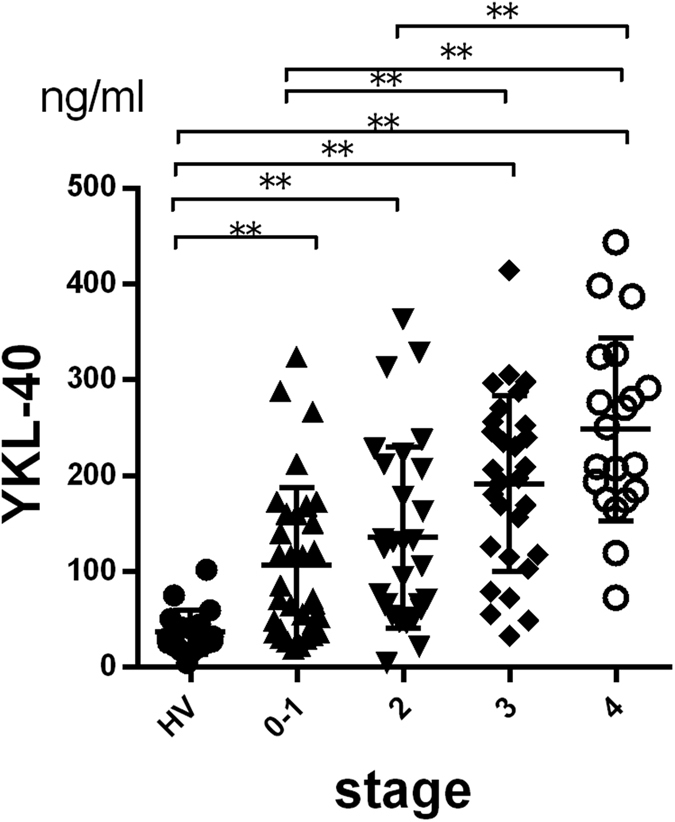
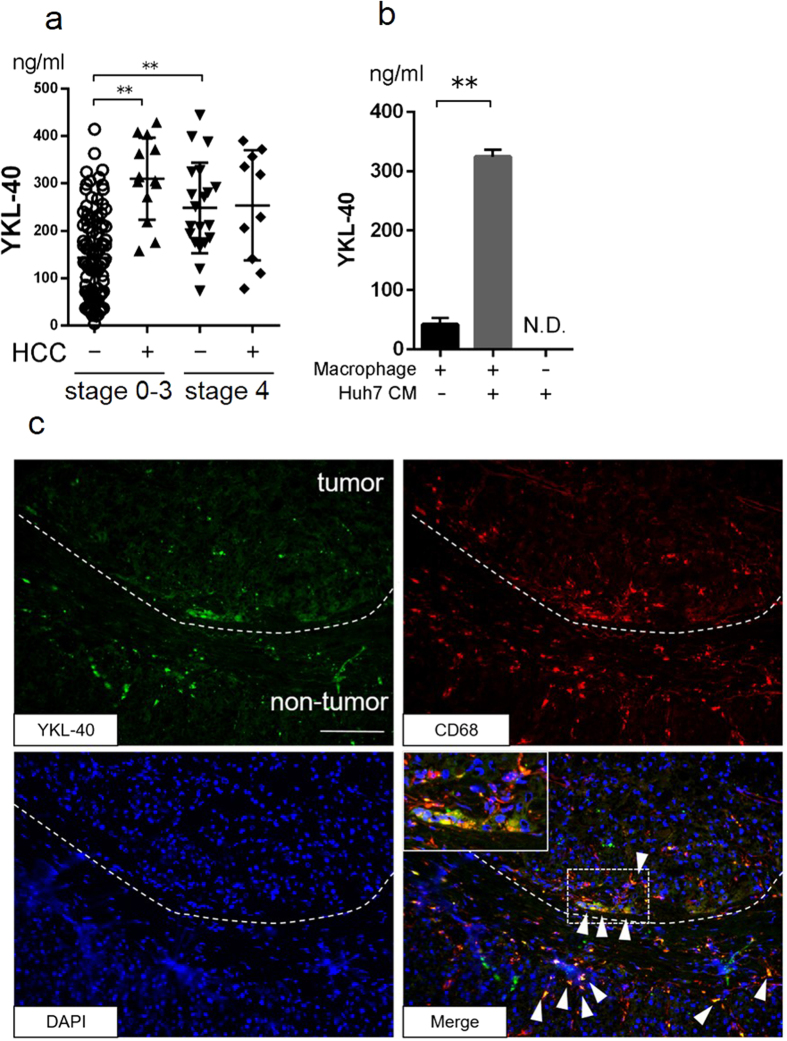
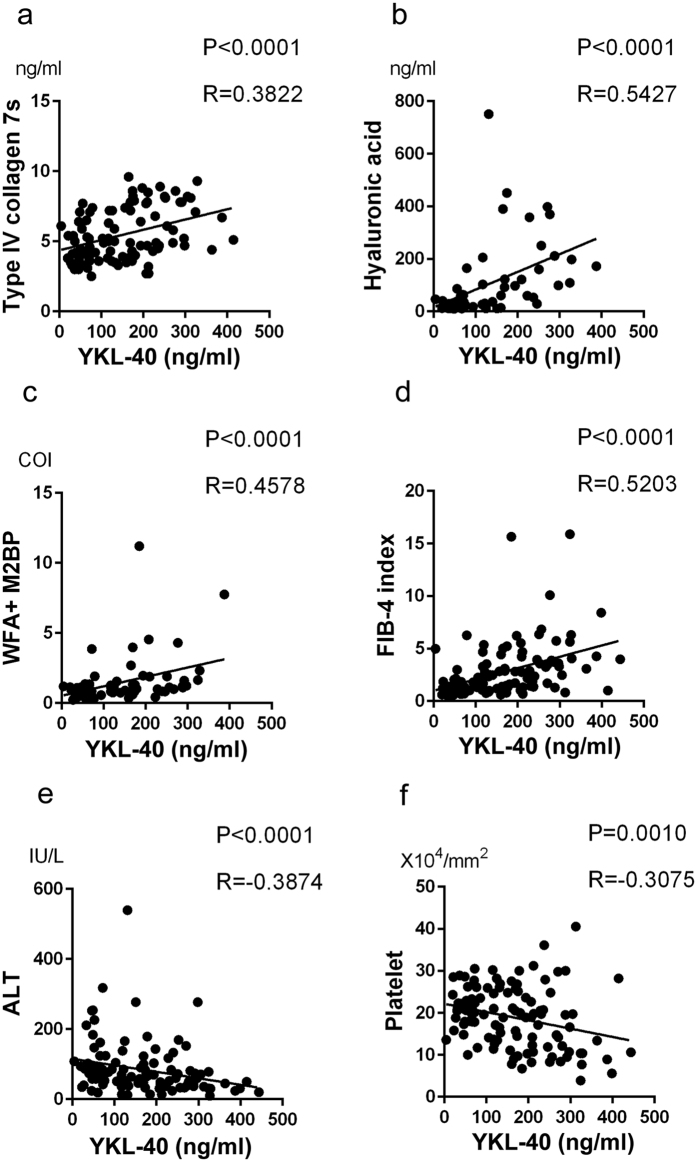
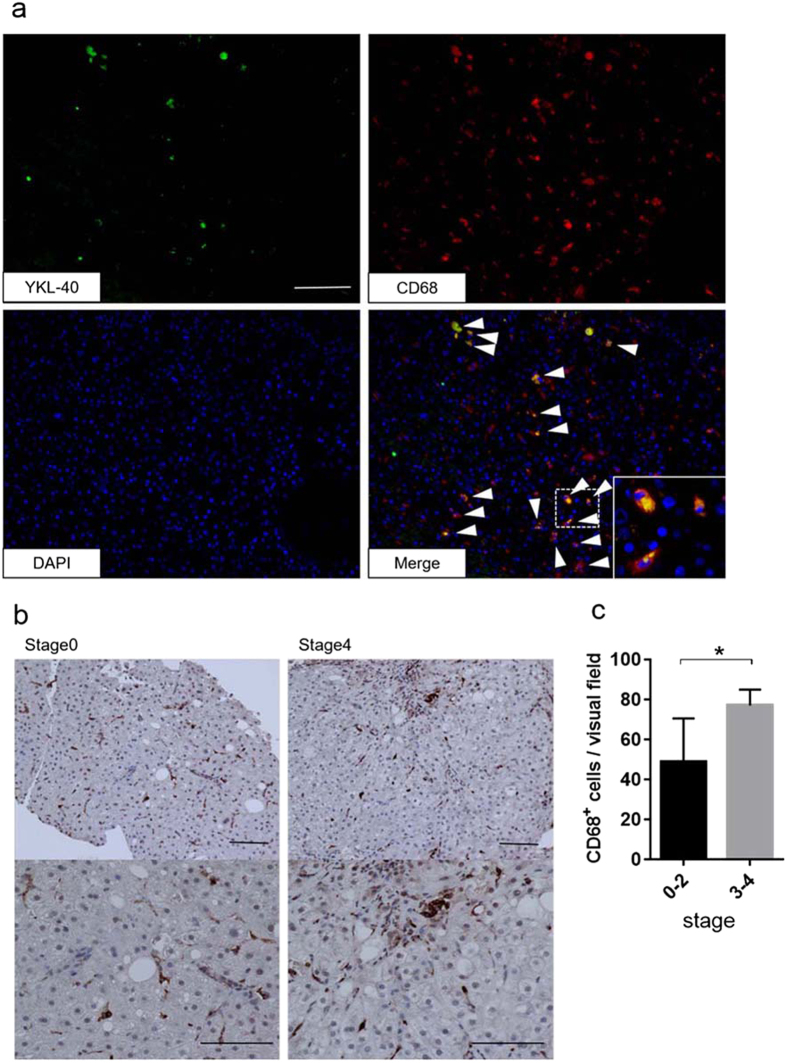
Non-alcoholic fatty liver disease (NAFLD) is a common cause of chronic non-viral liver disease. YKL-40, chitinase-like protein expressed in multiple tissues including liver, is involved in cell proliferation, inflammation and remodeling of the extracellular matrix. The aim of this study was to assess whether serum YKL-40 levels are associated with liver fibrosis in NAFLD patients. Serum YKL-40 levels were quantified in 111 NAFLD patients and 23 HCC patients with NAFLD. To identify the source of YKL-40, immunofluorescence staining of liver specimens from NAFLD patients was performed. Serum YKL-40 levels in NAFLD patients increased in accordance with the progression of liver fibrosis. Multivariate analysis revealed that YKL-40 was one of the independent factors significantly associated with severe fibrosis (F3-4). We established a new predictive model for fibrosis of NAFLD, using logistic regression analysis: YKL-40 based fibrosis score = -0.0545 + type IV collagen 7s * 0.3456 + YKL-40 * 0.0024. Serum YKL-40 levels of HCC patients with non-cirrhotic NAFLD were significantly higher than those without HCC. Immunofluorescence staining showed that YKL-40 was expressed by macrophages in liver tissue of NAFLD patients. In conclusion, macrophage-derived YKL-40 is a feasible biomarker of liver fibrosis in NAFLD patients.
非酒精性脂肪性肝病(NAFLD)是慢性非病毒性肝病的常见病因。YKL-40是一种在包括肝脏在内的多种组织中表达的几丁质酶样蛋白,参与细胞增殖、炎症反应和细胞外基质重塑。本研究旨在评估血清YKL-40水平是否与NAFLD患者的肝纤维化相关。对111例NAFLD患者和23例合并NAFLD的肝癌患者的血清YKL-40水平进行了定量分析。为了确定YKL-40的来源,对NAFLD患者的肝脏标本进行了免疫荧光染色。NAFLD患者血清YKL-40水平随肝纤维化进展而升高。多因素分析显示,YKL-40是与严重纤维化(F3-4)显著相关的独立因素之一。我们使用逻辑回归分析建立了一种新的NAFLD纤维化预测模型:基于YKL-40的纤维化评分 = -0.0545 + Ⅳ型胶原7s * 0.3456 + YKL-40 * 0.0024。非肝硬化NAFLD肝癌患者的血清YKL-40水平显著高于无肝癌患者。免疫荧光染色显示,YKL-40在NAFLD患者肝组织中的巨噬细胞中表达。总之,巨噬细胞来源的YKL-40是NAFLD患者肝纤维化的一个可行生物标志物。