Liu Jianjun, Su Mingxue, Wang Jing, Zhang Gan, Zhou Jing, Zhang Anqing, Ren Zixue, Zheng Xucai, Hong Shikai, Wang Shengying, Zhang Rongxin
Department of Head - Neck and Thoracic Surgery, Anhui Provincial Cancer Hospital, West branch of Anhui Province Hospital, Hefei, China.
Department of Infectious Disease Epidemiology, Lu'an People's Hospital, Lu'an, China.
Oncotarget. 2017 Feb 21;8(8):14058-14067. doi: 10.18632/oncotarget.12573.
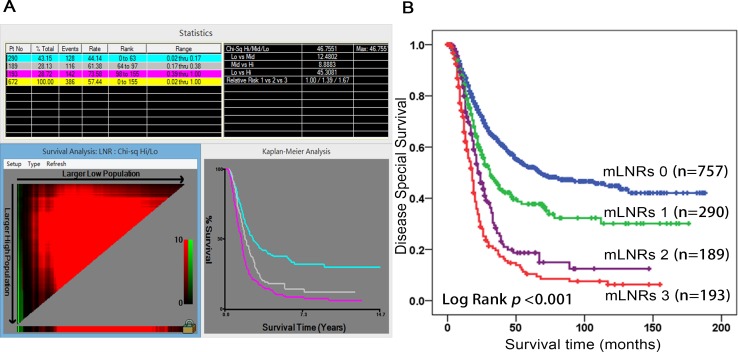
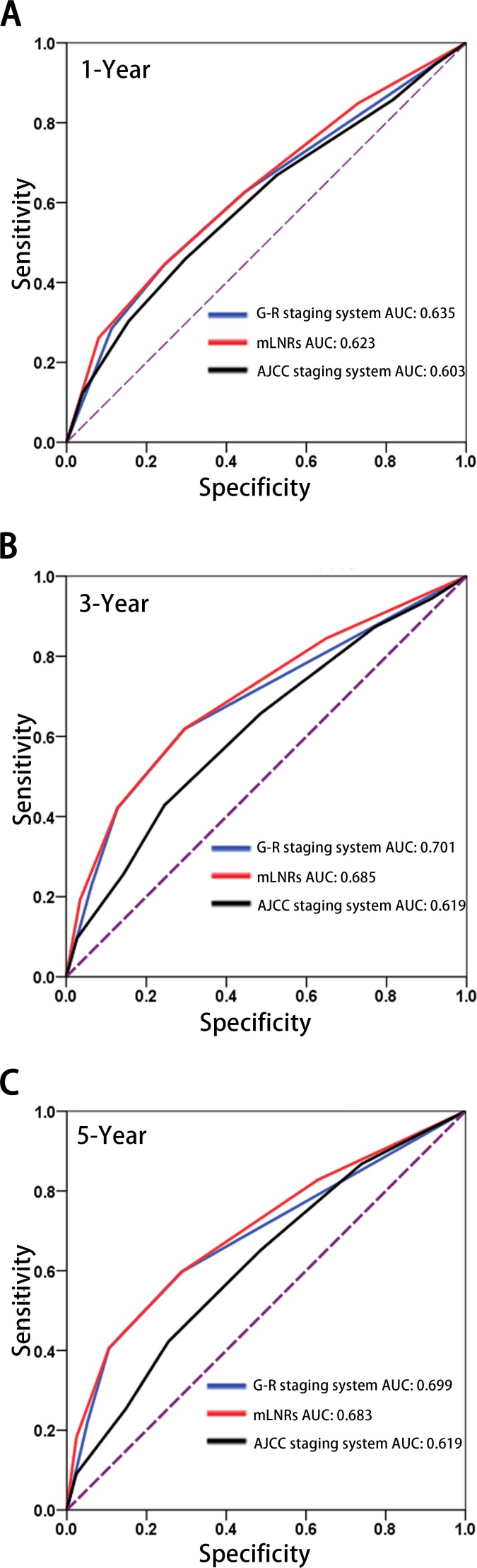
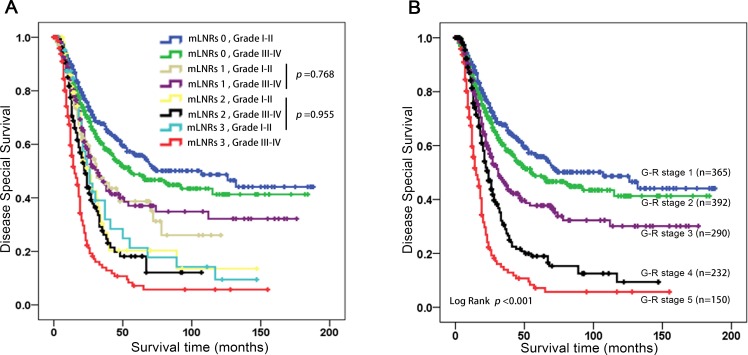
Although local advanced gastric cancer (AGC) could benefit from neoadjuvant radiotherapy (NRT), there are few studies evaluating patients' survival after NRT. In current study, we aimed to investigate the value of prognostic factors in AGC patients after NRT and to evaluate whether post-therapy pathological characteristics were predictive factors in these patients. We retrospectively analyzed AGC patients who underwent NRT from Surveillance, Epidemiology, and End Results (SEER) Database. The patients' clinical and post-therapy pathological characteristics were analyzed. The best cutoff points for continuous variables were identified by X-tile. The discrimination of risk factors were compared by receiver operating characteristic (ROC) curve. As a result, 1,429 AGC patients were included into this study. In the multivariate analysis, the lymph nodes status and histology grade were significant risk factors for DSS (disease special survival). Then, we propose a novel Grade-lymph node Ratio (G-R) staging system for the AGC patients' survival prognosis. Clearly, the new G-R staging system has a more-accurate 3-year and 5-year DSS prediction than the AJCC staging system (p = 0.001, 0.007, respectively). In conclusions, the current large, general population-based study demonstrated that the G-R staging system resulting in more-accurate DSS prediction. It could be regarded as a reliable classification for AGC patients after NRT in future.
尽管局部进展期胃癌(AGC)可从新辅助放疗(NRT)中获益,但评估NRT后患者生存率的研究较少。在本研究中,我们旨在探讨NRT后AGC患者预后因素的价值,并评估治疗后病理特征是否为这些患者的预测因素。我们对监测、流行病学和最终结果(SEER)数据库中接受NRT的AGC患者进行了回顾性分析。分析了患者的临床和治疗后病理特征。通过X-tile确定连续变量的最佳截断点。通过受试者工作特征(ROC)曲线比较危险因素的辨别力。结果,1429例AGC患者纳入本研究。多因素分析中,淋巴结状态和组织学分级是疾病特异性生存(DSS)的显著危险因素。然后,我们为AGC患者的生存预后提出了一种新的分级-淋巴结比率(G-R)分期系统。显然,新的G-R分期系统在3年和5年DSS预测方面比美国癌症联合委员会(AJCC)分期系统更准确(p分别为0.001、0.007)。总之,当前这项基于大样本人群的研究表明,G-R分期系统能更准确地预测DSS。未来它可被视为NRT后AGC患者的可靠分类方法。