Inwati Gajendra Kumar, Rao Yashvant, Singh Man
Centre for Nanosciences, Central University of Gujarat, Gandhinagar, 382030, India.
School of Chemical Sciences, Central University of Gujarat, Gandhinagar, 382030, India.
Nanoscale Res Lett. 2016 Dec;11(1):458. doi: 10.1186/s11671-016-1653-9. Epub 2016 Oct 14.
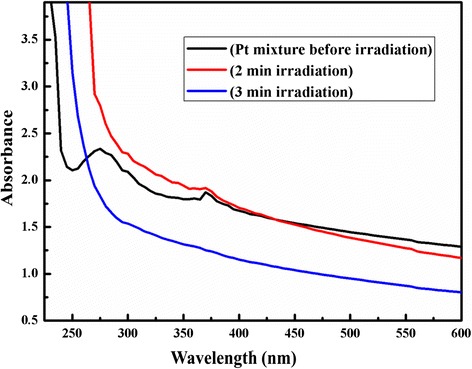
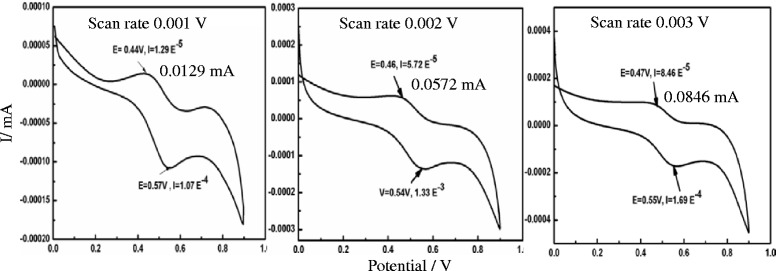
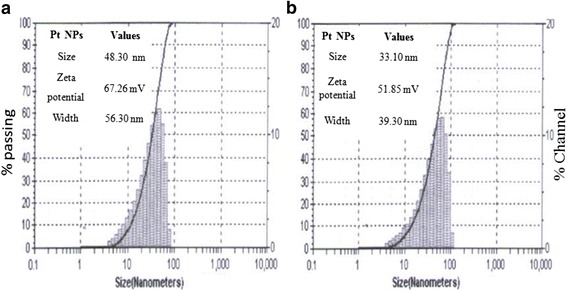
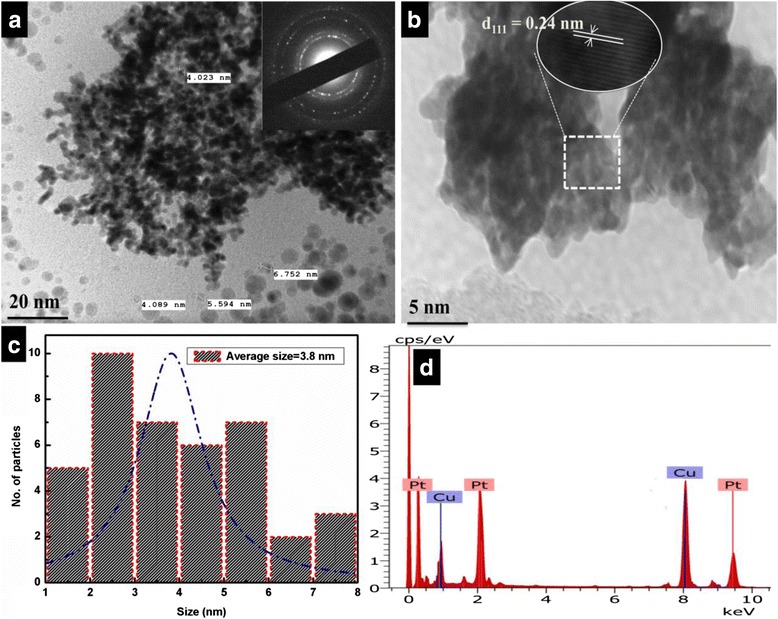
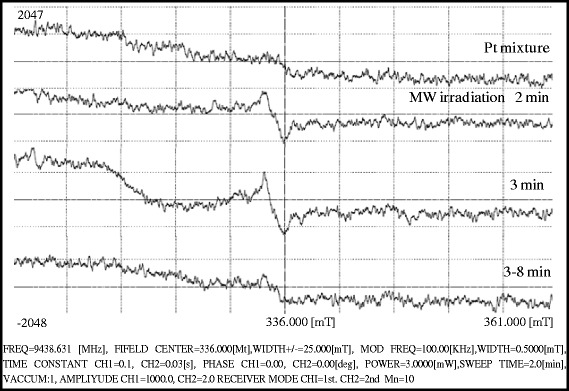
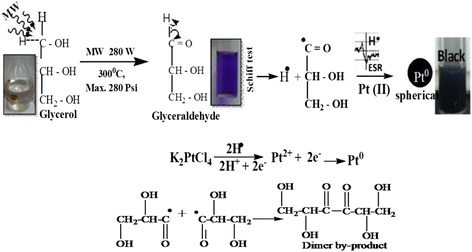
Microwave irradiation was employed for spherical-shaped platinum nanoparticle (Pt NPs) preparation. Spherical Pt NPs indexed with (111) facets were prepared using Pt(II) precursor salt, glycerol as solvent and reducing agent, and polyvinylpyrrolidone (PVP) as a shape directer under microwave irradiation for 3-5 min at 300 °C. Electron spin resonance (ESR) peak at 336.000 mT (milli Tesla) confirmed the free radical formation from aqueous glycerol solution which acted as reducing species under microwave. The 2-8-nm diameter of particles was obtained by high-resolution transmission electron microscope. Dynamic light scattering was used to optimize the microwave dose followed by 33 and 48 nm size and 51 and 67 mV zeta potential of Pt NPs, respectively. The PVP was demonstrated as shape controlling agent investigated by Fourier transmission infrared spectroscopy (FTIR). The electrocatalytic performance of as-prepared Pt colloids was investigated using cyclic voltammetry which showed a higher catalytic activity for ethanol redox reaction.
采用微波辐射法制备球形铂纳米颗粒(Pt NPs)。以Pt(II)前驱体盐为原料,甘油作为溶剂和还原剂,聚乙烯吡咯烷酮(PVP)作为形貌导向剂,在300℃下微波辐射3 - 5分钟,制备出具有(111)晶面的球形Pt NPs。在336.000 mT(毫特斯拉)处的电子自旋共振(ESR)峰证实了在微波作用下,作为还原物种的甘油水溶液中形成了自由基。通过高分辨率透射电子显微镜测得颗粒直径为2 - 8纳米。利用动态光散射优化微波剂量,随后分别得到尺寸为33和48纳米、zeta电位为51和67 mV的Pt NPs。通过傅里叶变换红外光谱(FTIR)研究表明,PVP是形貌控制剂。采用循环伏安法研究了所制备的Pt胶体的电催化性能,结果表明其对乙醇氧化还原反应具有较高的催化活性。