Wan Jian, Shan Yi, Fan Yibo, Fan Conghui, Chen Song, Sun Jie, Zhu Lili, Qin Long, Yu Mengjin, Lin Zhaofen
Department of Emergency and Critical Care Medicine, Shanghai Changzheng Hospital, The Second Military Medical University, Shanghai 200003, P.R. China.
Department of Emergency and Critical Care Medicine, The People's Hospital of Pudong New Area, Shanghai University of Health and Science, Shanghai 201200, P.R. China.
Mol Med Rep. 2016 Nov;14(5):4505-4510. doi: 10.3892/mmr.2016.5825. Epub 2016 Oct 12.
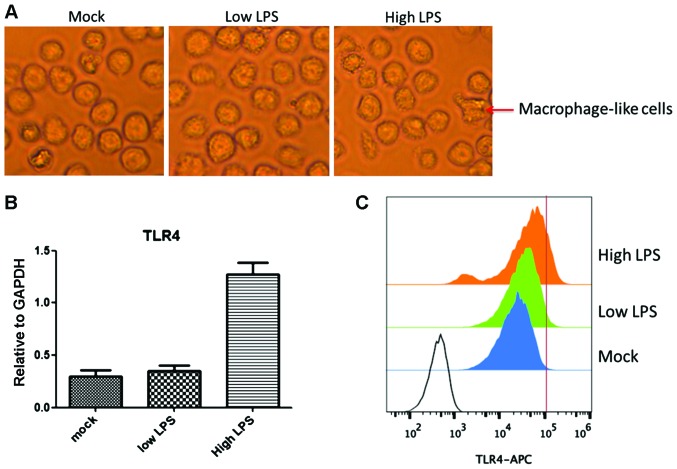
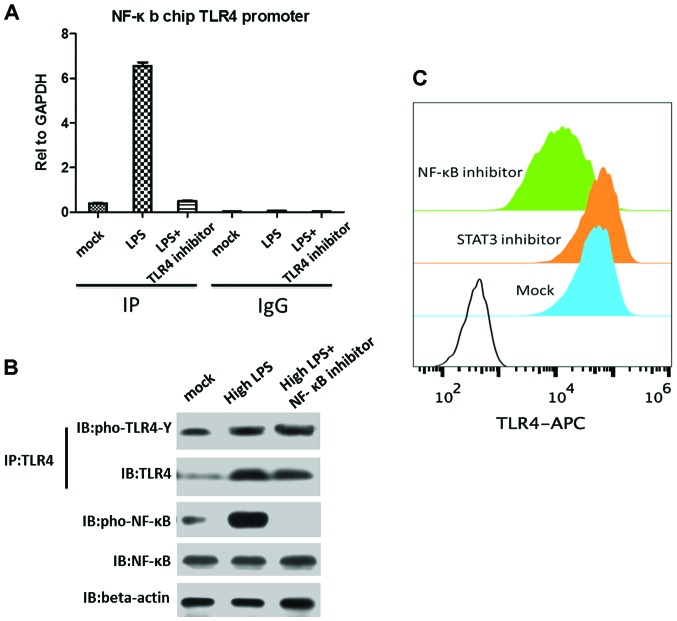
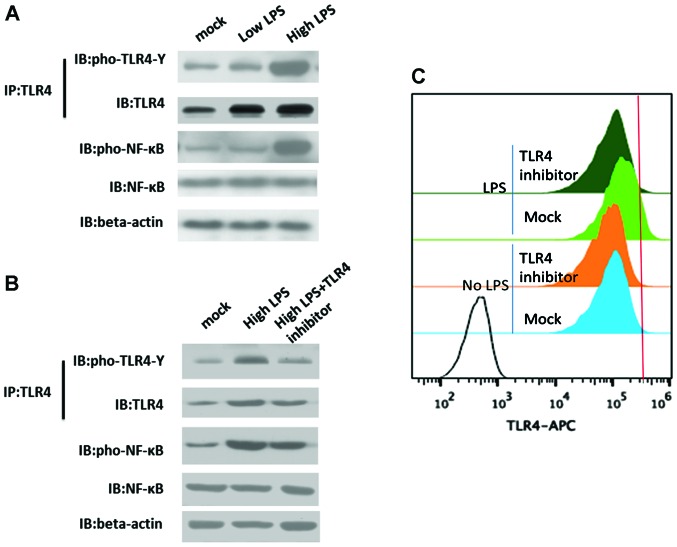
Toll-like receptor (TLR) family are receptors for extracellular or intracellular signaling, such as lipopolysaccharide (LPS), or 12-O-tetradecanoylphorbol-13-acetate. TLR induces the differentiation of human myeloid monocytic‑leukemia cells (THP-1) to macrophages. However, the relationship between extracellular or intracellular signaling and the TLR protein level remain to be determined. Using RT-PCR and western blot analysis, the aim of the present study was to determine whether TLR4, a major TLR family member, could be moderately upregulated by high concentration of LPS and whether it promoted the maturation of THP1 cells. The results showed that, upregulated TLR4 at the protein level and mRNA level enriched the TLR4 modulation style. In addition, TLR4 expression was blocked by nuclear factor (NF)-κB inhibitor, and LPS stimulated NF-κB binding in the TLR4 gene promoter. Therefore, the increased expression of TLR4 in the responsiveness of LPS-treated THP1 cells occurred in response to the upregulation of their respective receptors, as well as a tight binding of NF-κB in the TLR4 gene promoter.
Toll样受体(TLR)家族是细胞外或细胞内信号传导的受体,如脂多糖(LPS)或12-O-十四酰佛波醇-13-乙酸酯。TLR可诱导人髓系单核细胞白血病细胞(THP-1)分化为巨噬细胞。然而,细胞外或细胞内信号传导与TLR蛋白水平之间的关系仍有待确定。本研究旨在通过逆转录聚合酶链反应(RT-PCR)和蛋白质免疫印迹分析,确定TLR家族的主要成员TLR4是否可被高浓度LPS适度上调,以及它是否促进THP-1细胞的成熟。结果表明,TLR4在蛋白质水平和mRNA水平上的上调丰富了TLR4的调控方式。此外,TLR4的表达被核因子(NF)-κB抑制剂阻断,并且LPS刺激了TLR4基因启动子中的NF-κB结合。因此,LPS处理的THP-1细胞反应性中TLR4表达的增加是由于其各自受体的上调以及NF-κB在TLR4基因启动子中的紧密结合所致。