Schwelm Arne, Berney Cédric, Dixelius Christina, Bass David, Neuhauser Sigrid
Swedish University of Agricultural Sciences, Department of Plant Biology, Uppsala BioCenter, Linnean Centre for Plant Biology, P.O. Box 7080, SE-75007 Uppsala, Sweden; University of Innsbruck, Institute of Microbiology, Technikerstraße 25, 6020 Innsbruck, Austria.
Division of Genomics and Microbial Diversity, Dept of Life Sciences, Natural History Museum London, Cromwell Road, SW7 5BD, UK; Groupe Evolution des Protistes et Ecosystèmes Pélagiques, UMR 7144, CNRS & Université Pierre et Marie Curie, Station Biologique de Roscoff, Place Georges Teissier, 29680 Roscoff, France.
Protist. 2016 Dec;167(6):544-554. doi: 10.1016/j.protis.2016.08.008. Epub 2016 Sep 9.
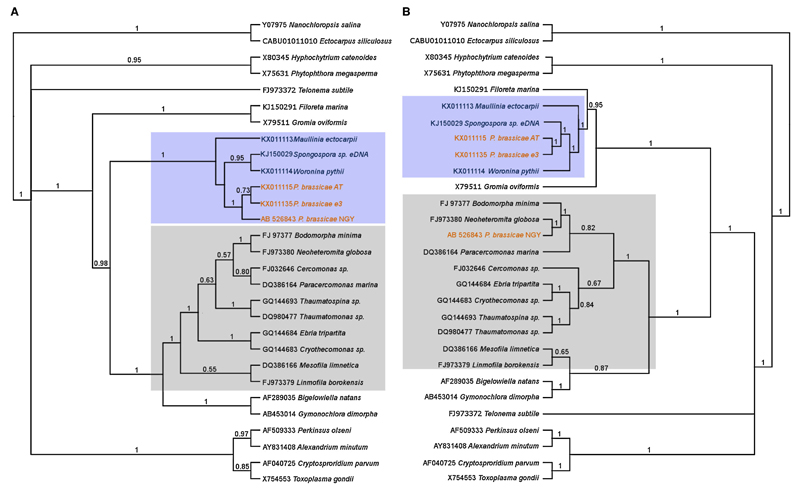
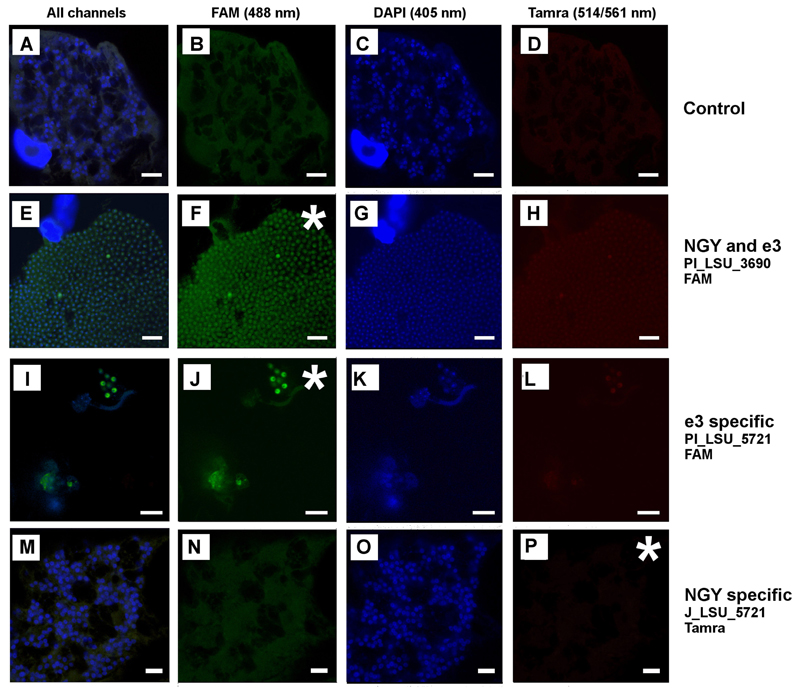
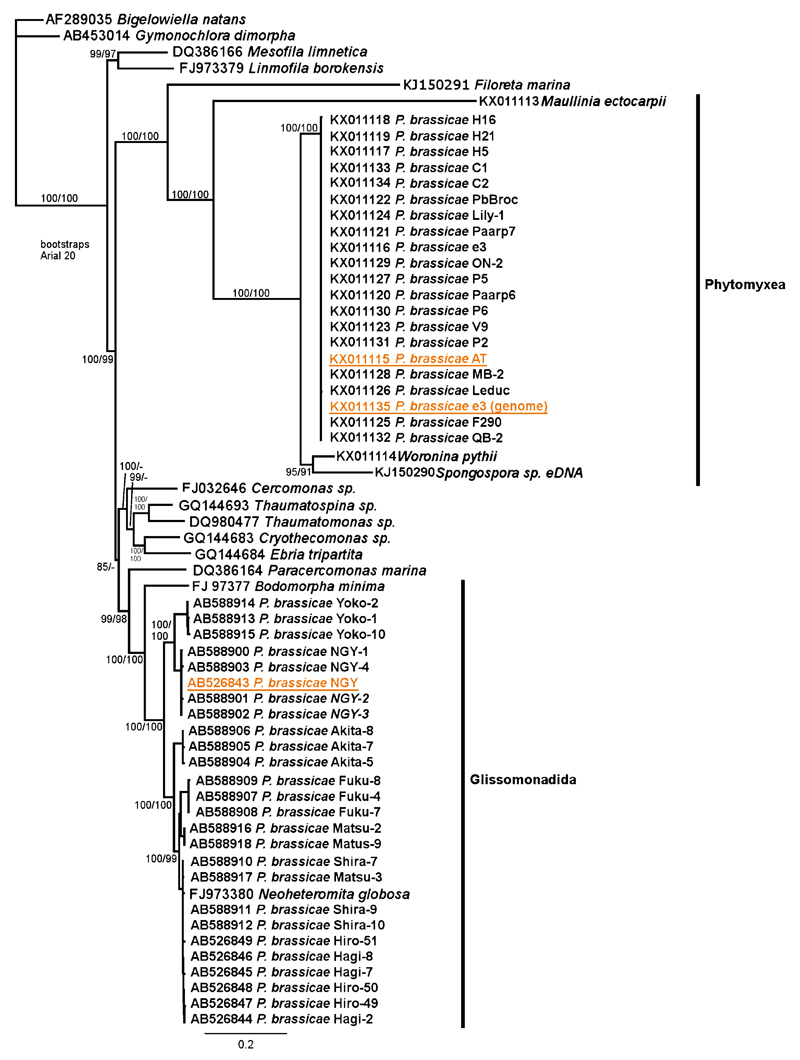
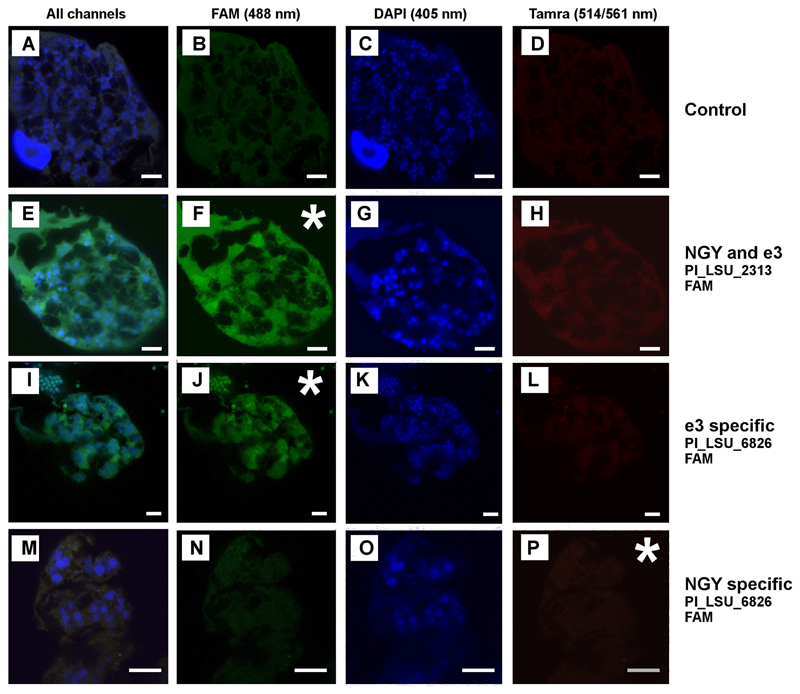
Clubroot disease caused by Plasmodiophora brassicae is one of the most important diseases of cultivated brassicas. P. brassicae occurs in pathotypes which differ in the aggressiveness towards their Brassica host plants. To date no DNA based method to distinguish these pathotypes has been described. In 2011 polymorphism within the 28S rDNA of P. brassicae was reported which potentially could allow to distinguish pathotypes without the need of time-consuming bioassays. However, isolates of P. brassicae from around the world analysed in this study do not show polymorphism in their LSU rDNA sequences. The previously described polymorphism most likely derived from soil inhabiting Cercozoa more specifically Neoheteromita-like glissomonads. Here we correct the LSU rDNA sequence of P. brassicae. By using FISH we demonstrate that our newly generated sequence belongs to the causal agent of clubroot disease.
由芸薹根肿菌引起的根肿病是栽培芸薹属植物最重要的病害之一。芸薹根肿菌存在不同致病型,这些致病型对其芸薹属寄主植物的侵袭力有所不同。迄今为止,尚未有基于DNA区分这些致病型的方法被报道。2011年,有报道称芸薹根肿菌28S rDNA内存在多态性,这有可能使区分致病型无需耗时的生物测定。然而,本研究中分析的来自世界各地的芸薹根肿菌分离株在其LSU rDNA序列中未显示多态性。先前描述的多态性很可能源自土壤中的Cercozoa,更具体地说是类似新异鞭毛虫的滑行生物。在此,我们校正了芸薹根肿菌的LSU rDNA序列。通过荧光原位杂交,我们证明新生成的序列属于根肿病的病原体。