Qi Wenjing, Liu Zhongyuan, Zhang Wei, Halawa Mohamed Ibrahim, Xu Guobao
State Key Laboratory of Electroanalytical Chemistry, Changchun Institute of Applied Chemistry, Chinese Academy of Sciences, Changchun 130022, China.
Chongqing Key Laboratory of Green Synthesis and Applications, College of Chemistry, Chongqing Normal University, Chongqing 401331, China.
Sensors (Basel). 2016 Oct 12;16(10):1674. doi: 10.3390/s16101674.
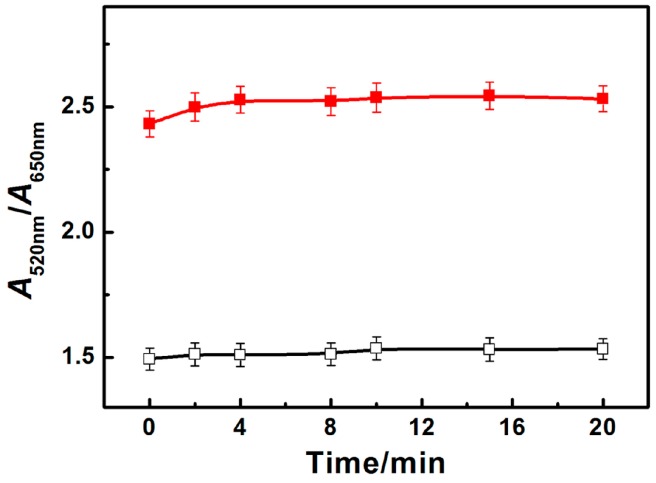
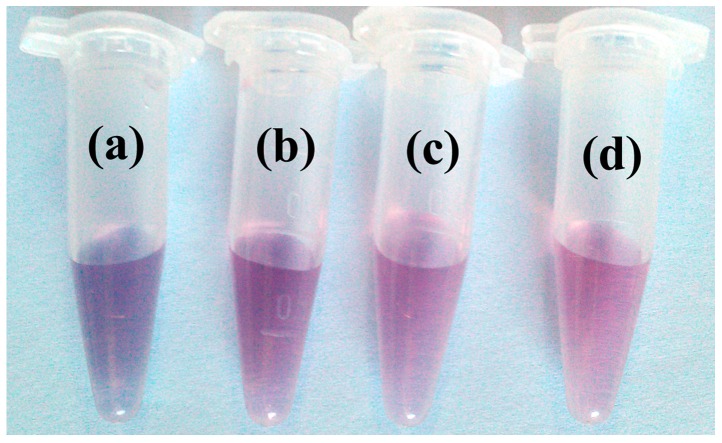
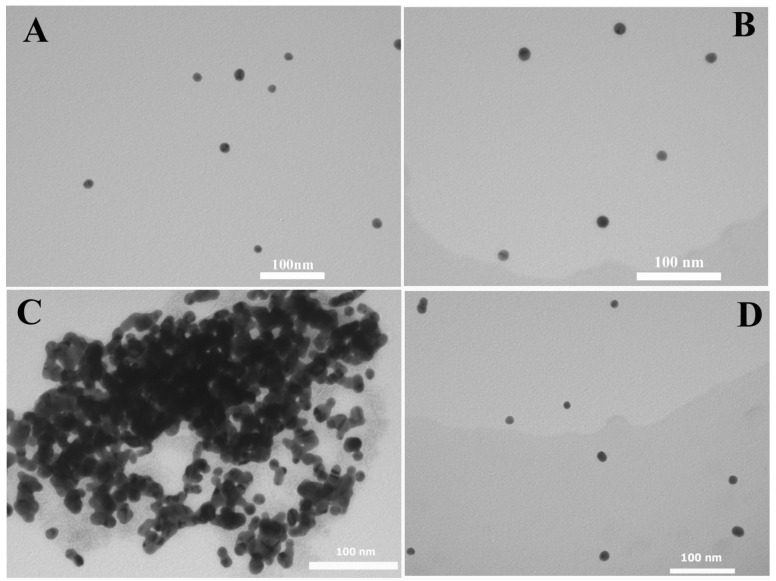
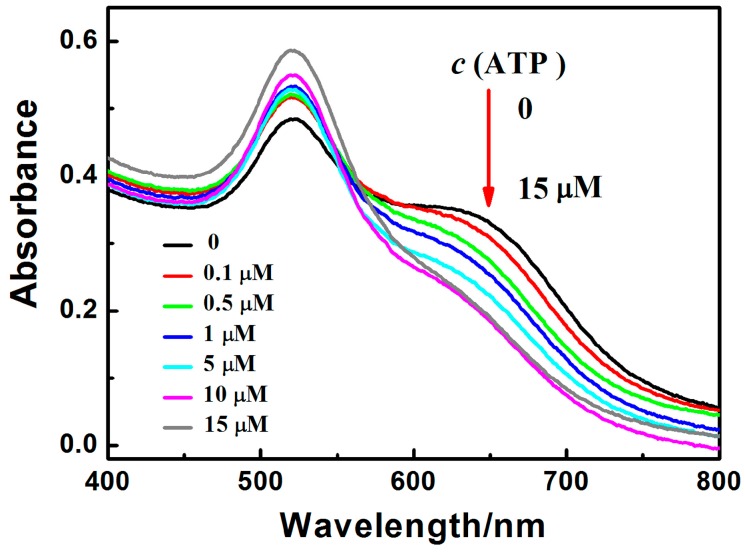
Zr(IV) can form phosphate and Zr(IV) (-PO₃-Zr-) complex owing to the high affinity between Zr(IV) with phosphate. Zr(IV) can induce the aggregation of gold nanoparticles (AuNPs), while adenosine triphosphate(ATP) can prevent Zr(IV)-induced aggregation of AuNPs. Herein, a visual and plasmon resonance absorption (PRA)sensor for ATP have been developed using AuNPs based on the high affinity between Zr(IV)with ATP. AuNPs get aggregated in the presence of certain concentrations of Zr(IV). After the addition of ATP, ATP reacts with Zr(IV) and prevents AuNPs from aggregation, enabling the detection of ATP. Because of the fast interaction of ATP with Zr(IV), ATP can be detected with a detection limit of 0.5 μM within 2 min by the naked eye. Moreover, ATP can be detected by the PRA technique with higher sensitivity. The / values in PRA spectra increase linearly with the concentrations of ATP from 0.1 μM to 15 μM (r = 0.9945) with a detection limit of 28 nM. The proposed visual and PRA sensor exhibit good selectivity against adenosine, adenosine monophosphate, guanosine triphosphate, cytidine triphosphate and uridine triphosphate. The recoveries for the analysis of ATP in synthetic samples range from 95.3% to 102.0%. Therefore, the proposed novel sensor for ATP is promising for real-time or on-site detection of ATP.
由于Zr(IV)与磷酸盐之间具有高亲和力,Zr(IV)可形成磷酸盐和Zr(IV) (-PO₃-Zr-) 配合物。Zr(IV)可诱导金纳米颗粒(AuNPs)聚集,而三磷酸腺苷(ATP)可防止Zr(IV)诱导的AuNPs聚集。在此,基于Zr(IV)与ATP之间的高亲和力,利用AuNPs开发了一种用于ATP的可视化等离子体共振吸收(PRA)传感器。在一定浓度的Zr(IV)存在下,AuNPs会聚集。加入ATP后,ATP与Zr(IV)反应,防止AuNPs聚集,从而实现对ATP的检测。由于ATP与Zr(IV)之间的快速相互作用,通过肉眼在2分钟内即可检测到ATP,检测限为0.5 μM。此外,利用PRA技术可更灵敏地检测ATP。PRA光谱中的/值随ATP浓度从0.1 μM到15 μM呈线性增加(r = 0.9945),检测限为28 nM。所提出的可视化和PRA传感器对腺苷、单磷酸腺苷、三磷酸鸟苷、三磷酸胞苷和三磷酸尿苷具有良好的选择性。合成样品中ATP分析的回收率在95.3%至102.0%之间。因此,所提出的新型ATP传感器在ATP的实时或现场检测方面具有广阔前景。