Department of Oncology, The First Affiliated Hospital of Nanjing Medical University, Nanjing, China.
Department of Pathology, The First Affiliated Hospital of Nanjing Medical University, Nanjing, China.
Sci Rep. 2016 Oct 19;6:35547. doi: 10.1038/srep35547.
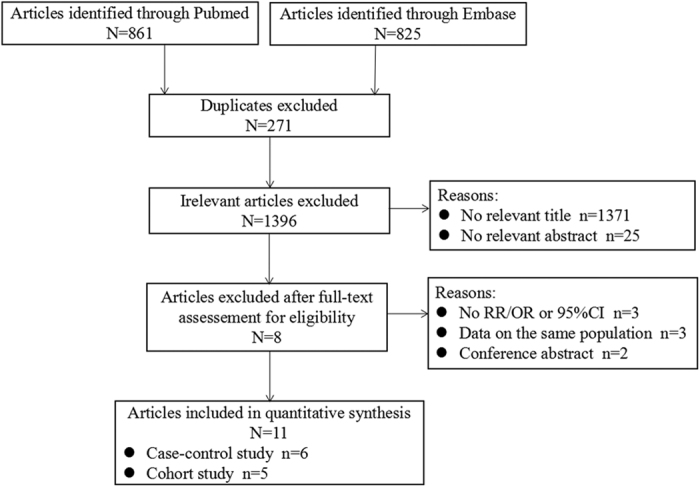
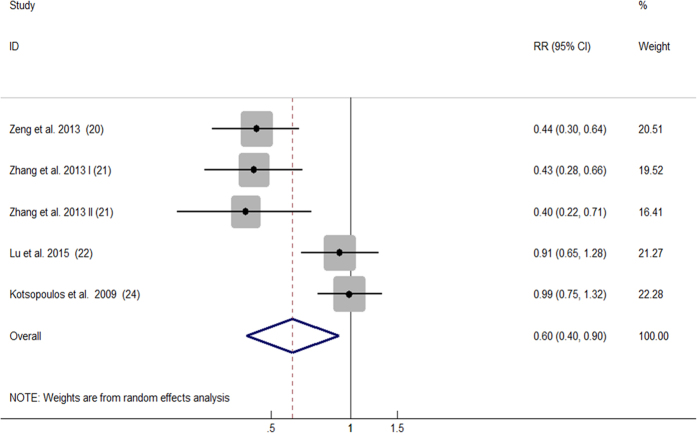
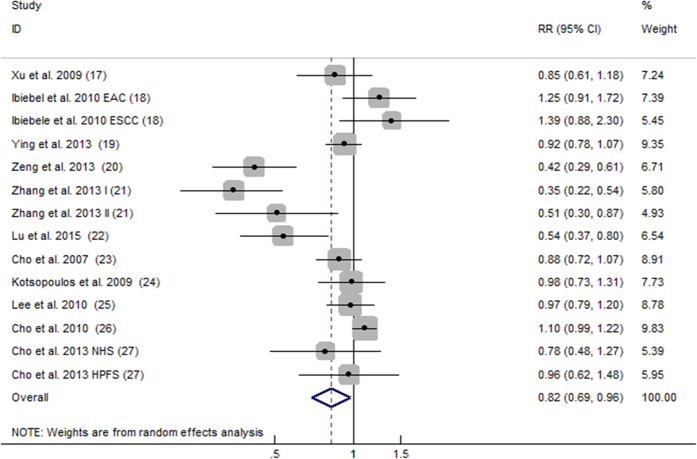
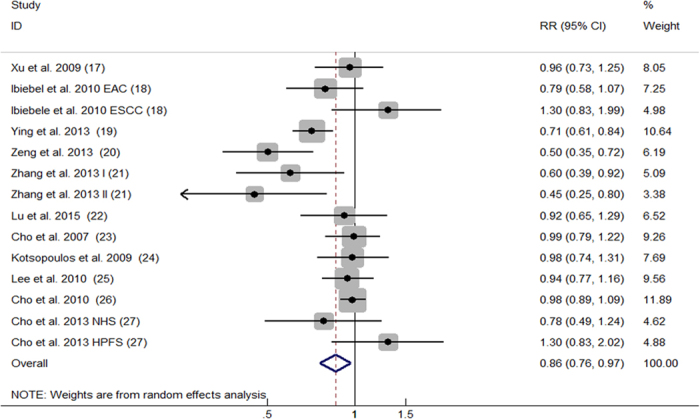
A number of human and animal in vitro or in vivo studies have investigated the relationship between dietary choline and betaine and cancer risk, suggesting that choline and betaine consumption may be protective for cancer. There are also a few epidemiologic studies exploring this relationship, however, with inconsistent conclusions. The PubMed and Embase were searched, from their inception to March 2016, to identify relevant studies and we brought 11 articles into this meta-analysis eventually. The pooled relative risks (RRs) of cancer for the highest versus the lowest range were 0.82 (95% CI, 0.70 to 0.97) for choline consumption only, 0.86 (95%CI, 0.76 to 0.97) for betaine consumption only and 0.60 (95%CI, 0.40 to 0.90) for choline plus betaine consumption, respectively. Significant protective effect of dietary choline and betaine for cancer was observed when stratified by study design, location, cancer type, publication year, sex and quality score of study. An increment of 100 mg/day of choline plus betaine intake helped reduce cancer incidence by 11% (0.89, 95% CI, 0.87 to 0.92) through a dose-response analysis. To conclude, choline and betaine consumption lowers cancer incidence in this meta-analysis, but further studies are warranted to verify the results.
已有许多人体和动物的体外或体内研究调查了饮食胆碱和甜菜碱与癌症风险之间的关系,表明胆碱和甜菜碱的摄入可能对癌症有保护作用。也有一些流行病学研究探索了这种关系,但结论不一致。我们检索了 PubMed 和 Embase 数据库,从建库至 2016 年 3 月,以确定相关研究,并最终纳入了 11 篇文章进行荟萃分析。胆碱摄入最高与最低范围的癌症汇总相对风险(RR)为 0.82(95%CI,0.70 至 0.97),仅甜菜碱摄入的 RR 为 0.86(95%CI,0.76 至 0.97),胆碱加甜菜碱摄入的 RR 为 0.60(95%CI,0.40 至 0.90)。按研究设计、地点、癌症类型、发表年份、性别和研究质量评分分层后,观察到饮食胆碱和甜菜碱对癌症有显著的保护作用。通过剂量-反应分析,胆碱和甜菜碱的摄入量每天增加 100mg 可使癌症发病率降低 11%(0.89,95%CI,0.87 至 0.92)。总之,本荟萃分析表明胆碱和甜菜碱的摄入可降低癌症的发生率,但需要进一步的研究来验证结果。