Hjorth Mette H, Stilling Maiken, Søballe Kjeld, Nielsen Poul Torben, Christensen Poul H, Kold Søren
a Department of Orthopaedics , Aarhus University Hospital , Aarhus.
b Department of Orthopaedics , Aalborg University Hospital , Aalborg , Denmark.
Acta Orthop. 2016 Dec;87(6):575-582. doi: 10.1080/17453674.2016.1244958. Epub 2016 Oct 19.
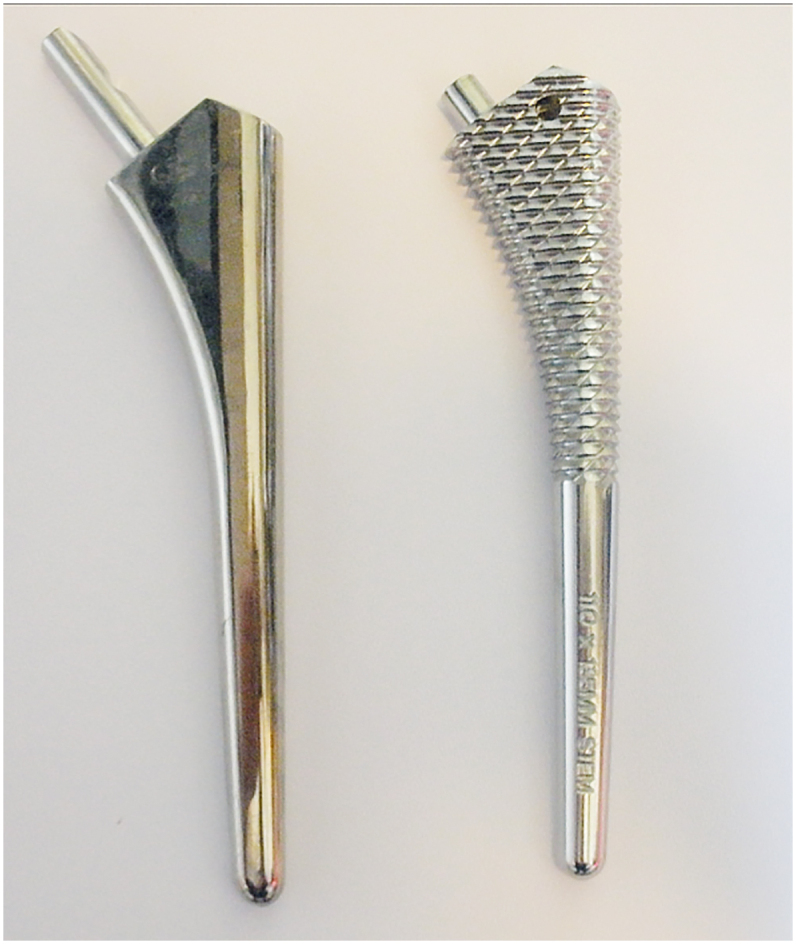
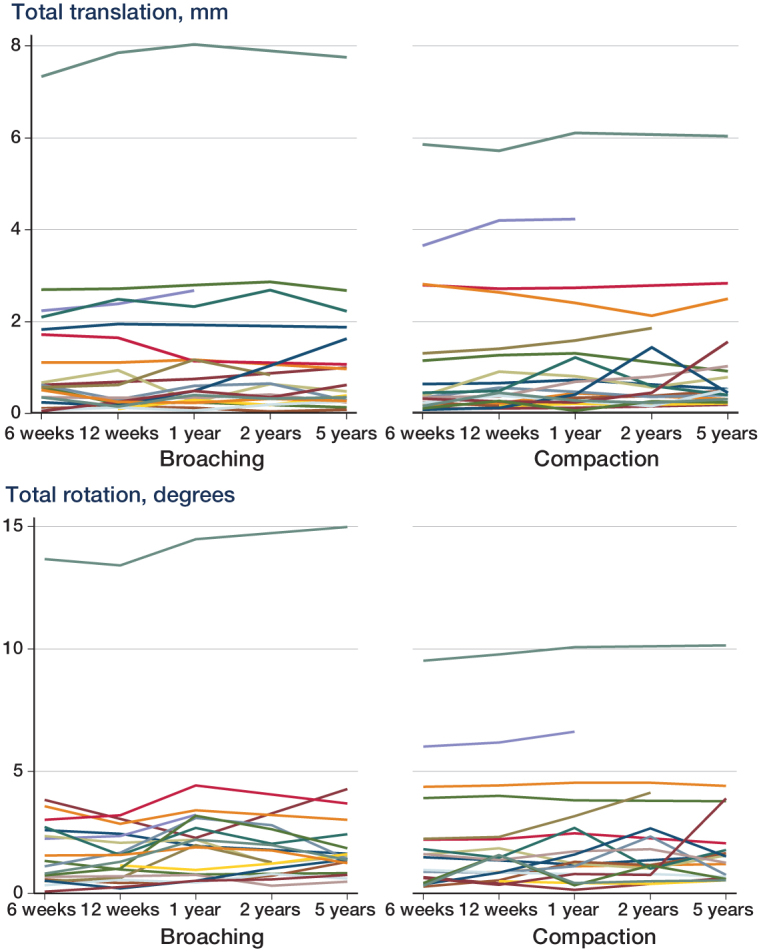
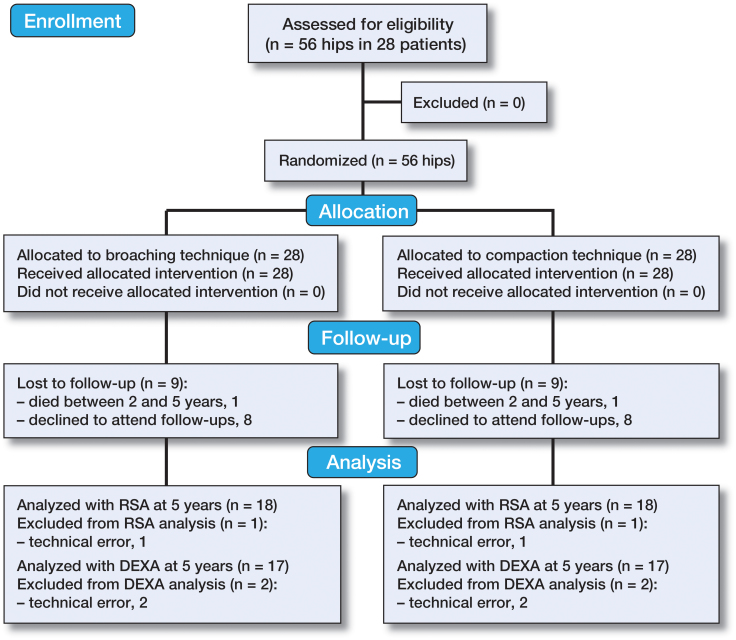
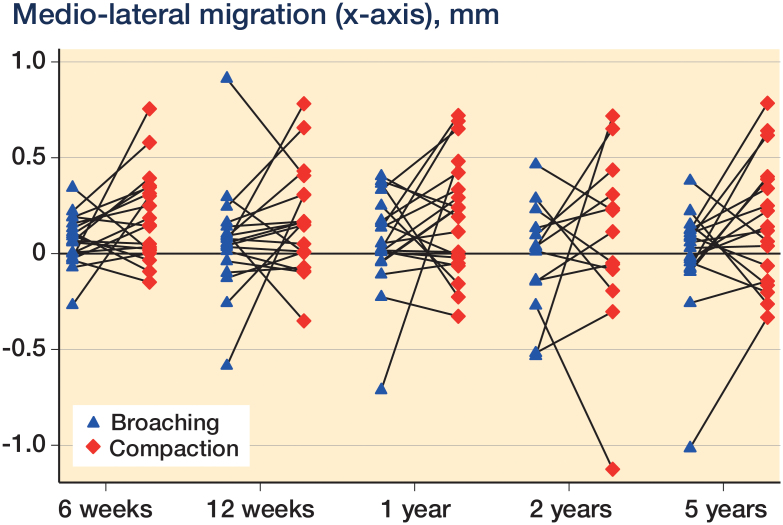
Background and purpose - Short-term experimental studies have confirmed that there is superior fixation of cementless implants inserted with compaction compared to broaching of the cancellous bone. Patients and methods - 1-stage, bilateral primary THA was performed in 28 patients between May 2001 and September 2007. The patients were randomized to femoral bone preparation with broaching on 1 side and compaction on the other side. 8 patients declined to attend the postoperative follow-up, leaving 20 patients (13 male) with a mean age of 58 (36-70) years for evaluation. The patients were followed with radiostereometric analysis (RSA) at baseline, at 6 and 12 weeks, and at 1, 2, and 5 years, and measurements of periprosthetic bone mineral density (BMD) at baseline and at 1, 2, and 5 years. The subjective part of the Harris hip score (HHS) and details of complications throughout the observation period were obtained at a mean interval of 6.3 (3.0-9.5) years after surgery. Results - Femoral stems in the compaction group had a higher degree of medio-lateral migration (0.21 mm, 95% CI: 0.03-0.40) than femoral stems in the broaching group at 5 years (p = 0.02). No other significant differences in translations or rotations were found between the 2 surgical techniques at 2 years (p > 0.4) and 5 years (p > 0.7) postoperatively. There were no individual stems with continuous migration. Periprosthetic BMD in the 7 Gruen zones was similar at 2 years and at 5 years. Intraoperative femoral fractures occurred in 2 of 20 compacted hips, but there were none in the 20 broached hips. The HHS and dislocations were similar in the 2 groups at 6.3 (3.0-9.5) years after surgery. Interpretation - Bone compaction as a surgical technique with the Bi-Metric stem did not show the superior outcomes expected compared to conventional broaching. Furthermore, 2 periprosthetic fractures occurred using the compaction technique, so we cannot recommend compaction for insertion of the cementless Bi-Metric stem.
背景与目的——短期实验研究证实,与对松质骨进行扩髓相比,采用打压植骨技术植入的非骨水泥型植入物固定效果更佳。患者与方法——2001年5月至2007年9月期间,对28例患者进行了一期双侧初次全髋关节置换术(THA)。患者被随机分为两组,一侧股骨采用扩髓技术进行准备,另一侧采用打压植骨技术。8例患者拒绝参加术后随访,剩余20例患者(13例男性),平均年龄58岁(36 - 70岁)接受评估。在基线、6周和12周以及1年、2年和5年时采用放射立体测量分析(RSA)对患者进行随访,并在基线以及1年、2年和5年时测量假体周围骨密度(BMD)。术后平均6.3年(3.0 - 9.5年)获取Harris髋关节评分(HHS)的主观部分以及整个观察期内并发症的详细情况。结果——5年时,打压植骨组股骨柄的内外侧移位程度(0.21mm,95%可信区间:0.03 - 0.40)高于扩髓组(p = 0.02)。术后2年(p > 0.4)和5年(p > 0.7)时,两种手术技术在平移或旋转方面未发现其他显著差异。没有单个柄出现持续移位。2年和5年时,7个Gruen区的假体周围骨密度相似。20例采用打压植骨技术的髋关节中有2例发生术中股骨骨折,而20例采用扩髓技术的髋关节中未发生骨折。术后6.3年(3.0 - 9.5年)时,两组的HHS评分和脱位情况相似。解读——与传统扩髓相比,采用双度量柄的打压植骨手术技术未显示出预期的更佳效果。此外,采用打压植骨技术发生了2例假体周围骨折,因此我们不推荐在植入非骨水泥型双度量柄时采用打压植骨技术。