Wang Yu-Chi, Chuang Chi-Cheng, Wei Kuo-Chen, Chang Cheng-Nen, Lee Shih-Tseng, Wu Chieh-Tsai, Hsu Yung-Hsin, Lin Tzu-Kan, Hsu Peng-Wei, Huang Yin-Cheng, Tseng Chen-Kan, Wang Chun-Chieh, Chen Yao-Liang, Chen Pin-Yuan
Department of Neurosurgery, Chang Gung Memorial Hospital at Linkou; School of Medicine, Chang Gung University, Taoyuan, Taiwan, ROC.
Department of Radiation Oncology, Chang Gung Memorial Hospital at Linkou, Chang Gung University, Taoyuan, Taiwan, ROC.
Sci Rep. 2016 Oct 20;6:35743. doi: 10.1038/srep35743.
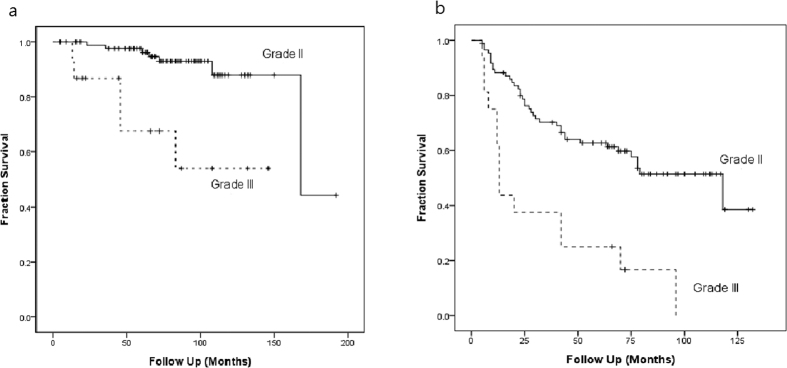
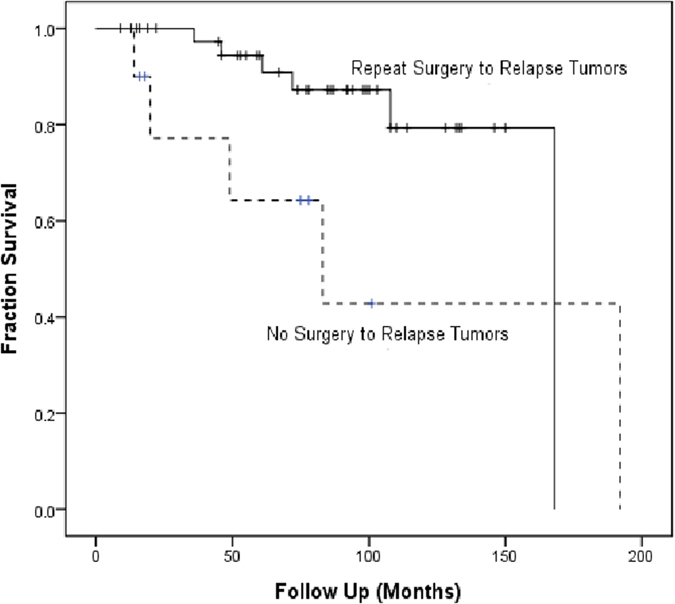
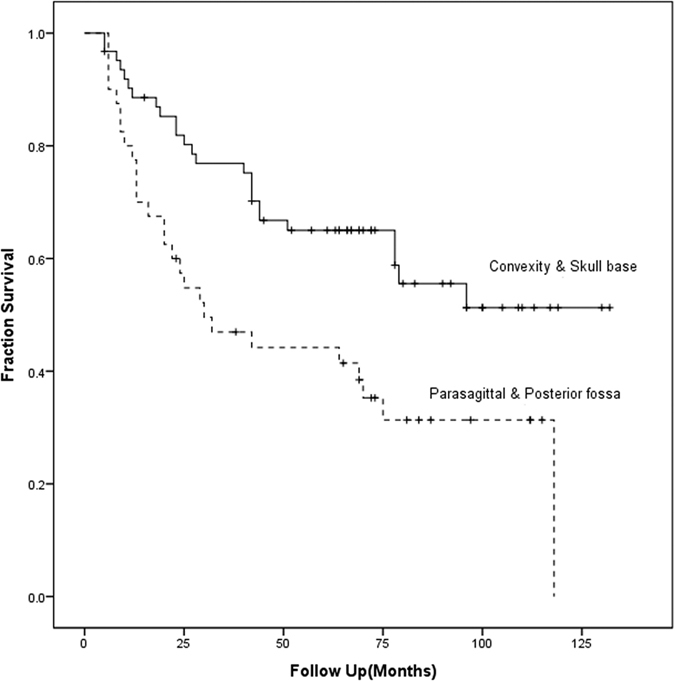
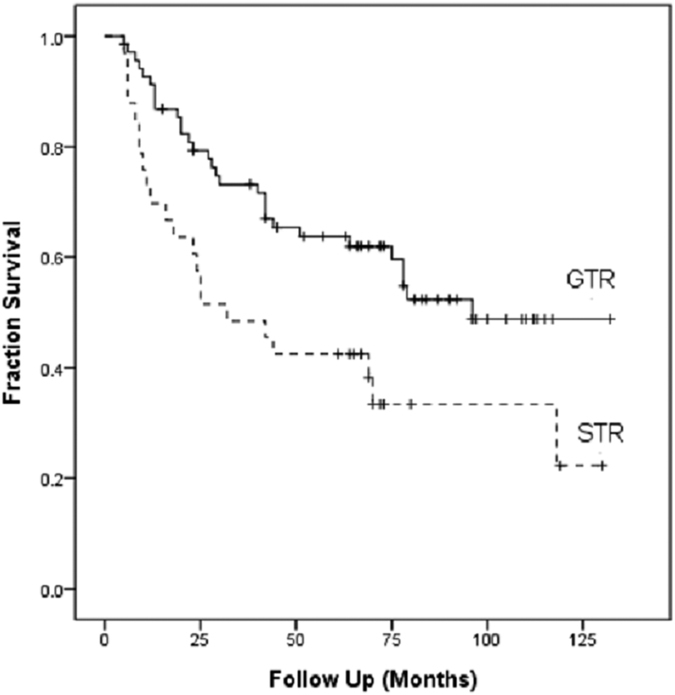
Atypical and malignant meningiomas are rare. Our aim was to examine the treatment outcomes following surgical resection, and analyze associations between clinical characteristics and overall survival (OS) or relapse free survival (RFS). 102 patients with atypical or malignant meningiomas underwent microsurgical resection between June 2001 and November 2009 were analyzed retrospectively. We compared demographics, clinical characteristics, treatment, and complications. The five-year and ten-year overall survival rates were 93.5% and 83.4%, respectively. Three factors significantly reduced OS: Malignant meningiomas (p < 0.001), which also decreased RFS (p < 0.001); female patients (p = 0.049), and patients with Karnofsky Performance Status (KPS) < 70 at diagnosis (p = 0.009). Fifty two patients (51%) experienced tumor relapse. Total resection of tumors significantly impacted RFS (p = 0.013). Tumors located at parasagittal and posterior fossa area lead to higher relapse rate (p = 0.004). Subtotal resection without adjuvant radiotherapy lead to the worst local control of tumor (p = 0.030). An MIB-1 index <8% improved OS and RFS (p = 0.003). Total resection of atypical and malignant meningiomas provided better outcome and local control. Adjuvant radiation therapy is indicated for patients with malignant meningiomas, with incompletely excised tumors; or with tumors in the parasagittal or posterior fossa area. The MIB-1 index of the tumor is an independent prognostic factor of clinical outcome.
非典型和恶性脑膜瘤较为罕见。我们的目的是研究手术切除后的治疗效果,并分析临床特征与总生存期(OS)或无复发生存期(RFS)之间的关联。对2001年6月至2009年11月期间接受显微手术切除的102例非典型或恶性脑膜瘤患者进行了回顾性分析。我们比较了人口统计学、临床特征、治疗方法及并发症。五年和十年总生存率分别为93.5%和83.4%。有三个因素显著降低总生存期:恶性脑膜瘤(p<0.001),其也降低无复发生存期(p<0.001);女性患者(p = 0.049),以及诊断时卡氏功能状态(KPS)<70的患者(p = 0.009)。52例患者(51%)出现肿瘤复发。肿瘤全切对无复发生存期有显著影响(p = 0.013)。位于矢状窦旁和后颅窝区域的肿瘤复发率更高(p = 0.004)。次全切除且未行辅助放疗导致肿瘤局部控制最差(p = 0.030)。MIB-1指数<8%可改善总生存期和无复发生存期(p = 0.003)。非典型和恶性脑膜瘤全切可带来更好的治疗效果和局部控制。对于恶性脑膜瘤、肿瘤切除不完全或肿瘤位于矢状窦旁或后颅窝区域的患者,建议行辅助放疗。肿瘤的MIB-1指数是临床结局的独立预后因素。