Wheeler Lucas C, Donor Micah T, Prell James S, Harms Michael J
Department of Chemistry and Biochemistry, University of Oregon, Eugene, Oregon, 97403, United States of America.
Institute for Molecular Biology, University of Oregon, Eugene, Oregon, 97403, United States of America.
PLoS One. 2016 Oct 20;11(10):e0164740. doi: 10.1371/journal.pone.0164740. eCollection 2016.
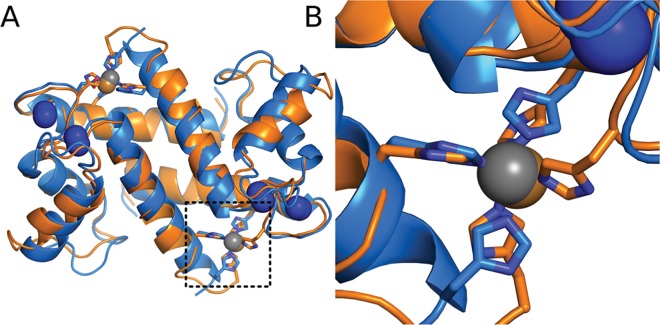
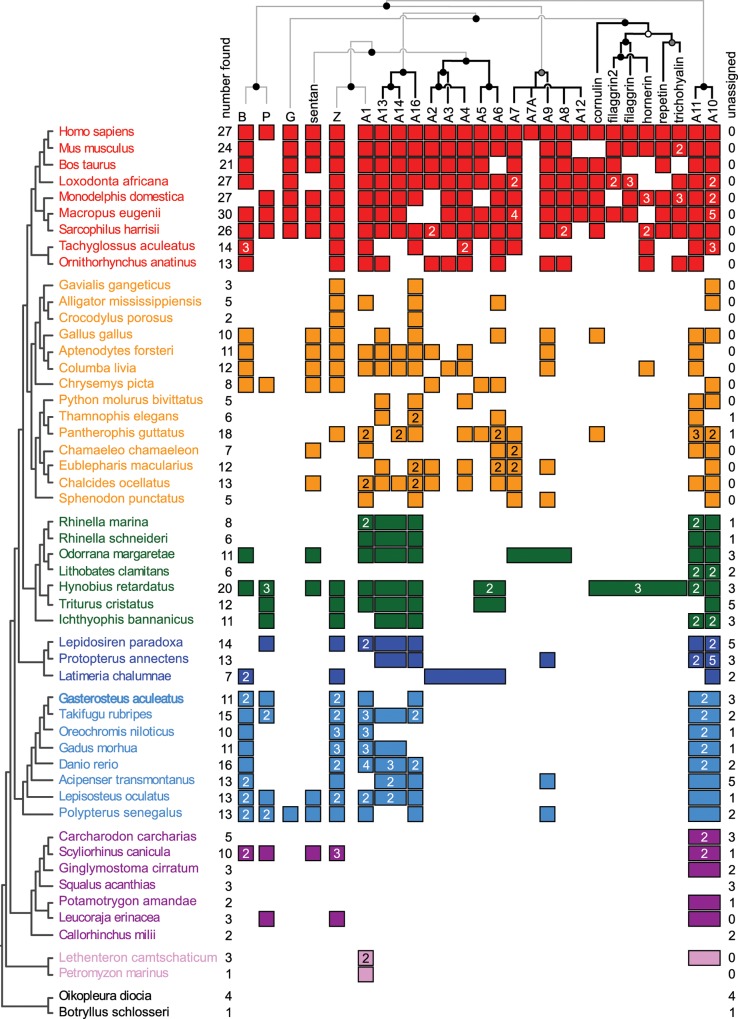
The S100 proteins are a large family of signaling proteins that play critical roles in biology and disease. Many S100 proteins bind Zn2+, Cu2+, and/or Mn2+ as part of their biological functions; however, the evolutionary origins of binding remain obscure. One key question is whether divalent transition metal binding is ancestral, or instead arose independently on multiple lineages. To tackle this question, we combined phylogenetics with biophysical characterization of modern S100 proteins. We demonstrate an earlier origin for established S100 subfamilies than previously believed, and reveal that transition metal binding is widely distributed across the tree. Using isothermal titration calorimetry, we found that Cu2+ and Zn2+ binding are common features of the family: the full breadth of human S100 paralogs-as well as two early-branching S100 proteins found in the tunicate Oikopleura dioica-bind these metals with μM affinity and stoichiometries ranging from 1:1 to 3:1 (metal:protein). While binding is consistent across the tree, structural responses to binding are quite variable. Further, mutational analysis and structural modeling revealed that transition metal binding occurs at different sites in different S100 proteins. This is consistent with multiple origins of transition metal binding over the evolution of this protein family. Our work reveals an evolutionary pattern in which the overall phenotype of binding is a constant feature of S100 proteins, even while the site and mechanism of binding is evolutionarily labile.
S100蛋白是一个庞大的信号蛋白家族,在生物学和疾病中发挥着关键作用。许多S100蛋白结合Zn2+、Cu2+和/或Mn2+作为其生物学功能的一部分;然而,这种结合的进化起源仍然不明。一个关键问题是二价过渡金属结合是祖传的,还是在多个谱系中独立出现的。为了解决这个问题,我们将系统发育学与现代S100蛋白的生物物理特性相结合。我们证明了已确立的S100亚家族的起源比以前认为的更早,并揭示过渡金属结合在整个谱系中广泛分布。使用等温滴定量热法,我们发现Cu2+和Zn2+结合是该家族的共同特征:人类S100旁系同源物的全部范围——以及在被囊动物双尾藻中发现的两种早期分支的S100蛋白——以微摩尔亲和力结合这些金属,化学计量比范围从1:1到3:1(金属:蛋白质)。虽然结合在整个谱系中是一致的,但对结合的结构反应却相当多变。此外,突变分析和结构建模表明,过渡金属结合发生在不同S100蛋白的不同位点。这与该蛋白家族进化过程中过渡金属结合的多个起源是一致的。我们的工作揭示了一种进化模式,即结合的总体表型是S100蛋白的一个恒定特征,即使结合的位点和机制在进化上是不稳定的。