Sharma Aditi, Lee Seung-Hwan, Lim Dajeong, Chai Han-Ha, Choi Bong-Hwan, Cho Yongmin
Animal Genomics and Bioinformatics Division, National Institute of Animal Science, RDA, 1500, Kongjwipatjwi-ro, Iseo-myeon, Wanju-gun, Jeollabuk-do, 55365, Republic of Korea.
Division of Animal and Dairy Science, Chugnam National University, 99 Daehak-ro, Yuseong-gu, Daejeon, 34134, Republic of Korea.
BMC Genet. 2016 Oct 20;17(1):139. doi: 10.1186/s12863-016-0444-8.
The native cattle breeds are an important genetic resource for meat and milk production throughout Asia. In Asia cattle were domesticated around 10,000 years ago and in Korea cattle are being raised since 2000 B.C. There are three native breeds of cattle in Korea viz. Brown Hanwoo, Brindle Hanwoo and Jeju Black. While one of these breeds, Brown Hanwoo, is a part of a Food and Agricultural Organization and national genetic evaluation plans, others get little attention. This study is an effort to understand and provide a detailed insight into the population structure and genetic variability of the Korean cattle breeds along with other Asian breeds using various methods. In this study we report the genetic variation and structure of the Korean cattle breeds and their comparison with five other Asian cattle breeds along with a panel of animals from European taurine, African taurine and indicine cattle breeds.
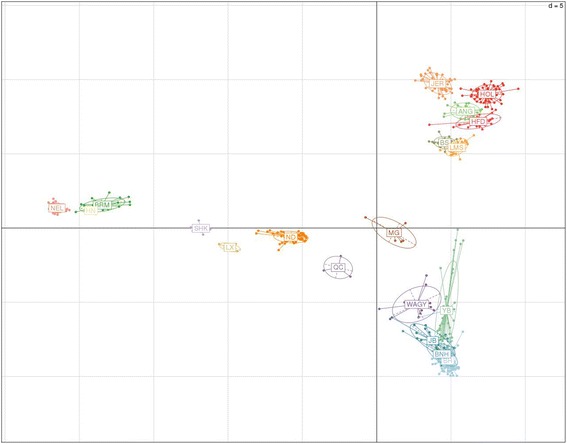
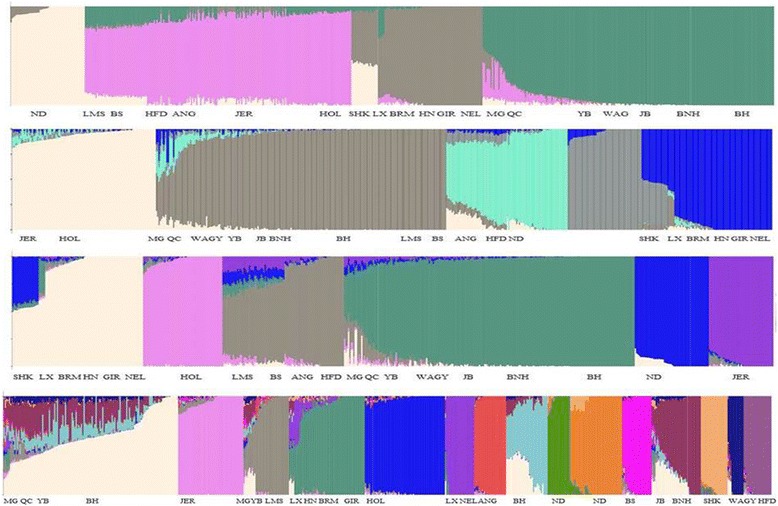
Asian cattle were found to be least differentiated which reflects their recent history. Amongst the Asian breeds Hainan, which is an indicine breed, had the lowest gene diversity while Yanbian had the highest followed by Mongolian and Korean cattle. Amongst the Korean breeds Brown Hanwoo had the highest diversity followed by Brindle Hanwoo and Jeju Black. The genetic diversity in Asian cattle breeds was found comparable to the European taurines and more than the African taurines and Zebu cattle. Korean cattle breed, Brown Hanwoo was consistently found to be closer to Yanbian, a Chinese cattle breed. We found low divergence and moderate levels of genetic diversity among the native Korean breeds. Indicine introgression from Hainan was seen in other Asian breeds. From Europe, Limousin, Holstein and Hereford introgression was found in Asian breeds.
In this study we provide a genome-wide insight into the genetic history of the native cattle breeds of Korea. The outcomes of this study will help in prioritization and designing of the conservation plans.
本地牛品种是亚洲各地肉类和牛奶生产的重要遗传资源。在亚洲,牛大约在10000年前被驯化,而在韩国,自公元前2000年起就开始饲养牛。韩国有三个本地牛品种,即褐毛韩牛、虎斑韩牛和济州黑牛。其中一个品种褐毛韩牛是食品及农业组织和国家遗传评估计划的一部分,而其他品种则很少受到关注。本研究旨在通过各种方法了解韩国牛品种以及其他亚洲品种的种群结构和遗传变异性,并提供详细的见解。在本研究中,我们报告了韩国牛品种的遗传变异和结构,并将其与其他五个亚洲牛品种以及一组欧洲瘤牛、非洲瘤牛和印度瘤牛品种的动物进行了比较。
发现亚洲牛的分化程度最低,这反映了它们的近代历史。在亚洲品种中,印度瘤牛品种海南的基因多样性最低,而延边的基因多样性最高,其次是蒙古牛和韩国牛。在韩国品种中,褐毛韩牛的多样性最高,其次是虎斑韩牛和济州黑牛。发现亚洲牛品种的遗传多样性与欧洲瘤牛相当,且高于非洲瘤牛和瘤牛。一直发现韩国牛品种褐毛韩牛与中国牛品种延边更为接近。我们发现韩国本地品种之间的差异较小,遗传多样性处于中等水平。在其他亚洲品种中发现了来自海南的印度瘤牛基因渗入。在亚洲品种中发现了来自欧洲的利木赞牛、荷斯坦牛和赫里福德牛的基因渗入。
在本研究中,我们提供了对韩国本地牛品种遗传历史的全基因组见解。本研究的结果将有助于保护计划的优先级确定和设计。