Decker Jared E, McKay Stephanie D, Rolf Megan M, Kim Jaewoo, Molina Alcalá Antonio, Sonstegard Tad S, Hanotte Olivier, Götherström Anders, Seabury Christopher M, Praharani Lisa, Babar Masroor Ellahi, Correia de Almeida Regitano Luciana, Yildiz Mehmet Ali, Heaton Michael P, Liu Wan-Sheng, Lei Chu-Zhao, Reecy James M, Saif-Ur-Rehman Muhammad, Schnabel Robert D, Taylor Jeremy F
Division of Animal Sciences, University of Missouri, Columbia, Missouri, United States of America.
Department of Animal Science, The University of Vermont, Burlington, Vermont, United States of America.
PLoS Genet. 2014 Mar 27;10(3):e1004254. doi: 10.1371/journal.pgen.1004254. eCollection 2014 Mar.
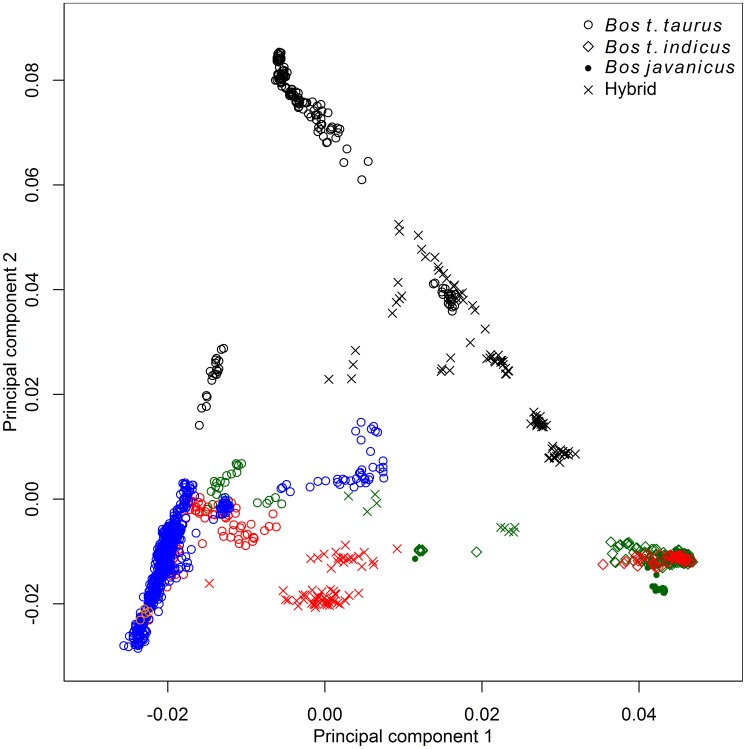
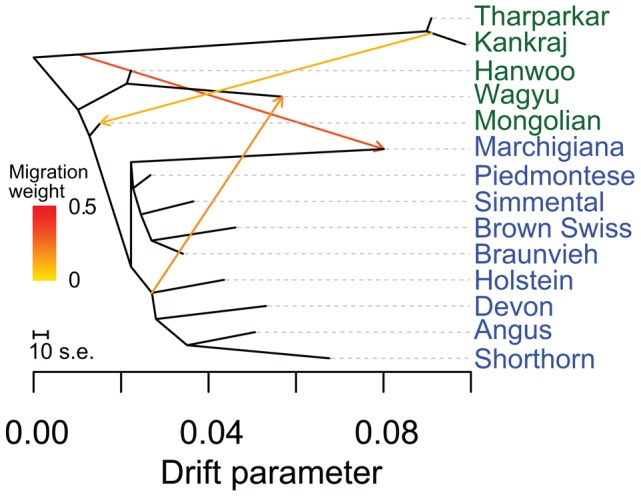
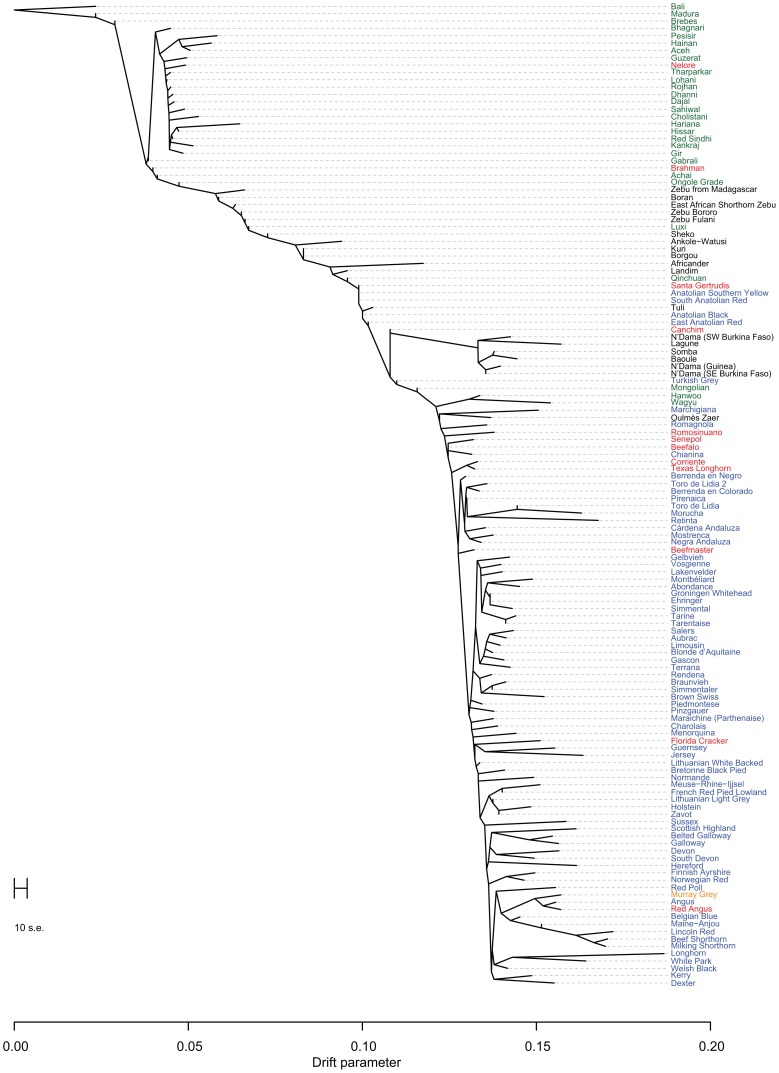
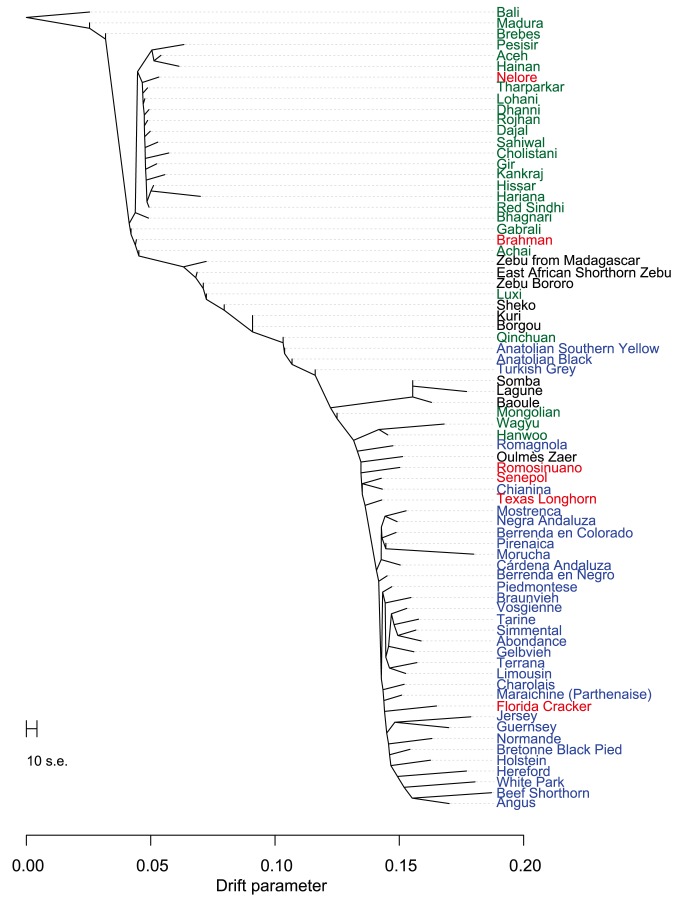
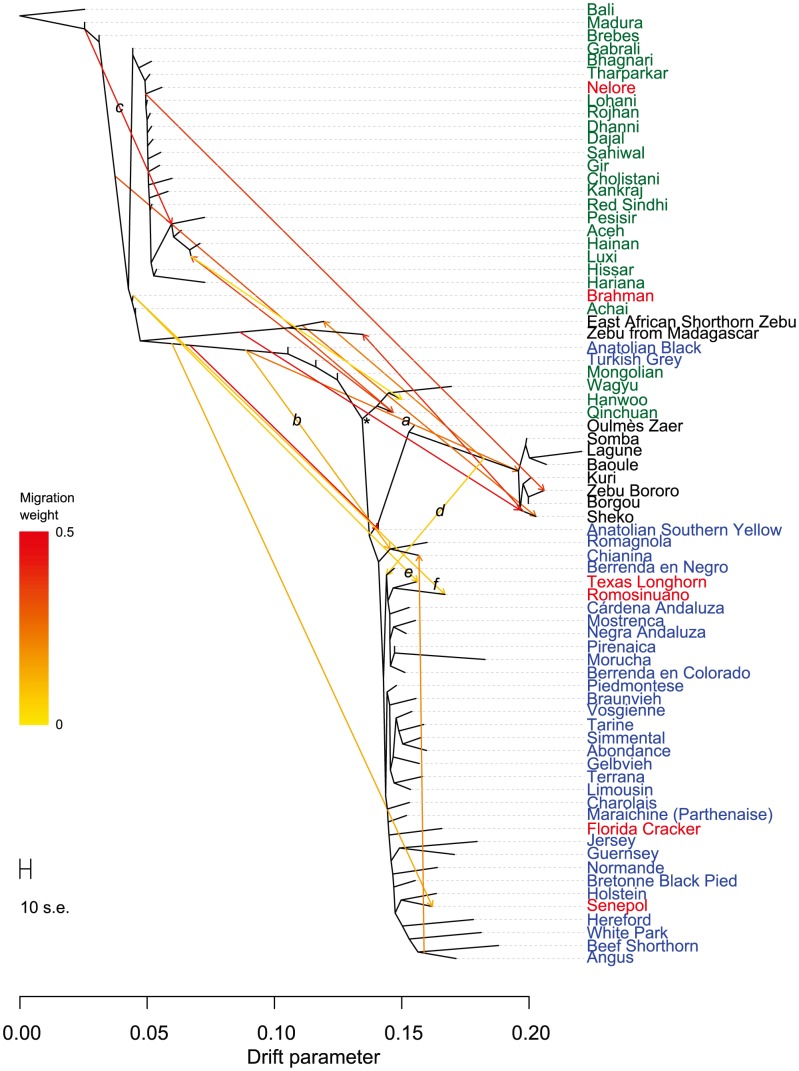
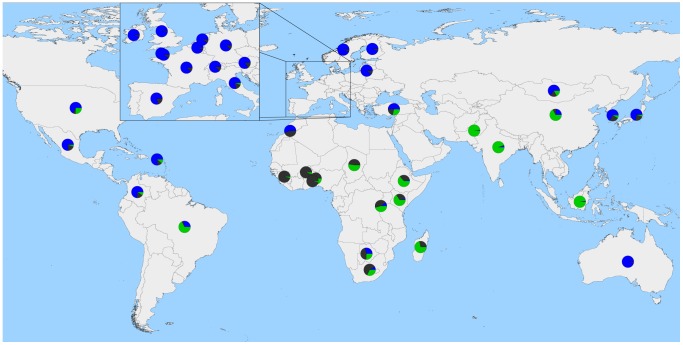
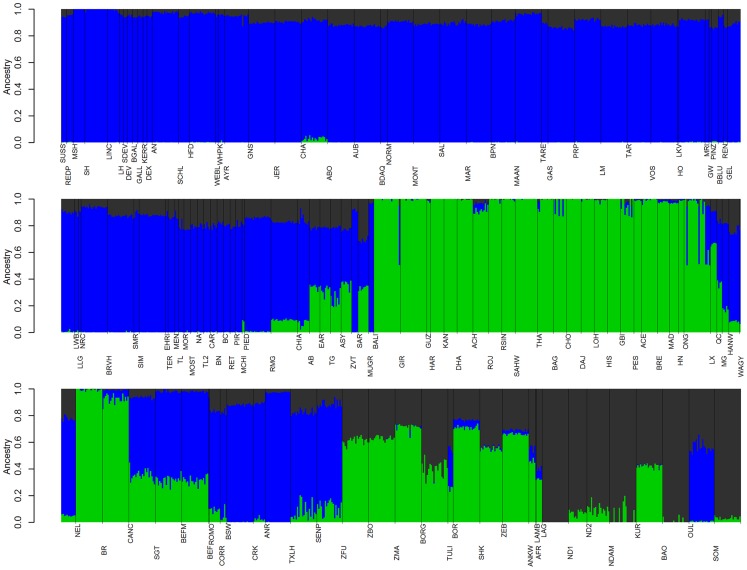
The domestication and development of cattle has considerably impacted human societies, but the histories of cattle breeds and populations have been poorly understood especially for African, Asian, and American breeds. Using genotypes from 43,043 autosomal single nucleotide polymorphism markers scored in 1,543 animals, we evaluate the population structure of 134 domesticated bovid breeds. Regardless of the analytical method or sample subset, the three major groups of Asian indicine, Eurasian taurine, and African taurine were consistently observed. Patterns of geographic dispersal resulting from co-migration with humans and exportation are recognizable in phylogenetic networks. All analytical methods reveal patterns of hybridization which occurred after divergence. Using 19 breeds, we map the cline of indicine introgression into Africa. We infer that African taurine possess a large portion of wild African auroch ancestry, causing their divergence from Eurasian taurine. We detect exportation patterns in Asia and identify a cline of Eurasian taurine/indicine hybridization in Asia. We also identify the influence of species other than Bos taurus taurus and B. t. indicus in the formation of Asian breeds. We detect the pronounced influence of Shorthorn cattle in the formation of European breeds. Iberian and Italian cattle possess introgression from African taurine. American Criollo cattle originate from Iberia, and not directly from Africa with African ancestry inherited via Iberian ancestors. Indicine introgression into American cattle occurred in the Americas, and not Europe. We argue that cattle migration, movement and trading followed by admixture have been important forces in shaping modern bovine genomic variation.
牛的驯化与发展对人类社会产生了重大影响,但牛品种和种群的历史一直未得到充分了解,尤其是非洲、亚洲和美洲的品种。利用在1543头动物中检测到的43043个常染色体单核苷酸多态性标记的基因型,我们评估了134个家养牛品种的种群结构。无论采用何种分析方法或样本子集,始终能观察到亚洲瘤牛、欧亚普通牛和非洲普通牛这三大主要群体。在系统发育网络中,可以识别出与人类共同迁徙和出口导致的地理扩散模式。所有分析方法都揭示了分化后发生的杂交模式。我们利用19个品种绘制了瘤牛基因渗入非洲的渐变群。我们推断非洲普通牛拥有很大一部分野生非洲原牛的血统,这导致它们与欧亚普通牛产生分化。我们检测到亚洲的出口模式,并确定了亚洲欧亚普通牛/瘤牛杂交的渐变群。我们还确定了除原牛和瘤牛之外的其他物种在亚洲品种形成中的影响。我们检测到短角牛在欧洲品种形成中的显著影响。伊比利亚和意大利的牛拥有来自非洲普通牛的基因渗入。美洲克里奥罗牛起源于伊比利亚,而非直接来自非洲,其非洲血统是通过伊比利亚祖先遗传的。瘤牛对美洲牛的基因渗入发生在美洲,而非欧洲。我们认为,牛的迁移、流动和贸易以及随后的混合是塑造现代牛基因组变异的重要力量。